

#DesignThinking para equipos directivos en Euskadi Surgen problemas. Es inevitable. Un centro educativo es una institución compleja y que aparezcan problemas entra dentro de la lógica de las relaciones humanas y de la gestión de la complejidad. Por otro lado, también es normal que un centro educativo se plantee retos. Crecer, mejorar, cambiar son procesos normales y, si no lo son, habría que normalizarlos porque una institución que no evoluciona, está ya muerta. ¿Y quién gestiona ambas situaciones? En este sentido, es importante que los equipos directivos cuenten con estrategias para resolver los problemas y afrontar los retos de manera eficaz (es decir, que los unos acaben solucionados y los otros alcanzados) pero también es necesario que esto se consiga de manera eficiente. Esta es la justificación para las tres sesiones de Design Thinking para equipos directivos organizadas por el Berritzegune Nagusia en Euskadi. Para mí ha sido una experiencia muy aleccionadora. Eskerrik asko! Me gusta: Me gusta Cargando...
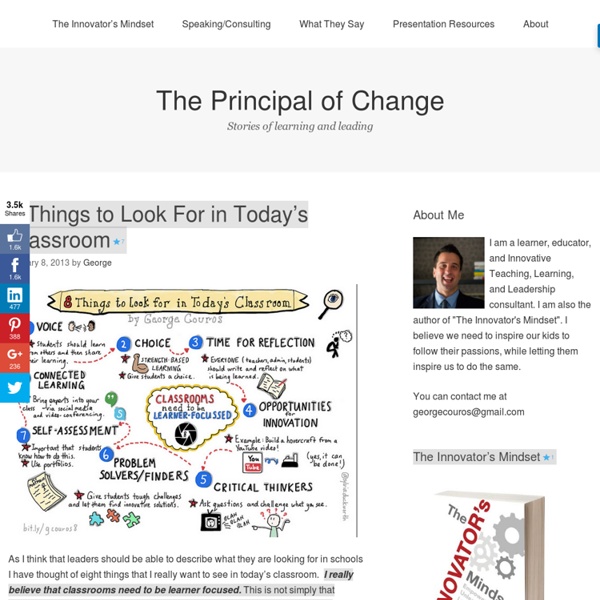
Christchurch Connected Educators: Choose to be More at Clarkville What’s it taken to CHOOSE TO BE MORE at Clarkville? From Pene Abbie, Principal, Clarkville School We are a small, semi-rural school on the outskirts of Christchurch, people used to say they wanted to send their children to our place because of this – being small and rural! It seemed that these two traits immediately determined a culture of great learning. Those of us on the inside knew it took more than this and we have spent the last seven years “reshaping our learning culture.” So what does this mean – and why, if our learners are doing pretty well, would we want to do anything differently? The process of reshaping the learning at Clarkville has required deep scrutiny of all we believe about great learning and all we know about great teaching. The result of this thinking and dissecting and inquiring has been to firmly place the learner at the centre of all we do, be and understand. So what do we believe? We will be people who know what to do when we don’t know what to do • lead by anyone
Schools Need to Include More Visual-Based Learning When asked what my first language is, I often answer, “visual.” I think in images, prefer to be taught through images, and like to express what I know through images. I find it disconcerting that as learners progress to the higher grades, there is less use of images and visuals to teach concepts. The power of the use of vision for learning is emphasized by developmental molecular biologist, John Medina, where in his publication, Brain Rules, he states: Vision Trumps All Other SensesWe are incredible at remembering pictures. Hear a piece of information, and three days later you’ll remember 10% of it. Created by students for teachers, the following video shows students frustrated with the lack of visual learning in the classroom: This post is a call to action to increase visual-based learning in the classroom through: Use Visuals, Images, Data Visualizations, Infographics and Videos to Teach Concepts Our brains are wired to rapidly make sense of and remember visual input. Like this:
Ideogramas: Imaginar y dibujar a partir de objetos cotidianos En esta entrada os muestro una de las primeras actividades que realizamos este curso en 3º de la eso: la elaboración de ideogramas a partir de objetos cotidianos. Una buena manera de fomentar la imaginación y la creatividad y practicar la línea artística y el pensamiento visual. Los resultados fueron excelentes y gran parte de ellos se encuentran recogidos en el siguiente vídeo: La idea partió de las geniales ilustraciones de Victor Nunes que descubrí en Pinterest. No os perdais su página de facebook. Y de los más sencillos, aunque también muy inspiradores, diseños de Marta altés. También encontrareis fantásticas imágenes para inspiraros en el tablero Ideogramas al que contribuyen entre otros, dos maestros del #VisualThinking: Garbiñe Larralde o Ramón Besonias., autores el proyecto colaborativo #dibujamelas del que os hablaré en un siguiente post. ¿Os animáis a garabatear ideogramas?
Small Change, Big Impact - Design Thinking in Action, Phase 1 - Matt Ives Matt Ives This is a write up of an experiment in Design Thinking I recently went through. The task was to make a small change to my learning environment with the aim of positively impacting learning. To jump to the end for a little bit, this process I’ve gone through has been a transformative one. It’s dawned on me, sitting here reflecting after it all, that even the smallest changes can have massive impacts. All it takes is an open mind, a juicy problem, and an eye to action. This is empowering and meaningful and impactful for teachers struggling with edicts from higher up and other challenges. I hope that in telling my story others can take heart – make a small change, and see where the rabbit hole leads. So, here’s my story… I’ve always embraced the messiness and noise and buzz of learning “happening”. As I was watching, a student sat alone on a beanbag, trying hard to focus on his independent task at hand. Collaboration is of key importance, sure.
5 Tips for Teaching Digital Citizenship in the Elementary Classroom -- THE Journal Digital Citizenship 5 Tips for Teaching Digital Citizenship in the Elementary Classroom While we shouldn't stop teaching children how to say "please" and "thank you," and bullies will still exist in the face-to-face world, it is vital that we treat online safety and digital citizenship with the same amount of seriousness and attention. By Mary Beth Hertz04/18/12 As elementary level teachers, we are charged not just with teaching academics, but with teaching students social skills as well: "Ignore bullies and tell an adult if you feel threatened,'" "Don't talk to strangers," "Treat people the way you want to be treated." You're probably familiar with phrases similar to these if you teach the younger grades. But when was the last time you talked to your students about how to use good manners while leaving a comment on a blog post? These are the new citizenship skills for our students. The growing trend of schools banning and blocking social media sites and mobile devices frightens me.
¿Qué es Visual Thinking y cómo puedes usarlo? | Extrem Service Jam Por Laura Gutiérrez Araujo (@lauracrisgu) ¿Recuerdas cuando eras pequeño?… antes de siquiera aprender las vocales y las letras, ya pintabas en las paredes, cogías cualquier boli que pillaras por ahí y te ponías a dibujar arboles, soles y grandes montañas (las niñas también dibujábamos corazones). Los primeros regalos que le diste a tu padre y a tu madre fueron divertidos dibujos en los cuales representabas cuánto los querías. El pensamiento visual o visual thinking (en Inglés) es algo innato a la condición humana. El pensamiento visual es una herramienta que consiste en volcar y manipular ideas a través de dibujos simples y fácilmente reconocibles, creando conexiones entre si por medio de mapas mentales, con el objetivo de entenderlas mejor, definir objetivos, identificar problemas, descubrir soluciones, simular procesos y generar nuevas ideas. ¿Cómo convertir las ideas en imágenes? 1. 2. 3. 4. Aunque el proceso no siempre es lineal. Si, pero…¿y si no sé dibujar? 1. 2. 3. Fuentes:
2 reasons to keep the ‘e’ in e-learning | Disrupt & Transform The question comes up frequently in discussions related to using technologies in education: Why do we still have the ‘e’ in ‘e-learning’? Shouldn’t it be just about the learning? And doesn’t the retention of the ‘e’ just perpetuate a short-sighted focus on the tech, not the teach? These questions, in my experience, often come from the early-adopters who are already well down the track of thinking about the effective use of technology. What the questions miss, however, is the importance of the strategic use of technology – the word ‘e-learning’ reminds us that this is a specialist field, that to use technology appropriately requires a clear understanding of the relationship between content, pedagogy and technology. The other reason to retain the ‘e’ is that, for many schools and teachers, for a number of reasons, there still is little or no ‘e’ going on. So, keep the ‘e’, at least while we are in a period of capability building. [Image: freedigitalphotos.net; tpack.org] Like this:
What Easter Island’s colossal stone statues teach about the dangers of modern school reform EASTER ISLAND, CHILE: A tourist walks behind a platform with seven huge statues (moais in Rapa Nui language), the only ones facing the sea, in Ahu Akivi in Easter Island, 3700 km off the coast of Chile, 12 February 2005. The Chilean island, located in the Polynesian archipielago, has many archeological sites and its Rapa Nui National Park is included on UNESCO’s World Heritage Site list since 1995. AFP PHOTO/MARTIN BERNETTI (Photo credit should read MARTIN BERNETTI/AFP/Getty Images) Eastern Island is a remote volcanic island in Polynesia that is a territory of Chile and known worldwide for its colossal statues — more than 800 — that were created by early inhabitants during the 10th – 16th Centuries. By Yong Zhao The stone statues on Easter Island (Diamond, 2005) have a lot to teach us about education. Early Europeans did not believe that the “Polynesians, ‘mere savages,’ could have created the statues or the beautifully constructed stone platforms” (Diamond, 2005, p. 82). Auerswald, P.
6 pasos para resolver problemas en el aula con la metodología Design Thinking Cuando hablamos de “Design Thinking” nos referimos a un proceso que busca la innovación en cualquier proceso (ya sea en el marco de una empresa, de un colegio, o en cualquier otro entorno), cuya finalidad es responder a las necesidades de las personas que conviven en ese entorno y que utiliza la tecnología y el diseño como base para conseguir lograr sus objetivos. Para ponerlo en práctica podemos identificar en él seis pasos fundamentales. Son los siguientes: Observación. Comprensión. Definición. Ideación. Prototipación. Probar. El Design Thinking implica una serie de valores que a su vez tienen un gran valor dentro de la escuela. Ser visual frente a ser teórico. y además hacerlo con una mayor intensidad y motivación, frente a la simple presentación de un texto escrito. Iterar. Ser multidisciplinar. Por último, el proceso de comunicación y discusión basado en la lluvia de ideas se debe desarrollar bajo las siguientes prerrogativas: Aplaza las decisiones críticas. Visualiza las ideas.
It’s About Learning - Reggio-Inspired Visible Learners focuses on how we can make deep learning experiences visible for high school students and adult learners. It is inspired by the Reggio Emilia pedagogy of listening and relationships, and grounded in the philosophy of children as capable and powerful, rather than unskilled and passive. The two key principles are group learning and documentation. Group Learning Group learning experiences enable students to problem-solve, create, encounter new perspectives, and build collective understanding. Teachers can facilitate powerful group learning by: • Designing tasks that are group-worthy and focus on meaningful topics. Documentation The core of documentation is observing. In classrooms that make learning visible, the practice of documentation has several distinct features: Students develop greater attentiveness to the value of remembering pivotal experiences when recording them is part of the classroom culture. Conclusion
Digital Reporting Digital reporting tools are not seen to improve student instruction or assessment but have had a significant negative impact on teacher work, according to teachers and principals surveyed in a new Alberta study. Researchers from the University of Alberta and the Alberta Teachers’ Association surveyed over 1,000 teachers and conducted focus groups with teachers and administrators as part of a study on digital reporting and assessment tools being released today. Nearly two-thirds of teachers reported that digital reporting tools, like PowerSchool and TeacherLogic, have not improved the level of instruction and assessment in classrooms. The same proportion of teachers also indicated that the tools have had a significant impact on their workload. This study found that digital reporting tools are inflexible and have been mandated on teachers with very little consultation and poor provisioning of professional development and technological support. - Dr Jason Daniels, University of Alberta
Greate ideas fro teachers to integrate into their classrooms. by tutorz Jan 21