

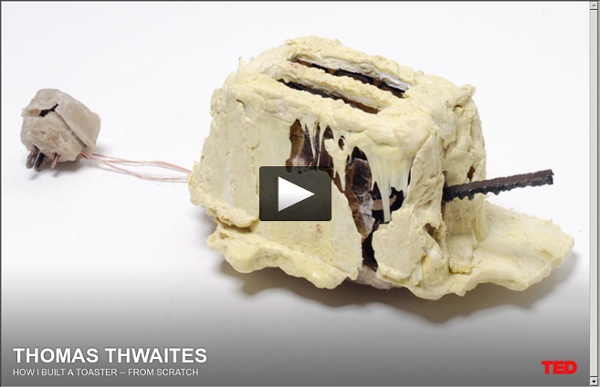
http://www.ted.com/talks/thomas_thwaites_how_i_built_a_toaster_from_scratch.html
A Solar Grill Prototype for a Greener Tomorrow Students at MIT are working on a case study for a new type of solar powered outdoor grill. Based on the technology from MIT professor David Wilson, this grill would collect thermal energy from the sun and store it to allow cooking times for up to twenty five hours at temperatures above 450 degrees Fahrenheit. The study is being conducted by Derek Ham, Eric Uva, and Theodora Vardouli, all part of an entrepreneurship course called “iTeams.” I-Teams, (short for “Innovation Teams”) is a unique MIT course that assembles cross-disciplinary teams of students from across MIT. The goal of i-Teams is to teach students the process of science and technology commercialization focusing on how to judge a technology’s commercial potential. Each team has access to faculty, practitioners, business mentors, and fellow students throughout their project.
Digital Photography Tutorials Learn how to take and edit digital photographs using visual tutorials that emphasize concept over procedure, independent of specific digital camera or lens. This is a complete listing of all tutorials on this site; click the drop-down links in the top menu to see particular topics. Photography is going through an exciting transition period as many film photographers are beginning to explore the new capabilities of digital cameras. While the fundamentals have remained similar, other aspects are markedly different. This is a great time to get involved with digital photography. How Big a Backyard Would You Need to Live Off the Land? posted by Dave Llorens on January 4th, 2011 What’s One Block Off the Grid? One Block Off the Grid makes it easier and more affordable for homeowners to go solar by negotiating great solar deals on their behalf.
Help Build A Sustainable Off-Grid Friggebod With Floda31 It must be nice to be former Swedish housing minister Birgit Friggebo; She is now immortalized for her removing of the requirement for building approval for structures under 150 square feet, known forever as Friggebods, a portmanteau of her name and bod, or shed. It led to an explosion of innovative design and opportunity for young architects and designers. At Floda31, "a laboratory for innovation and creativity", Marije de Haas and Richard Holland and their students are building a Friggebodar, a" completely sustainable off-grid mini-house that can function at a climate ranging from +30C to -30C. " It's made of my favourite materiel-du-jour, Cross laminated timber. Floda31 Friggebodar from Marije de Haas on Vimeo.
Could Composting Toilets Save Cities Millions in Waste Water Treatment? Image credit: Biolet From the humanure approach of pooping in a bucket to the rough-and-ready "tree bog" composting toilet, I've posted plenty of low tech DIY options for dealing with human waste. But my fellow TreeHugger writers, to their credit, have often had more ambitious, mainstream plans for saner sanitation. Four Amazing Green Greenhouses Built 40 Years Ago By Michael Jantzen All images credit Michael Jantzen Artist and designer Michael Jantzen is best known for his visionary building ideas like his M-House, covered recently in Fast Company, but I was really excited by his older stuff like his Autonomous House, that I called a Thirty-year old green wonder. Trolling the older work on his site, I found some amazing looking greenhouse structures, and called him to find out more. What he built and what he said is really remarkable. In fact, it's amazing. In 1980 he built this commercial greenhouse to raise seedlings prior to the beginning of the gardening season in Illinois.
Green Scissors 2011 Green Scissors 2011 identifies wasteful government subsidies that are damaging to the environment and could end up costing taxpayers more than $380 billion. Green Scissors 2011 builds on last year’s report by advancing cuts that could potentially save taxpayers $380 billion or more over five years. The report makes the case that the federal government can help protect our natural resources, reduce the growth of government spending, and make a significant dent in the national debt by eliminating harmful spending.
How to Build Hugelkultur Irrigation-Free Raised Bed Gardens (Video) Image credit: Paul Wheaton Some time ago I posted on hugelkultur raised bed gardening—an initially labor intensive method of growing that involves burying massive amounts of woody biomass underneath your growing bed, providing a long-term release of nutrients and a greatly increased water-storage capacity as the materials slowly rot down. (Advocates say that big-enough hugelkultur beds should never need watering.) Vertech Limited Bridge,WorldArchitectureNews, Vertech Limited, Peeblesshire, Urban Design,Sustainability When sending your plastic bottles for recycling, where do you imagine they’ll end up -perhaps as another bottle or even a plastic bag? One innovative Welsh company have just completed a European-first - by turning 50 tonnes of waste plastic into a record 90ft Thermoplastic road bridge suitable for heavy goods vehicles. Vertech Limited, a relatively new start-up company have partnered with Dawyck Estates, specialist bridge designer Cass Hayward LLP, Cardiff University’s School of Engineering, Rutgers University’s AAMIPP Department and Axion International - with support from the Welsh Assembly Government - to make the project a reality. The bridge spans the River Tweed at Easter Dawyck in Peeblesshire and forms part of the historic John Buchan Way. It was built off-site and assembled in just 4 days by an outstanding team from Glendinning Groundworks Ltd, a local Peeblesshire contractor, and 10 Field Squardron (Air Support), Royal Engineers. Contact Vertech for further details.
Underground House With Green Roof Approved In Protected Area Next To Achaeological SIte Architizer/via OK, I am deeply conflicted about this one. The UK has very strict greenbelt and cultural heritage landscape rules to preserve heritage views and historic sites, and to control suburban sprawl. Design Probes - Urban beehive The design of the beehive is unconventional, appealing, and respects the natural behavior of the bees. It consists of two parts: entry passage and flower pot outside, and glass vessel containing an array of honeycomb frames, inside. The glass shell filters light to let through the orange wavelength which bees use for sight. The frames are provided with a honeycomb texture for bees to build their wax cells on.
A Quick Guide to Starting a Beehive © Jaymi Heimbuch via Flickr With Colony Collapse Disorder consistently chipping away at our global honeybee population, the art of beekeeping has become more important than ever. So when I found out my local newspaper--the San Francisco Chronicle--had a rooftop beehive, I just had to see it for myself as I've been curious about starting my own hive for a few years now. I do hope what I learned on my visit inspires you to start your own apiary. Since 2009, colony loss levels reached 29-percent, according to the USDA, and they increased to 34-percent come 2010. Compounded by a steady drop in beekeeping since World War II, it's a scary time for our bees considering just how important they are to our global food system.
Building Green Is No Longer Enough, It is Time To Build Resilient Building the Green Modern Home: Looking at Windows/via Green living has often been about technology; about smart grids and hybrid cars and solar panels. But it is also about simplicity and low tech, about walkable communities and bicycles. I go on about learning from old buildings designed before the age of oil and electricity, so that we will know how to live after the oil is gone. One feature I often talk about is how our walkable communities and older buildings are resilient; they can cope better when the power goes out, and you can walk to the store when the car is out of gas.
'Sun-Root' Solar Living Roof System Unveiled SolarFlyer2_for_pr PRLog (Press Release) - Jan. 9, 2012 - Green Roof Technology today announced the ‘Sun-Root’ solar-living roof system, the first fully integrated, non-penetrative solar and extensive green roof system in North America. The ‘Sun-Root’ living roof system is the most advanced green roofing technology available on the market. The ‘Sun-Root’ living roof system was unveiled for the first time in North America on November 30, 2011 at CitiesAlive 2011 in Philadelphia, PA. Green Roof Technology has been at the forefront of green roof innovations for over three decades and remains the leading authority on green roofs in North America.