

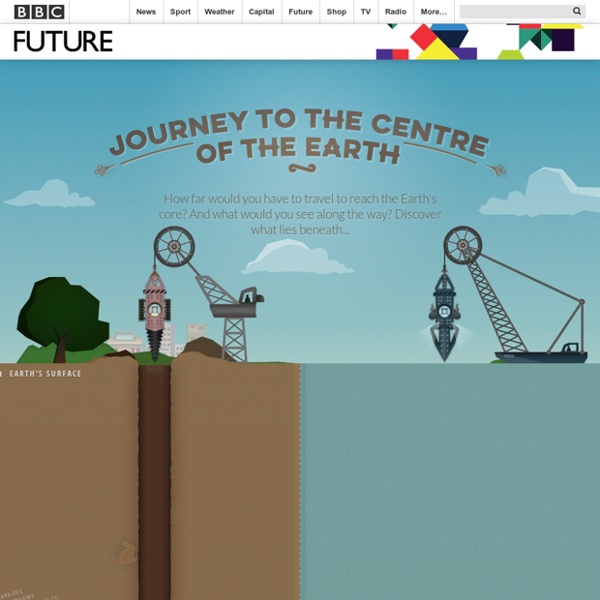
http://www.bbc.com/future/bespoke/story/20150306-journey-to-the-centre-of-earth/index.html
Related: Ikt2 • Inclassables • (serious)GameiMoviemanual för nybörjare Jag har skapat en manual för nybörjare till appen iMovie. Den tar upp en del av, enligt mig, de viktigaste funktionerna att känna till för att komma igång. Manualen har bilder och beskrivningar för funktionerna i iMovie när man vill skapa en film eller trailer. iMovie rymmer så mycket mer, men har du väl startat, kommer du att själv upptäcka finesser under resan. Glöm inte att det rymmer sig mycket information under den lilla knappen med frågetecknet som dyker upp på alla sidor. How Pluto's most spectacular image was made—and nearly lost By the end of the day on 14 July, the stunning picture of Pluto above would become iconic—the most “liked” image ever on NASA’s Instagram account. Even U.S. President Barack Obama would tweet it out. But the night before, at 11:07 p.m.
L’approche historique de la découverte de la théorie de la tectonique des plaques par un escape game ! Contexte local de la mise en place de l’Escape Game au collège. Cette séance s’inscrit dans le cycle 4 pour une classe de 4ème. Le jeu se déroule pendant d’une heure d’accompagnement personnalisé. Les élèves travaillent en effectif réduit : un groupe de 12-14 élèves dont le niveau scolaire est hétérogène. Les élèves ont déjà appréhendé en classe la notion de plaques lithosphériques définies en surface par l’activité sismique et volcanique et en profondeur par l’étude de la vitesse de propagation des ondes sismiques. Les notions de lithosphère et d’asthénosphère sont connues.
Deekit — Deekit. Online whiteboard for remote teams. simulation - Evolution of life La Terre est une planète active et cette activité se manifeste sous deux formes spectaculaires : les séismes et les volcans. Néanmoins, l’expression de cette activité ne se produit pas de manière aléatoire mais dans des zones bien caractérisées, selon des mouvements bien définis et aux conséquences connues. Ces éléments de la théorie de la tectonique des plaques, permettent également de résoudre des énigmes scientifiques à propos de la répartition des fossiles. Si cela vous intrigue, venez explorer les secrets des changements de face de la Terre ! Crédits
Blog Animation is a powerful technique that allows you to turn complex ideas or vague concepts into a clear and comprehensive story. However, sometimes it might be easier or less time-consuming to demonstrate something using camera-recorded video instead of recreating a situation using animated objects: a product demo, an exterior site, a manufacturing process, an interview — live action helps showing your audience how something works or what you've achieved. This helps you to concretize your story, and to connect with your audience. Other examples of useful recorded video footage include stock videos, event footage but also screen recordings, e.g. to explain a software application. Of course video footage also has its downsides: a long recording of a person being interviewed or a tedious monologue might give your audience a harder time concentrating as there is limited visual or textual support.
How Big Is The Brain? Here's Some Perspective. SExpand Imagine your brain is the size of Earth. How big would all of its constituent parts be? The brain-mapping folks at Eyewire teamed up with Visual.ly and FEI to host a Scale-Of-The-Brain infographic competition. With competition judges like Christopher Jobson (of Colossal), Maria Popova (of Brainpickings) and MIT neuroscientist and professional brain-mapper Sebastian Seung, entries neede to be not only visually appealing but scientifically accurate. Educational Technology and Mobile Learning: Tynker- A Wonderful App for Teach... July 16 , 2015 Tynker is an excellent website for teaching students coding. Students will get to learn the fundamentals of coding and programming through game-like puzzles, tutorials, stories and several interactive activities. Tynker also provides a wide variety of educational resources for teachers and educators. Some of these include: ready-to-use , grade specific lesson plans, STEM project templates that integrate coding across the curriculum, automatic assessment and powerful tracking tools for a better classroom management and many more. Tynker’s Hour of Code activities is another wonderful resource designed specifically to teach students computational thinking and the basics of computer programming via a wide variety of activities. To use Tynker in their class, teachers are not required to have any coding experience or training.
Educational Technology and Mobile Learning: Teachers' Top Educational Chrome ... July 16, 2015 Over the last weekend, we spent sometime sifting through our Chrome extensions archive and curated for you the list below. We singled out the the apps that have been most popular among teachers and educators during the first six months of this year. The apps cover a range of themes from tools to enhance your productivity and help you stay focused to add-ons for annotating and editing PDFs, you will definitely find something to use in your teaching. Enjoy “Classroom is a new tool in Google Apps for Education that helps teachers create and organize assignments quickly, provide feedback efficiently, and easily communicate with their classes. Classroom helps students organize their work in Google Drive, complete and turn it in, and communicate directly with their teachers and peers.”
Webtools: No Registration Needed for Students Welcome to my list of webtools that don’t require student registration. This started off as a simple curation for myself and has ballooned into something that I never thought would get this big. And it is still growing. I started added comments to each link, but that is taking a long time to complete. Please bear with me as I update it. While I do try to verify each link on a regular basis, please be aware that websites do change and some of these sites may no longer be active or may have switched to a paid version.
Educational Technology and Mobile Learning: A Comprehensive Collection of Som... January 4, 2015 Google Drive has proved to be an indispensable tool in teachers digital toolkit. It provides everything teachers need to write up a document, create a quick presentation or spreadsheet and design beautiful visuals and drawings, creative possibilities in Google Drive are endless. Additionally, Drive works across different devices and platforms so you can easily continue working on your documents anywhere you go and without even the need for Internet connection. In 2015 Google Drive has known a lot of improvements with the addition of a number of key features. We have covered all of these features in Drive for Teachers section here in EdTech and mLearning.
10 Epic Tools Busy Teachers Need to Be Aware of Robert A. Heinlein once said, “Progress is made by lazy men looking for easier ways to do things.” And he was right.