
CoP - Using Astronomy as an aid to teaching STEM. The idea for this CoP, simply called “Using Astronomy as an aid to teaching STEM”, came from many interactions with schools and their teachers and culminating in the inGenious astronomy chat that involved 35 schools from across Europe in December 2012.

Astronomy is a great way to “package” ideas, and understanding the universe naturally requires teachers and students to ask questions that involve all the STEM subjects, and even some non-STEM subjects. This CoP will encourage teachers to look at new ways to present some old ideas, using the fast-changing face of astronomy to provide the context. Picture Album: Solar System. Explore the planet Mars with realistic Mars habitats, rockets, ground cars and robots. Mars Science Laboratory. Mars Exploration Program. Curiosity Cam, Ustream.TV: Follow the Curiosity rover on Twitter (@MarsCuriosity) and Facebook. FAQsGet answers to some of the most common questions about.
ESA. Outreach Resources. Mars Express / Space Science / Our Activities / ESA. Education / ESA. Extrasolar planets. NASA Astrobiology: Life in the Universe. The Origin and Evolution of Life in the Universe. Your Online Guide to the Living Universe. Kepler: Educator Web Links. Educator Web Links Oct 2011: Agent Exoplanet—Astronomers at Las Cumbres Observatory are investigating exoplanets and you can too.
Through Agent Exoplanet you use images taken by Las Cumbres Observatory Global Telescope Network (LCOGT), measure the brightness of a star while a planet moves between it and our viewpoint (exoplanet transit event), and contribute to understanding the properties of each exoplanet. Things to put on your computer to stay up-to-date on exoplanet discoveries: NASA Sites Spacemath@NASA introduces students to the use of mathematics in relation to scientific discoveries announced in NASA press releases and other articles, Created and maintained by Dr.
NASA Space Science Education Resource Directory - NASA space science products for use in classrooms, science museums, planetariums, and other settings. Kepler: Interactives. Kepler: Activation Lab Simulations. Discover an exoplanet : the transit method. Unveil an extrasolar planet by observing the light intensity emitted by its mother star An extrasolar planet, or exoplanet, is a planet outside the Solar System.
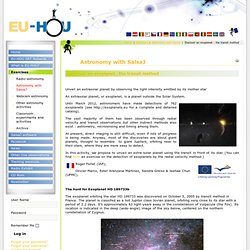
Until March 2012, astronomers have made detections of 762 exoplanets (see for a complete and detailed catalog). The vast majority of them has been observed through radial velocity and transit observations but other indirect methods also exist : astrometry, microlensing and timing among them. At present, direct imaging is still difficult, even if lots of progress is being made. Anyway, most of the discoveries are about giant planets, thought to resemble to giant Jupiters, orbiting near to their stars, where they are more easy to detect.
SETI@home. Faulkes Telescope Project. No. 41 - 2011: You Can Participate in Astronomy Research Projects. You Can Participate in Astronomy Research Projects Finding Exoplanets: The graph in this illustration shows how the light we see from a star decreases slightly when one of its planets crosses the star’s disk.
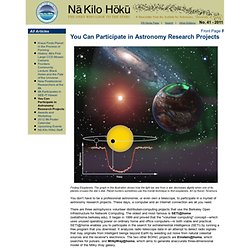
Planet hunters sometimes use this transit technique to find exoplanets. Art by Karen Teramura. You don't have to be a professional astronomer, or even own a telescope, to participate in a myriad of astronomy research projects. These days, a computer and an Internet connection are all you need. There are three astrophysics volunteer distributed-computing projects that use the Berkeley Open Infrastructure for Network Computing. Galaxy Zoo. Planet Hunters. 11 Com b - Visual Exoplanet Catalogue. The planetary system 11 Com hosts at least one planet.
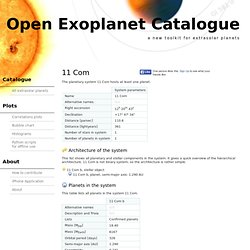
Image Click on the image to get a higher resolution image. Enciclopedia dei Pianeti Extrasolari. A Newly Confirmed Planet and 42 Additional Planet Candidates « Planet Hunters. Artistic rendition of a sunset viewfrom the perspective of an imagined Earth-like moon orbiting the giant planet, PH2 b.
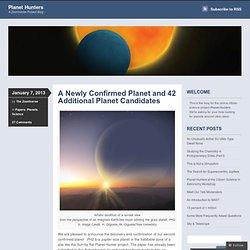
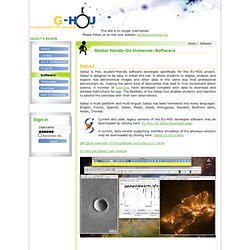
Image Credit: H. Giguere, M. Giguere/Yale University. Life beyond Earth. Heavens-Above Home Page. EarthKAM. Stellarium. Global Hands-On Universe: Software. SalsaJ is free, student-friendly software developed specifically for the EU-HOU project.
Sun for All Project. Download poster The project “Sun for all”, funded by Ciência Viva (2005 117/ 18) aims to promote science in general and astronomy in particular, among students.
The project rests on the asset of over 30000 Sun images (spectroheliograms) that are kept in the Astronomical Observatory of the University of Coimbra, as a result of a work of over 80 years of daily solar observations that started in 1926. Gravity and Orbits - Gravitational Force, Gravity, Force. Solar system (in bulgarian language) Planet Impact: Home. Apps. CIT Cosmos: The CIT Blackrock Castle Virtual Observatory for iPhone, iPod touch and iPad on the iTunes App Store. Sky Map for Android. What is Sky Map? Google Sky Map turns your Android-powered mobile phone into a window on the night sky. It will identify objects that appear in the sky and allow users to search for them.
How can I get Sky Map? The app is available for download at the Google Play. Where is Sky Map be available? Sky Map can be downloaded from the Google Play in countries where an Android-powered device is available. Is the app available only in English? The app is currently available in over a dozen languages. Does the app work on all Android-powered devices? Yes, the device will work on all Android-powered devices running Android 1.5 or higher. How does Sky Map work? The app uses Android-powered devices' built-in compass, GPS, and clock to display an annotated Sky Map of the area it is facing. Sky Map. Sky Map is a hand-held planetarium for your Android device.
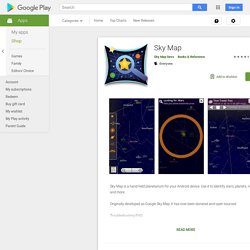
Use it to identify stars, planets, nebulae and more. Originally developed as Google Sky Map, it has now been donated and open sourced. Pocket Universe: Virtual Sky Astronomy for iPhone 3GS, iPhone 4, iPhone 4S, iPhone 5, iPod touch (3rd generation), iPod touch (4th generation), iPod touch (5th generation) and iPad on the iTunes App Store. About our Universe. Kinetic City: Video caricati. Mars:2020:Springtime. The Beauty of Science (Richard Feynman) Carl Sagan's COSMOS. Great Minds: Carl Sagan - Pale Blue Dot [new HD version] The Scale of the Universe 2. Powers of Ten™ (1977) Cosmic voyage to elsewhere : The scale of the Universe. O Big Bang de João Magueijo (Discovery-2008) Astronomy’s biggest name.
Education / ESA. Physics on Stage - 6-10 November 2000 - CERN. ESA. Outreach Resources. Dark Energy, Dark Matter. Dark Energy, Dark Matter In the early 1990s, one thing was fairly certain about the expansion of the Universe.
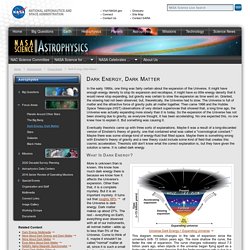
It might have enough energy density to stop its expansion and recollapse, it might have so little energy density that it would never stop expanding, but gravity was certain to slow the expansion as time went on. WMAP- Expansion of the Universe. The expansion or contraction of the universe depends on its content and past history. With enough matter, the expansion will slow or even become a contraction. On the other hand, dark energy drives the universe towards increasing rates of expansion. The current rate of expansion is usually expressed as the Hubble Constant (in units of kilometers per second per Megaparsec, or just per second). Hubble found that the universe was not static, but rather was expanding! Historical Overview. Antimatter.
I teach an introductory course in big bang cosmology at Waterford Institute of Technology in Ireland and this weblog will be mainly concerned with the universe and its puzzles (see Categories)…with occasional pieces on science and society, climate science, surfing, skiing and whatnot. Mars Exploration Program. Sunrise Project 2012 Results. Close to the Spring Equinox students from several schools all around Europe have built pinhole cameras by themselves.
The pinhole cameras were made of matt-black cardboard and other simple material using a design scheme that was provided by Sakari Ekko the project coordinator. The pictures from these observations have now been released and are presented next. All images are copyright of the authors. Photo 1. Sunrise Project 2011 Results. ERATOSTHEN PROJECT. Odysseus Contest. The Odysseus contest challenges students between 14 and 18 years old age from all EU countries to develop a project on space exploration, using their knowledge, creativity and critical thinking. Students wishing to participate must form a team of 2 to 5 members, with a teacher as a coach and prepare and submit a project in one of the contest’s categories: i) Solar System, ii) Spaceship – global cooperation and iii) Co-evolution of life. The entry must be digital and it may take the form of any digital file and could include a project worksheet in the format provided by the organizers and describing the background thinking of the project.
The contest will be open from July 2012 to February 2013. All entries will be assessed and scored on scientific knowledge, practical implementation and creativity by highly experienced evaluators, according to predefined Evaluation Criteria. Welcome to the Cassiopeia Project. Books. Cosmos: Carl Sagan: 9780345331359: Amazon.com.
Universe (9780716785842): Roger Freedman, William J. Kaufmann. Demon Haunted World Science As a Candle: Carl Sagan: Amazon.com. Mars, a Cosmic Stepping Stone: Uncovering Humanity's Cosmic Context: Amazon.it: Kevin Nolan: Libri in altre lingue.