
Read My Work - Joanne the Poet. Klotho the Fibre Goddess Describes Fate.
Daniel Ellsberg and the Pentagon Papers. Web crawl data from Common Crawl. by H.
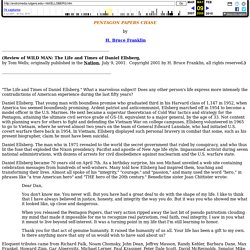
Jane Hirshfield. American poet, essayist, and translator.
Martha Serpas. Serpas grew up in Galliano, Louisiana, and received her BA from Louisiana State University.
She subsequently did graduate study at New York University (MA), Yale Divinity School (M.Div.), and the University of Houston (PhD). Serpas formerly taught at the University of Tampa and is currently on faculty at the University of Houston[1] Her first volume of poetry, Cote Blanche, appeared in 2002 from New Issues press at Western Michigan University; a second volume of poetry, "The Dirty Side of the Storm" was released by Norton in October 2006; and her third, "The Diener" was released by LSU Press in 2015.
Her poems are included in Uncommonplace: An Anthology of Louisiana Poets (LSU Press); "The Art of the Sonnet" (Harvard); "Bearing the Mystery: The Best of Image"; and other anthologies. A 2005 issue of The New Yorker includes three of her poems. Additional poems are included in Harold Bloom's 2006 anthology "American Religious Poems. " Frits Warmolt Went, May 18, 1903 — May 1, 1990. IF EVER A SCIENTIST could be said to have been born into his profession, it was Frits Went.
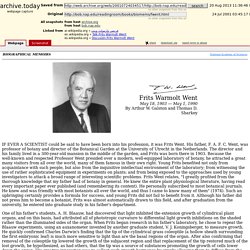
His father, F. A. F. C. Mumia Abu-Jamal. Mumia Abu-Jamal (born Wesley Cook[1] on April 24, 1954) is an American prisoner convicted for the 1981 murder of Philadelphia police officer Daniel Faulkner.[2] His original sentence of death, handed down at his first trial in July 1982, was commuted to life imprisonment without parole in 2012.[3] Described as "perhaps the world's best known death-row inmate" by The New York Times,[4] supporters and detractors have disagreed on his guilt, whether he received a fair trial, and the appropriateness of the death penalty.[5][6][7] Born in Philadelphia, Abu-Jamal became involved in black nationalism in his youth, and was a member of the Black Panther Party until October 1970.
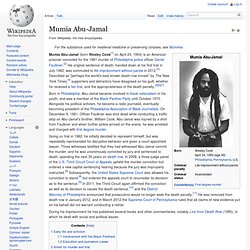
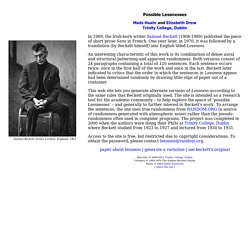
Alongside his political activism, he became a radio journalist, eventually becoming president of the Philadelphia Association of Black Journalists. On December 9, 1981, Officer Faulkner was shot dead while conducting a traffic stop on Abu-Jamal's brother, William Cook. Early life and activism[edit] Possible Lessnesses. Mads Haahr and Elizabeth DrewTrinity College, Dublin In 1969, the Irish-born writer Samuel Beckett (1906-1989) published the piece of short prose Sans in French.
Jutta Ditfurth. Jutta Ditfurth in July 2017 Jutta Gerta Armgard von Ditfurth (born September 29, 1951) is a German sociologist, writer, and radical ecologist politician.
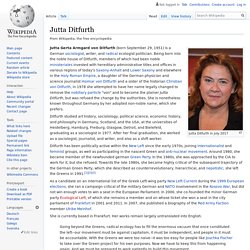
Being born into the noble house of Ditfurth, members of which had been noble ministeriales invested with hereditary administrative titles and offices in various regions of today's Saxony-Anhalt and Lower Saxony and elsewhere in the Holy Roman Empire, a daughter of the German physician and science journalist Hoimar von Ditfurth and a sister of the historian Christian von Ditfurth, in 1978 she attempted to have her name legally changed to remove the nobiliary particle "von" and to become the plainer Jutta Ditfurth, but was refused the change by the authorities.
She is nonetheless known throughout Germany by her adopted non-noble name, which she prefers. She is currently based in Frankfurt. Her works remain largely untranslated into English. Publications[edit] ON THE TRAIL OF LORD BYRON IN VENICE - Venice PrestigeVenice Prestige.
L'Ange du Foyeur - Max Ernst. German artist Biography[edit] Early life[edit]
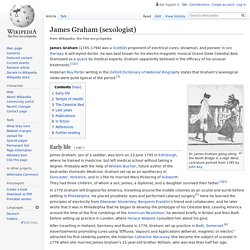
James Graham (sexologist) Graham with some of his patients.
The Temple of Health was a success and Graham became the talk of London, featuring in satirical plays, poems, prints and newspaper skits. During the 1780s he was publicly associated with society figures. Tom Dula. Confederate Army soldier Early life[edit] Tom Dula was born to a poor Appalachian hill country family in Wilkes County, North Carolina,[5] most likely the youngest of three brothers, with one younger sister, Eliza.[6] Dula grew up, attended school, and "probably played with the female Fosters" - Anne (later Melton) and her cousins Laura and Pauline.[7] As the children grew up, Tom and Anne apparently became intimate.
Anne Foster's mother found Anne and Tom in bed together when Anne was 14 years old and Tom was just 12. Gioseffo Zarlino. Sulkhan Tsintsadze. Education[edit] Tsintsadze studied the cello until 1942 with E.N. Kapelniski in Tbilisi at the Gymnasium of Music. He furthered his studies of the cello at the Conservatory of Tbilisi with K. Minjar. From the years 1945 to 1953 he went to the Moscow Conservatory to study the cello with Semyon Matveyevich Kozolupov and composition with Semyon Semyonovich Bogatyryov. Career[edit] Emitt Rhodes - Emitt Rhodes. Alain LeRoy Locke. Alain Leroy Locke (September 13, 1885 – June 9, 1954) was an American writer, philosopher, educator, and patron of the arts. Distinguished as the first African-American Rhodes Scholar in 1907, Locke was the philosophical architect —the acknowledged "Dean"— of the Harlem Renaissance.[1] As a result, popular listings of influential African Americans have repeatedly included him. On March 19, 1968, the Rev.
Dr. Martin Luther King, Jr. proclaimed: "We're going to let our children know that the only philosophers that lived were not Plato and Aristotle, but W. E. Early life and education[edit] John Atkinson Grimshaw, Reflections on the Thames, Westminster,1880 - John Atkinson Grimshaw. John Atkinson Grimshaw (6 September 1836 – 13 October 1893) was an English Victorian-era artist who has been called a "remarkable and imaginative painter"[1] best known for his nocturnal scenes of urban landscapes[2][3] Today, he is considered one of the most renowned painters of the Victorian era, as well as one of the best and most accomplished nightscape, and townscape, artists of all time. John Henry Twachtman. 19th-century American painter John Henry Twachtman (August 4, 1853 – August 8, 1902) was an American painter best known for his impressionist landscapes, though his painting style varied widely through his career. Art historians consider Twachtman's style of American Impressionism to be among the more personal and experimental of his generation.
He was a member of "The Ten", a loosely allied group of American artists dissatisfied with professional art organizations, who banded together in 1898 to exhibit their works as a stylistically unified group. Studies[edit] Dick Cheney. 46th Vice President of the United States Richard Bruce Cheney (/ˈtʃeɪni/;[1] born January 30, 1941) is an American politician and businessman who served as the 46th vice president of the United States from 2001 to 2009. He has been cited as the most powerful vice president in American history.[2][3] He was also one of the most unpopular politicians in the history of the US, holding an approval rating of just 13% at the time of leaving office.[4] Jean Passerat. Jean Passerat (18 October 1534 – 14 September 1602) was a 17th-century French political satirist and poet. Oswald Spengler. German historian and philosopher.
Lillian Hellman. Minicubby.com. Interview with Philip Tseng. Paul Creston. Otto Erich Deutsch. Otto Erich Deutsch (5 September 1883 – 23 November 1967) was an Austrian musicologist. Ernest Fanelli. Cquintana. Bernard Francis Law. Law was the Archbishop of Boston from 1984 until his resignation on December 13, 2002,[1][2] in response to the Roman Catholic Church sex abuse scandal in his archdiocese. Church documents showed he had extensive knowledge of sexual abuse committed by dozens of Catholic priests within his archdiocese and had failed to remove them from the ministry.[3] One priest alone was alleged to have raped or molested 130 children over decades, while Law and other local officials moved him among churches rather than going to the authorities.[3]
Giovanni Sollima. The Erasure of Maya Angelou’s Sex Work History. As Black History Month draws to a close, we thought revisiting Peech’s seminal essay on Maya Angelou would be appropriate. Dr. Giorgio Moroder. Frederick Williamson. Roland Emmerich. Randy Shilts. Jimmy Driftwood. Aleksandr Aljabjev. Theodor Bernhard Sick. Home. KARLHEINZ STOCKHAUSEN: COMPLETE LIST OF WORKS. René Leibowitz. Sam Riviere speaks to Andy Spragg. Rowan Williams. Official Website. Carl Foreman. Dan Musgrave – Ape, Writer. Geoffrey Ward.
Howard Skempton. John le Carré. About – Association for the Study of the Arts of the Present. On "The Armadillo" Rudolf Diesel. Augusto César Sandino. McMansion Hell. Selected Writing. Phil Klay. Colum McCann. Anita Bryant. The Barrett Brown Review of Arts and Letters and Jail: A Sign of Things to Come. McMaster University - Academia.edu. Denise Scott Brown. Sonia Sanchez. Hermann Oberth. Songs of My Selfie — Constance Renfrow. Publications and Awards – Angus McLinn. Franco Zeffirelli. Jacques Rancière. Thomas Frank. The Problem With Rupi Kaur's Poetry. DIVISION OF LITERATURES, CULTURES, AND LANGUAGES. My Story - Daniel David Wallace.
The Movement (literature) Paul Tillich. Donald Davie. The Way It Is - Bruce Hornsby & the Range, Bruce Hornsby. Alpha Band - Alpha Band. Larry Poons. Gram Parsons. Nudie Cohn. The Making of Americans. Van Dyke Parks. J. G. Ballard. Louis Theroux. Walter Pater. Michael Hornburg. Carl Wittman. Anthony Collins. Meet the feminist playwright who’s castrating rapists Off-Broadway. Goffredo Mameli. Saverio Mercadante. Rajneesh. Daniel Ortega. Cyril Connolly. Russell Means. Isaiah Berlin. Henry Bishop (composer) Linus Pauling. Hasta Siempre, Comandante. Giovanni Battista Cirri.