
German Cinema. French Cinema. Youtube. Youtube. Youtube. John Cassavetes. The Long Battle Over ‘Gone With the Wind’ But the film put the nostalgic Lost Cause mythology — by that point, the dominant national view of the Civil War — front and center, starting with the opening title cards paying tribute to “a land of Cavaliers and Cotton fields,” a “pretty world where Gallantry took its last bow.”
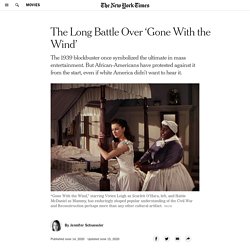
Even during production, there were calls for an African-American boycott. Afterward, there were protests outside theaters in Chicago, Washington and other cities. While responses to the finished film in the black press were mixed, the criticism was harsh. Signs of Life: A letter from Apichatpong Weerasethakul - Filmkrant. Last week, Jia Zhang-ke sent us a letter from his quarantine in Beijing.

This week, Thai slow cinema luminary Apichatpong Weerasethakul responds from his home in Chiang Mai. I was touched by Jia Zhangke’s letter which made me feel the importance of kinship in our time of confinement. James Lipton, Scholarly Host Of ‘Inside The Actors Studio,' Dies At 93. James Lipton, best known as the distinctive host of the long-running talk show “Inside the Actors Studio,” died Monday.
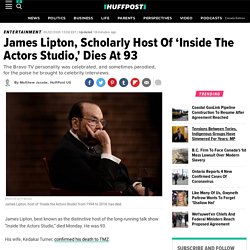
He was 93. His wife, Kedakai Turner, confirmed his death to TMZ. Sirui 50mm f/1.8 Anamorphic Available, Hacks, Reviews, and More - Sony Addict. If you want a fairly fast and affordable Anamorphic lens the Sirui 50mm f/1.8 Anamorphic is available from Adorama.

Express Your Cinematic Side! 50mm F1.8 Anamorphic 1.33X Lens Cinematize your shots! Compared to a traditional 50mm APS-C lens, the new SIRUI 50mm F1.8 camera lens enlarges your horizontal field of view to up to 33% to achieve a FOV equivalent of an APS-C 37.5mm lens. Affordable and durable, The F1.8 camera lens with aluminum enclosure is robust yet lightweight to create cinematic widescreen shots.
Homenaje a Luis Ospina. Cuando terminó la filmación, Luis se fue a editar a Bogotá y a Nueva York, mientras yo sellaba un nuevo pacto con Carlos Mayolo, ayudándole en la preproducción de Carne de tu carne.

Mayolo había sido actor de Pura sangre, y ahí nos convertimos en cómplices de la felicidad. Gracias a ellos, a Karen, a Elsa Vásquez y al resto de la pandilla, aprendí los oficios del cine. Gracias al apoyo de Focine, las películas se fueron reproduciendo unas tras otras, mientras mi amistad con Ospina se profundizó. Él y Karen cambiaron de locación a un apartamento en el barrio Centenario. Yo vivía a una cuadra de distancia, así que nos veíamos a diario, comenzando jornadas vespertinas que se extendían hasta las primeras horas de la madrugada.
De aquellos tiempos me queda, más allá de la inmersión en un oficio a todas luces fascinante, entender la amistad como una forma de protegerse del mundo.
Documentary. Editing. Blackmagic Pocket 4K. 16mm. DJI OSMO POCKET User Guide: Everything You Need To Know! Stanley Kubrick. Theo Angelopoulos. The Industry. Paul Clipson. John Smith. James Benning. Academy Posters Category - 116 Items - Media Storehouse. Filmoteca española online. Where to begin with Béla Tarr. Film Noir. Atom Egoyan. Lars von Trier. Jim Jarmusch. Michelangelo Antonioni. How to Read a Film. Composition In Storytelling. Hollywood's Corporate Art. Men don’t make movies.
Industries don’t make movies. Corporations do.
Watching violent films does make people more aggressive, study shows. Their brains were scanned as they watched a succession of shootings and street fights on day one, emotional but non-violent scenes such as people interacting during a natural disaster on day two and nothing on day three.
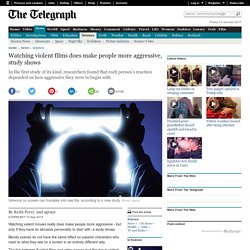
While watching violence the aggressive group had less activity in the orbito-frontal cortex, which controls emotion-related decision making and self-control. These subjects said they felt more more inspired and determined and less upset or nervous than their non-aggressive counterparts when watching violent instead of only emotional scenes. Their blood pressure also went down progressively while the calm groups' rose. During the final 'mind wandering' stage - when no films were shown - the aggressive participants had unusually high brain activity in a network of regions known to be active when not doing anything in particular.
This suggests they have a different brain function map than their non-aggressive peers, said the researchers. Louis Le Prince, who shot the world's first film in Leeds - BBC News. Who made the first film?

The Lumiere brothers and Thomas Edison are usually credited with pioneering the moving image. However a new documentary argues that the first film was actually shot in Leeds in 1888 - but that its maker disappeared before he could claim his place in cinema history. When film producer and distributor David Wilkinson visits Hollywood or New York or Cannes, he tells his movie business contacts that he comes from the city "where film was invented". His puzzled acquaintances figure that he does not have an American accent, so cannot come from the birthplace of Thomas Edison, and is clearly not from France, the land of the Lumieres.
WALPOLE PICTURE THEATRE, Ealing, London. Cinematograph opening in July 1912. Photograph commissioned by Bovis Ltd of their building by architect J S Beard. - 42-36683420 - Droits gérés. Film Analysis. Tarkovsky. Wes Anderson. Labour in a Single Shot. 8mm & Super 8. Violent Femme. How Scarlett Johansson learned to become aloof from her own seductiveness.
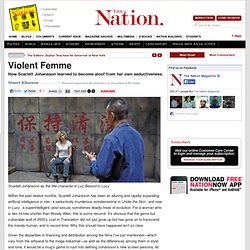
Scarlett Johansson as the title character in Luc Besson’s Lucy. John Waters discusses 50 years of John Waters movies, and why he refuses to go backward. Jean-Claude Carrière: 'If you want fame, don't be a screenwriter' Link to video: The Discreet Charm of the Bourgeoisie Reading this on mobile?

Click here to view The Discreet Charm Of The Bourgeoisie Production year: 1972 Country: France Cert (UK): 15 Runtime: 105 mins Directors: Luis Bunuel Cast: Bulle Ogier, Delphine Seyrig, Delphine Syirg, Fernando Rey, Paul Frankeur, Stephane Oudran More on this film Jean-Claude Carrière welcomes me into the former gaming house and den of iniquity that he has called home for nearly half his 80 years; the 19th-century building stands in a sun-dappled Parisian courtyard.
Centre for Moving Image Research. Was 12 Years a Slave the best film of the year? I hope not. 12 Years a Slave is a remarkable film and I share the widespread delight that it won recognition at the Oscars in Hollywood, especially when there was always a risk that an enjoyable bit of immoral trash like The Wolf of Wall Street might have done some business at its high-minded expense. But best film of the year? I hope not. It's a political film with a political message for our times – slavery isn't over when there are an estimated 21 million slaves today, so Steve McQueen reminded his audience on Sunday night. Movie History on Pinterest is theatermasterp on Pinterest.
Watch 12 Essential Making-of Documentaries, Feat. Eraserhead & Being John Malkovich. Did the 'Blue is the Warmest Color' Director Push Too Far? In “Blue Is the Warmest Color,” which took home the Palme d’Or at Cannes, our brightly burning heroines first meet in a lesbian bar in Lille. Adèle, a fifteen-year-old high-school student, has already spotted Emma, a blue-haired sparkplug, on the street, and pleasured herself to thoughts of her. When the chance at conversation arises, Adèle asks Emma, somewhat mechanically, what she does. Emma replies that she studies at the École des Beaux-Arts. “Beaux-Arts?” We Hear the Sound of Splashing. From Trainspotting, Miramax, 1996 by Julian Hanich In this essay [1] I try to categorize the range of artistic options that filmmakers currently have at hand to evoke bodily disgust. [2] Or, to reframe this approach in a slightly different manner: If we examine the variety of disgusting scenes at the movies, how can we usefully distinguish them?
My aim is to provide a number of brushstrokes for a broader panoramic picture of disgust. The Stylistic Milestones of Saul Bass. This week marks the birthday of Saul Bass, one of the most important and prolific visual artists to ever work in motion pictures. As testament to his enduring significance, Bass has been posthumously honored with one of contemporary society’s highest acknowledgements of cultural achievement – his very own Google doodle based on his famous designs for Anatomy of a Murder (1959). In recent years, the interest in Bass’s career seems to be growing. Rogerebert.com. I have heard theories that Federico Fellini's "La Dolce Vita" catalogs the seven deadly sins, takes place on the seven hills of Rome, and involves seven nights and seven dawns, but I have never looked into them, because that would reduce the movie to a crossword puzzle. I prefer it as an allegory, a cautionary tale of a man without a center. Fellini shot the movie in 1959 on the Via Veneto, the Roman street of nightclubs, sidewalk cafes and the parade of the night.
A Personal Reflection on the Work of Abel Ferrara in Light of His New Picture (Written in the Shadow of Serge Daney) on Notebook.
David Thomson On Films: The Stunted Adulthood Of Wes Anderson. Hearts of Darkness: A Filmmaker's Apocalypse - Coppola's final speech. The Essay Film. Ingmar Bergman. Kieslowski. Rockefeller's Melancholy on Notebook. Aki Kaurismäki's Le Havre is like all his other work and thank goodness for that. A Walk Through Carlito’s Way. Casavettes. Kenneth Anger @ 85 on Notebook. Trailer for The Films of Kenneth Anger, Vol 1,released by Fantoma in 2007. ‘The Act of Killing’ and Indonesian Death Squads. Steven Soderbergh - The State of Cinema Video & Transcript — SF Film Society Blog.
Stunning Behind-the-Scenes Photos Show Iconic Movies in a New Light. Why France is gearing up for a culture war with the United States.
The Sweet Spot Video: Take a Walk on the Dark Side. Iran. Pontecorvo's Colonel Mathieu: the paratrooper who embodied France. Science Fiction Films and American Society in the Fifties. Chapter One: Science fiction films and the political climate. Film Terms Glossary - Dictionary. Nestor Almendros. 9/11. Frame Rates. CGI. The Bobby Miller. 3D. Kogonada. The Cinematography of 10 Great Filmmakers Captured in Cinemagraphs.
Ο Αγγελόπουλος για τα ''αργά'' πλάνα & την καταξίωση (1980) WG Sebald: Darkness on the edge of Anglia. Verso Presents: J. Hoberman's Defining Films of the 21st Century. VersoBooks.com. Welcome to the OFFICIAL SITE of WIM WENDERS. The Danish Poet (complete) by Torill Kove. Rupert Everett: the queen of mean. Watch: ‘135 Shots That Will Restore Your Faith in Cinema' Nicholas Rombes: Minecrafting Realism. Waking Up at the Movies by Jana Prikryl. Supercut Film School: Q&A With Elusive, Anonymous Video Essayist kogonada. Inside the strange Hollywood scam that spread chaos across the Middle East.