
Of Wife and the Domestic Servant in the Arab World. My goal in this short essay is to capture for the reader the gains and losses associated with Islamic-based family rules in the context of an economy that has a generous supply of cheap domestic workers and a sparing one of female public employment.
Gender & the Middle East - curators... Gender & The Middle East - Reading... War of Position and War of Maneuver: Sexperts, Sex Pervs, and Sex Revolutionaries. The recent issue of Foreign Policy on sex has instigated critical feedback from many who have rightly challenged racist and Orientalist representations of gender and sexuality in the Muslim and Arab worlds.
Several critics have rightly pointed out that essentialist approaches to culture that rely on facile binaries of men/women, freedom/oppression, and West/East lack any meaningful analyses of geopolitics, economy, colonial and post-colonial formations, and historical nuances. Let's Talk About Sex. This week Foreign Policy published a “Sex Issue.”
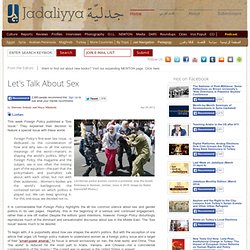
They explained their decision to feature a special issue with these words. The Sex Issue. When U.S. magazines devote special issues to sex, they are usually of the celebratory variety (see: Esquire, April 2012 edition; Cosmopolitan, every month).

Suffice it to say that is not what we had in mind with Foreign Policy's first-ever Sex Issue, which is dedicated instead to the consideration of how and why sex -- in all the various meanings of the word -- matters in shaping the world's politics. Why? The Duck of Minerva: "Seriously, Guys!": How (Not) to Write About Gender and Foreign Affairs. Why Do They Hate Us? - By Mona Eltahawy. In "Distant View of a Minaret," the late and much-neglected Egyptian writer Alifa Rifaat begins her short story with a woman so unmoved by sex with her husband that as he focuses solely on his pleasure, she notices a spider web she must sweep off the ceiling and has time to ruminate on her husband's repeated refusal to prolong intercourse until she too climaxes, "as though purposely to deprive her.

" Just as her husband denies her an orgasm, the call to prayer interrupts his, and the man leaves. After washing up, she loses herself in prayer -- so much more satisfying that she can't wait until the next prayer -- and looks out onto the street from her balcony. She interrupts her reverie to make coffee dutifully for her husband to drink after his nap. Taking it to their bedroom to pour it in front of him as he prefers, she notices he is dead. She instructs their son to go and get a doctor. Yes: They hate us. But let's put aside what the United States does or doesn't do to women. Reuters. Mona Eltahawy and Leila Ahmed on women in the Middle East. On "Why do they hate us?" and its critics.
On Listening (a response to the Mona Eltahawy criticism) Unless you live under a rock, dear blog reader, you’ve probably witnessed the hulabaloo over the past 24 hours about an article by Mona Eltahawy entited “Why Do They Hate Us?”
I don’t feel the need to comment on the article’s content, particularly as many already have, but I would instead like to comment on a thread of commentary that I find particularly bothersome. I can’t find the tweet, but last night I noted someone–a journalist, no less–tweet something along the lines of “Hmm, interesting – most of my [American? Foreign? Can't remember] friends like [the article], most of my Arab friends don’t.” While the tone of the comment was ambiguous and I’ll assume a bit of irony, I’ve seen other similar comments that are a bit more…obtuse. Oh, Mona! « AmericanPaki. Since yesterday it appears Mona Eltahawy has had her hands full fending off the massive outrage her Foreign Policy article entitled “Why do they hate us?
The real war on women is in the Middle East” provoked. Even much to the dismay of disappointed feminists, her tweets suggest those disagreeing with her have not bothered to provide intelligible debate. However, it was pretty clear, even yesterday, this was certainly not the case. I realise Mona has likely been quite swamped with responses. But her tweeting patterns suggest that she is responding mainly to two types of people: those that are lauding her work, and those that have been shamelessly slandering her. Do Arab men hate women? It's not that simple. Photograph: Foreign Policy The latest edition of Foreign Policy, the cover of which bears the same stark question posed by its main article Why Do They Hate Us?
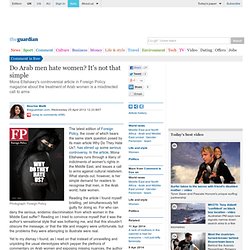
, has stirred up some serious controversy. In the article, Mona Eltahawy runs through a litany of indictments of women's rights in the Middle East, and issues a call to arms against cultural relativism. What stands out, however, is her simple demand for readers to recognise that men, in the Arab world, hate women. Reading the article I found myself bristling, yet simultaneously felt guilty for doing so. Yet to my dismay I found, as I read on that instead of unravelling and unpicking the usual stereotypes which pepper the plethora of commentary on Arab women and exposing missing nuances, the author simply reinforced a monolithic view – holding the argument together using rhetoric, personal anecdotes and a rhythmic punctuation with her main theme – that all Arab men hate Arab women.
Hatred and misogyny in the Middle East, a response to Mona el Tahawy. A veritable twitter storm has sprung up around an article by Mona el Tahawy in the latest issue of Foreign Policy, entitled Why Do They Hate Us?
In the article, El Tahawy documents and condemns the abuses meted out upon women throughout the Middle East. So far, so uncontroversial, you might think. But in fact, the article treads across a terrain peppered like a mine-field with complex issues relating to the representation of women's struggles in the contemporary Middle East. Many of the criticisms have been unfair, or down-right abusive, but there are real questions which ought to be raised about the piece.
What follows will make most sense if you've read the article. How Not to Study Gender in the Middle East. Between the Liberalisation of Islamist Politics and the Feminisation of Islamic Interpretation: Arab Muslim Women after the Uprisings. By Dr Aitemad Muhanna This piece is part of a forthcoming report to be published by the Norwegian Peacebuilding Resource Centre.
As the Arab uprisings have unfolded, Arab women have stood shoulder to shoulder with men, struggling for a better future for themselves and for their male counterparts. Gender & Politics / Culture.