
The Real Story of Christmas Part 1 of 5. The Real Story of Christmas Part 2 of 5. The Real Story of Christmas Part 3 of 5. The Real Story of Christmas Part 4 of 5. The Real Story of Christmas Part 5 of 5. Christmas in Puritan New England. The Puritan view of Christmas[edit] Puritans heaped contempt on Christmas, Daniels writes, calling it 'Foolstide' and suppressing any attempts to celebrate it for several reasons.
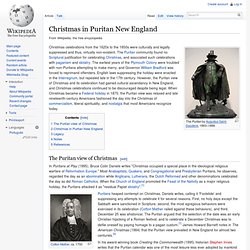
First, no holy days except the Sabbath were sanctioned in Scripture, second, the most egregious behaviors were exercised in its celebration (Cotton Mather railed against these behaviors), and third, December 25 was ahistorical. Puritans & Christmas. Why was Christmas banned in America until 1820? Saturnalia. In Roman mythology, Saturn was an agricultural deity who was said to have reigned over the world in the Golden Age, when humans enjoyed the spontaneous bounty of the earth without labor in a state of social egalitarianism.
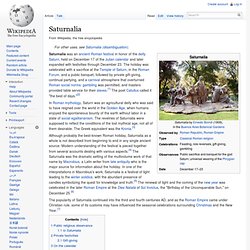
The revelries of Saturnalia were supposed to reflect the conditions of the lost mythical age, not all of them desirable. The Greek equivalent was the Kronia.[3] Although probably the best-known Roman holiday, Saturnalia as a whole is not described from beginning to end in any single ancient source. Modern understanding of the festival is pieced together from several accounts dealing with various aspects.[4] The Saturnalia was the dramatic setting of the multivolume work of that name by Macrobius, a Latin writer from late antiquity who is the major source for information about the holiday.
Public religious observance[edit] The day was supposed to be a holiday from all forms of work. Io Saturnalia[edit] Private festivities[edit] Dice players in a wall painting from Pompeii. Saturnalia - Celebrate the Saturnalia. "For how many years shall this festival abide!
Never shall age destroy so holy a day! While the hills of Latium remain and father Tiber, while thy Rome stands and the Capitol thou hast restored to the world, it shall continue. " - Saturnalia Conspicuous Consumption in Saturnalia as in Christmas Around Christmas it's often difficult to separate commerce from religion. I want to do something different this year. Mithraic mysteries. Double-faced Mithraic relief.
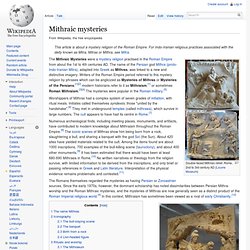
Rome, 2nd to 3rd century AD (Louvre Museum) The Mithraic Mysteries were a mystery religion practised in the Roman Empire from about the 1st to 4th centuries AD. The name of the Persian god Mithra (proto-Indo-Iranian Mitra), adapted into Greek as Mithras, was linked to a new and distinctive imagery. Christmas Without Christ. Part 2: Pre-Christian and Christian Traditions Pre-Christian Traditions It is not, however, clear that this dating was done for wholly Christian reasons.
I don't think that it is entirely coincidental that in 274 CE, when the winter solstice fell on December 25th, pagan emperor Aurelian proclaimed this day as Natalis Solis Invicti, the festival of the birth of the invincible sun. Throughout pagan Europe, Christianity was known for supplanting pagan celebrations and holy places in an effort to speed conversion, and it is easy to see this as another example of the same. But there was more involved than just the date. For an entire week, from December 17th to 24th, no work was done and the only law was for everyone to be in good cheer. Does any of this sound familiar? Pre-Christian Origins of Christmas Traditions and Customs. Dear Everyone, Happy Holidays!
It’s Christmas Eve and I have had a wonderful month celebrating this season and what it represents for me. A couple of days ago, I attended a Solstice dinner party with lovely friends. I’ve been making treats, watching my favorite holiday movies and now I am in the Midwest, preparing to celebrate tomorrow surrounded by my beautiful family by extension – my partner’s family. Because of all of this and how much I look forward to this time of year, it’s especially disheartening to hear the annual complaints about the supposed “War on Christmas” – the yearly whining by some Christians who seem to be stuck in a permanent victim mentally about how people who do not practice their religion are trying to co-opt their traditions.
Even the gentler “reminders” or insistence that “Jesus is the reason for the season” are actually offensive and misguided, even if more benign. And this is a GOOD thing. HOWEVER. History of Christmas Traditions: some pre-Christian? — Bill Petro. The Shocking Pagan Origin of CHRISTMAS! Hope of Israel Ministries (Ecclesia of YEHOVAH): Should Christians Celebrate "Christmas"?
The True Origin of Christmas. Every year after Thanksgiving, most people’s thoughts turn to Christmas.
It is the time when professing Christians are supposed to focus on Jesus Christ. After all, it is the “Christ-mass” season! Rudolph the Red-nosed Reindeer, holly wreaths, decorated trees, mistletoe, season’s greetings, seasonal music, “chestnuts roasting on an open fire” and Santa Claus are all associated with this holiday. These all bring warm feelings to those who celebrate it. I grew up in a family that kept Christmas, and it was a very big event in our household every year. Christmas is thought by most to be a wonderful time, focusing the participants on giving, family togetherness, beautiful music and decorations, feasting on special foods and singing Christmas carols throughout the neighborhood (as my family did every year).