
Black Hole Birth Announcement - Space News. For the first time, astronomers have produced a complete description of a black hole, a concentration of mass so dense that not even light can escape its powerful gravitational pull.
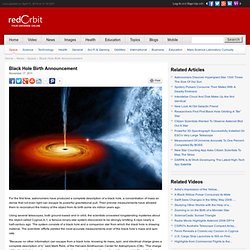
Their precise measurements have allowed them to reconstruct the history of the object from its birth some six million years ago. Using several telescopes, both ground-based and in orbit, the scientists unraveled longstanding mysteries about the object called Cygnus X-1, a famous binary-star system discovered to be strongly emitting X-rays nearly a half-century ago. The system consists of a black hole and a companion star from which the black hole is drawing material. Carlsaganexistence.jpg (JPEG Image, 590x801 pixels) - Scaled (80%) » David Eagleman on Possibilianism at Poptech. Astronomer's guide to the solar system. Dr Marek Kukula, Public Astronomer at the Royal Observatory, Greenwich, takes readers on a hitch-hiker's guide to our solar system using this collection of photographs showing the best "tourist" attractions of our solar system.
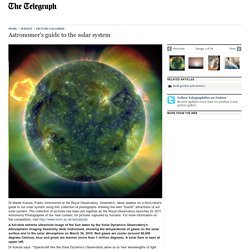
The collection of pictures has been put together as the Royal Observatory launches its 2011 Astronomy Photographer of the Year contest, for pictures captured by humans. For more information on the competition, visit A full-disk extreme ultraviolet image of the Sun taken by the Solar Dynamics Observatory's Atmospheric Imaging Assembly (AIA) instrument, showing the temperatures of gases on the solar surface and in the solar atmosphere on March 30, 2010. Red gases are cooler (around 60,000 degrees Celsius), blue and green are warmer (more than 1 million degrees). A solar flare is seen at upper left. Dr Kukula says: "Spacecraft like the Solar Dynamics Observatory allow us to 'see' wavelengths of light which would be invisible to human eyes.
TAM Panel - Our Future in Space. How to see the best meteor showers of 2012: Tools, tips and save the dates. (PhysOrg.com) -- Whether you're watching from a downtown area or the dark countryside, here are some tips to help you enjoy these celestial shows of shooting stars.
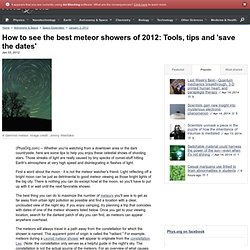
Those streaks of light are really caused by tiny specks of comet-stuff hitting Earth's atmosphere at very high speed and disintegrating in flashes of light. First a word about the moon - it is not the meteor watcher's friend. Light reflecting off a bright moon can be just as detrimental to good meteor viewing as those bright lights of the big city. There is nothing you can do except howl at the moon, so you'll have to put up with it or wait until the next favorable shower. The best thing you can do to maximize the number of meteors you'll see is to get as far away from urban light pollution as possible and find a location with a clear, unclouded view of the night sky. SolarSystemAbundances.png (800×357) I Bet We Could Explore The Galaxy at Kontraband. Discovery of the Most Distant Galaxy in the Cosmic Dawn « NAOJ. Big History Project Home. Two Suns? Twin Stars Could Be Visible From Earth By 2012.
By Dean Praetorius | HuffingtonPost.com Earth could be getting a second sun, at least temporarily.

Dr. Brad Carter, Senior Lecturer of Physics at the University of Southern Queensland, outlined the scenario to news.com.au. Betelgeuse, one of the night sky’s brightest stars, is losing mass, indicating it is collapsing. It could run out of fuel and go super-nova at any time. When that happens, for at least a few weeks, we’d see a second sun, Carter says. The Star Wars-esque scenario could happen by 2012, Carter says... or it could take longer. But doomsday sayers should be careful about speculation on this one. In fact, a neutrino shower could be beneficial to Earth.
UPDATE: To clarify, the news.com.au article does not say a neutrino shower could be beneficial to Earth, but implies a supernova could be beneficial, stating, "Far from being a sign of the apocalypse, according to Dr Carter the supernova will provide Earth with elements necessary for survival and continuity. " Top Image: Source. 'Space Chronicles': Why Exploring Space Still Matters. After decades of global dominance, America's space shuttle program ended last summer while countries like Russia, China and India continue to advance their programs.
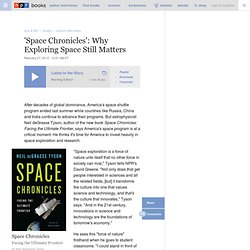
But astrophysicist Neil deGrasse Tyson, author of the new book Space Chronicles: Facing the Ultimate Frontier, says America's space program is at a critical moment. He thinks it's time for America to invest heavily in space exploration and research. "Space exploration is a force of nature unto itself that no other force in society can rival," Tyson tells NPR's David Greene. "Not only does that get people interested in sciences and all the related fields, [but] it transforms the culture into one that values science and technology, and that's the culture that innovates," Tyson says. "And in the 21st century, innovations in science and technology are the foundations of tomorrow's economy.
" He sees this "force of nature" firsthand when he goes to student classrooms. Today, Mars is bone-dry; it once had running water. A long terme, la race humaine devra quitter la Terre. Mon pôte Stephen Hawking, physicien mondialement connu, a accordé une petite interview dans laquelle il explique que si l'humanité veut survivre, il faut qu'elle réfléchisse dès à présent à quitter la planète Terre.
"Je crois que l'avenir à long terme de la race humaine doit être dans l'espace.