
Exoskeleton. Sarcos Exoskeleton Bringing Iron Man Suit Closer To Reality. 'Iron Man' Actor Clark Gregg Spends a Day With the Raytheon Sarcos XOS 2 Exoskeleton. How China Plans To Send Robots To the Moon. China is planning to send a robotic exploration rover to the Moon around 2013.

Despite the fact that the moon is so close (cosmically speaking), we haven't really interacted much with the lunar surface since the late '70s. We've taken pictures of it and crashed the occasional spacecraft into it, but in general the moon has been bypassed for sexier planets like Mars. The opening keynote at this year's IEEE International Conference on Robotics and Automation (ICRA), in Shanghai, was given by Ziyuan Ouyang, the chief scientist of China's lunar exploration program, which is quite possibly the most active lunar program in the world right now. Ouyang confirmed that, yes, China is planning to send robots to the moon, and he revealed interesting details about the project. For the past four years, China has been engaged in a three-phase plan that will ultimately culminate in a lunar rover and a lunar sample return mission, scheduled to take place in 2013 and 2017 respectively.
Looks familiar, huh? Interview: iRobot's Colin Angle on Robotics Industry, Remote Presence Robots. At the InnoRobo conference in Lyon, France, last month, I got a chance to speak with Colin Angle, CEO of iRobot -- in a very candid interview about his view on the robotics industry, his vision for AVA, a new robot platform his company is developing, and how he sees things shaping up in the coming years.
Cool over function In keeping with a presentation Colin gave earlier in the day, he started off our conversation with a discussion on how there have been hundreds of millions of dollars spent on making cool demos – but relatively little in the way of solving high value business needs. To illustrate his point, he mentioned the incredible effort that has been undertaken on the development of humanoid robots. He calls this an exercise of “cool over utility. " As he explained it, the challenge of having to build a system that supports the model of bipedal legs and actually executing walking and balancing has been a costly adventure. Thoughts on remote presence How AVA fits in Other juicy bits. JPL Animation Shows Off New Mars Rover's Harrowing Travel Plan. This video shows how the Mars Science Laboratory rover (aka "Curiosity") is planning to get from here to the surface of Mars.

Since MSL is too large for airbags and Mars doesn't have enough atmosphere for a parachute to do the whole job, the only option is a rocket-assisted landing. The "sky-crane" system in the video above has never been used for a mission before, and I can't even imagine how agonizing it's going to be waiting to find out whether everything went successfully when touchdown happens in August of 2012. Boing Boing recently had the chance to send a photographer to JPL to check out the more or less completed rover before it's sent of to Florida next month to prepare for its November launch. Here are a couple of my favorite pics: Mars Science Laboratory (Curiosity Rover) Mission Animation. Hardware and Software Platform for Mobile Manipulation R&D.
Modular Open interfaces let you use different grippers, forearms, whole arms or sensors.

Modularity Specs Power to Go The 1.3 kWh battery system can run the servers and robot at full tilt for 2 hours. Onboard chargers let PR2 run while plugged in and charging. EtherCAT A single EtherCAT bus gives you real time, deterministic control of all your motors at 1 kHz while also providing accurate triggering of all your cameras. Ethernet + WiFi With a 32 gigabit backplane and multigigabit connection to each server, the gigabit Ethernet network handles all the camera data and the dual radio WiFi with ease. Safety From the counterbalance {*style:<br>*} to the power system, {*style:<br>*}PR2‘s hardware and {*style:<br>*}software are designed to minimize risks {*style:<br>*}while retaining the power {*style:<br>*}of an open platform. Can Japan Send In Robots To Fix Troubled Nuclear Reactors? Editor's Note: This is part of IEEE Spectrum's ongoing coverage of Japan's earthquake and nuclear emergency.
When it comes to robots, Japan is a superpower, with some of the world's most advanced robotic systems and the highest levels of industrial automation. So it makes sense to ask: Why can't Japan use robots to fix the damaged reactors at the Fukushima Dai-1 nuclear power plant? Many people have wondered about this possibility, and there's been a lot of speculation and confusion. One news report even slammed Japan for lacking nuclear-disaster robots.
Robots Enter Fukushima Reactors, Detect High Radiation. This is part of IEEE Spectrum's ongoing coverage of Japan's earthquake and nuclear emergency.
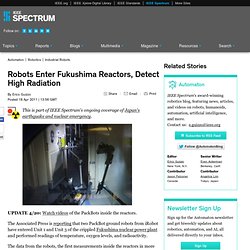
UPDATE 4/20: Watch videos of the PackBots inside the reactors. The Associated Press is reporting that two PackBot ground robots from iRobot have entered Unit 1 and Unit 3 of the crippled Fukushima nuclear power plant and performed readings of temperature, oxygen levels, and radioactivity. Japanese Robot Surveys Damaged Gymnasium Too Dangerous for Rescue Workers.
Editor's Note: This is part of our ongoing news coverage of Japan's earthquake and nuclear emergency.

Japanese researchers have sent a robot into a damaged gymnasium where a partially collapsed ceiling makes it dangerous for rescue workers. The team used a remote-controlled ground robot to enter the building in Hachinohe, Aomori Prefecture, in the northeastern portion of Japan's Honshu island, and assess damages. The roboticists, led by Fumitoshi Matsuno, a professor at Kyoto University and vice president of the International Rescue System Institute, used their KOHGA3 robot, a tank-like machine equipped with cameras and sensors, to carry out the mission. "Part of the ceiling fell down," Prof. Matsuno told me. Several robotics teams have been on standby throughout Japan, ready to assist in rescue and recovery operations after the earthquake and tsunami that struck the country early this month.
At the Hachinohe gymnasium, Prof. Then it was time to explore other parts of the gymnasium. Inspection of the damaged gymnasium by using a rescue robot "KOHGA3. Japan Earthquake: iRobot Sending Packbots and Warriors to Fukushima Dai-1 Nuclear Plant. Editor's Note: This is part of our ongoing news coverage of Japan's earthquake and nuclear emergency. iRobot Warrior 710s getting prepared for deployment to Japan.
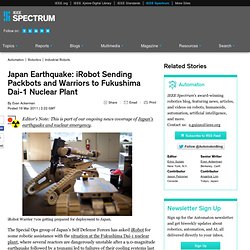
The Special Ops group of Japan's Self Defense Forces has asked iRobot for some robotic assistance with the situation at the Fukushima Dai-1 nuclear plant, where several reactors are dangerously unstable after a 9.0-magnitude earthquake followed by a tsunami led to failures of their cooling systems last week.
Four robots, including iRobot's Packbot 510 and Warrior 710, left Bedford, Mass., this morning on their way to Japan, along with a team of iRobot employees to provide support, an iRobot spokesperson told me. The iRobot team will be training Japanese defense personnel, who will control the robots remotely, from a protected vehicle, and iRobot employees will not be getting close to the reactors themselves. These robots may be able assist at Fukushima Dai-1 in several different ways.
Japan Earthquake: Robots Help Search For Survivors. Editor's Note: This is part of our ongoing news coverage of Japan's earthquake and nuclear emergency.

Japan's earthquake will be a major test for search-and-rescue robots like Quince, developed by Chiba Institute of Technology roboticists, shown here during a demonstration. Japan's leading experts in rescue robotics are deploying wheeled and snake-like robots to assist emergency responders in the search for survivors of the devastating earthquake and tsunami that struck the country last Friday. Details are still scarce, but I've gotten word that at least two teams plan to use their search and rescue robots, one team in Tokyo and another in or around Sendai, the city that suffered the most damage in the 8.9 magnitude earthquake and ensuing tsunami.
I'm waiting confirmation about a third team, also in Tokyo. Dr. She reports that Dr. Quince. Active Scope Camera by Tohoku University : DigInfo [HD] [CC] Japan Earthquake: Global Hawk UAV May Be Able to Peek Inside Damaged Reactors. Editor's Note: This is part of our ongoing news coverage of Japan's earthquake and nuclear emergency.

UPDATE: The U.S. Air Force informs us that the schematic below is of a Global Hawk model Block 40; the drone used in Japan is a Block 30. A U.S. Air Force Global Hawk drone based out of Guam is tentatively scheduled to overfly the damaged reactors at the Fukushima Dai-1 nuclear plant today, in order to provide a more complete picture of what's going on inside the facility. Japan, after being struck by its biggest-ever recorded earthquake on 11 March, and then hit by a devastating tsunami an hour later, has been battling a third potential catastrophe in the form of a nuclear meltdown.
Japan Earthquake: More Robots to the Rescue. Editor's Note: This is part of our ongoing news coverage of Japan's earthquake and nuclear emergency. Japanese roboticists plan to use the KOHGA3 ground robot (shown here during a test) to inspect a collapsed building in Hachinohe, in the northeastern portion of Honshu island. Japan is mobilizing more robots to assist with rescue and recovery operations after the 9.0 magnitude earthquake that struck the country last Friday. As we reported earlier, two teams are on standby, ready to deploy ground and snake-like robots.
One team is based in Tokyo and the other in Sendai, but they are prepared to travel anywhere in Japan where they are needed. Now I've learned that two other teams are also ready to field their robots. Another team, led by Prof. KOHGA3 Disaster2011. Shobokon0616_kobe.mpg.
Industrial Robots. Medical Robots. Transportation robots.