
The biology of dreaming. O one would normally consider David Maurice, Ph.D., professor of ocular physiology in the Department of Ophthalmology at Columbia-Presbyterian Medical Center, a revolutionary.
Nevertheless, he has reignited a decades-long controversy that could spark a revolutionary re-evaluation of an entire field of behavioral research. Dr. Maurice has developed a startling new line of scientific inquiry that, when added to other findings, could change our understanding of rapid eye movement (REM) sleep and the nature of dreams. What Maurice has done is to suggest an alternative explanation for the phenomenon known as REM sleep, the stage in which the eyes rapidly move and most dreams occur. Dr. Google. Jungian Personality Types. Melon: A Headband and Mobile App to Measure Your Focus by Melon. Collections Sections Categories.
Genetics. How to Stop Worrying. Undoing the Worrying Habit Once acquired, the habit of worrying seems hard to stop.

We're raised to worry and aren't considered "grown up" until we perfect the art. Teenagers are told: "you'd better start worrying about your future". If your worries aren't at least as frequent as your bowel movements, you're seen as irresponsible, childish, aimless. E-learning Neuroanatomy. Www.springerlink.com/content/73111458270l875k/fulltext.pdf. How the Brain Stops Time. One of the strangest side-effects of intense fear is time dilation, the apparent slowing-down of time. It's a common trope in movies and TV shows, like the memorable scene from The Matrix in which time slows down so dramatically that bullets fired at the hero seem to move at a walking pace. 13 Things to Avoid When Changing Habits. “Habit is habit, and not to be flung out of the window by any man, but coaxed downstairs a step at a time.” - Mark Twain Post written by Leo Babauta.
Follow me on Twitter. Me, Myself and My Stranger: Understanding the Neuroscience of Selfhood. Where are you right now?
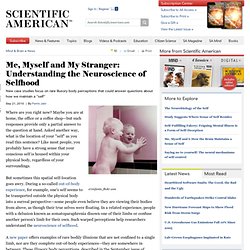
Maybe you are at home, the office or a coffee shop—but such responses provide only a partial answer to the question at hand. Asked another way, what is the location of your "self" as you read this sentence? Like most people, you probably have a strong sense that your conscious self is housed within your physical body, regardless of your surroundings. But sometimes this spatial self-location goes awry. How to increase serotonin in the human brain without drugs. How to increase serotonin in the human brain without drugs. BrainSCANr. The Whole Brain Atlas. Cognitive Atlas. Blue Brain Project.
The Dark Side of Oxytocin, the Hormone of Love - Ethnocentrism. VS Ramachandran on your mind. Jill Bolte Taylor's stroke of insight. Oliver Sacks: What hallucination reveals about our minds. Gero Miesenboeck reengineers a brain. Keith Barry does brain magic. Neuroscientists reveal magicians' secrets - Technology & science - Science - LiveScience. NEW YORK — There is a place for magic in science.
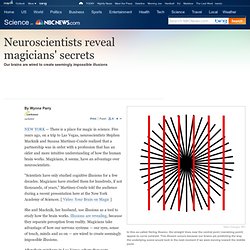
Five years ago, on a trip to Las Vegas, neuroscientists Stephen Macknik and Susana Martinez-Conde realized that a partnership was in order with a profession that has an older and more intuitive understanding of how the human brain works. Magicians, it seems, have an advantage over neuroscientists. "Scientists have only studied cognitive illusions for a few decades. Scientists extract images directly from brain. Researchers from Japan's ATR Computational Neuroscience Laboratories have developed new brain analysis technology that can reconstruct the images inside a person's mind and display them on a computer monitor, it was announced on December 11.
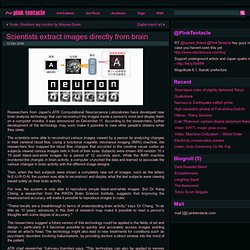
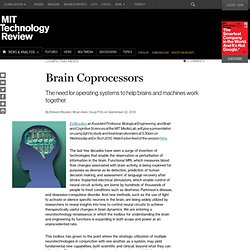
According to the researchers, further development of the technology may soon make it possible to view other people's dreams while they sleep. The scientists were able to reconstruct various images viewed by a person by analyzing changes in their cerebral blood flow. Using a functional magnetic resonance imaging (fMRI) machine, the researchers first mapped the blood flow changes that occurred in the cerebral visual cortex as subjects viewed various images held in front of their eyes. Subjects were shown 400 random 10 x 10 pixel black-and-white images for a period of 12 seconds each. Technology Review: Brain Coprocessors. Ed Boyden, an Assistant Professor, Biological Engineering, and Brain and Cognitive Sciences at the MIT Media Lab, will give a presentation on using light to study and treat brain disorders at 3.30pm on Wednesday at EmTech 2010.
Neuroscience of free will. Neuroscience of free will is the part of neurophilosophy that studies the interconnections between free will and neuroscience.
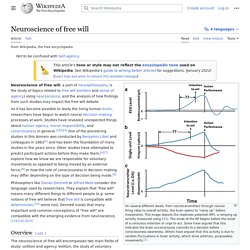
As it has become possible to study the living brain, researchers have begun to watch decision making processes at work. Findings could carry implications for our sense of agency and for moral responsibility and the role of consciousness in general.[1][2][3] Relevant findings include the pioneering study by Benjamin Libet and its subsequent redesigns; these studies were able to detect activity related to a decision to move, and the activity appears to begin briefly before people become conscious of it.[4] Other studies try to predict activity before overt action occurs.[5] Taken together, these various findings show that at least some actions - like moving a finger - are initiated unconsciously at first, and enter consciousness afterward.[6] A monk meditates. Overview[edit] Neuromarketing. Neuromarketing is a new field of marketing research that studies consumers' sensorimotor, cognitive, and affective response to marketing stimuli.
Researchers use technologies such as functional magnetic resonance imaging (fMRI) to measure changes in activity in parts of the brain, electroencephalography (EEG) and Steady state topography (SST) to measure activity in specific regional spectra of the brain response, and/or sensors to measure changes in one's physiological state, also known as biometrics, including (heart rate and respiratory rate, galvanic skin response) to learn why consumers make the decisions they do, and what part of the brain is telling them to do it. Neuromarketing research raised interest for both academic and business side. In fact, certain companies, particularly those with large-scale goals, have invested in their own laboratories, science personnel and / or partnerships with academia. [1]
Neuromarketing: Companies Use Neuroscience for Consumer Insights - Forbes.com. Where Brain Science and Marketing Meet. Transparent Corporation.