
Israeli Drone Feeds Hacked By British and American Intelligence. AMERICAN AND BRITISH INTELLIGENCE secretly tapped into live video feeds from Israeli drones and fighter jets, monitoring military operations in Gaza, watching for a potential strike against Iran, and keeping tabs on the drone technology Israel exports around the world.
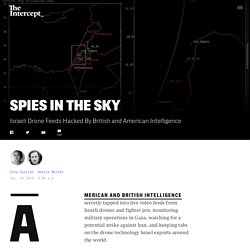
Under a classified program code-named “Anarchist,” the U.K.’s Government Communications Headquarters, or GCHQ, working with the National Security Agency, systematically targeted Israeli drones from a mountaintop on the Mediterranean island of Cyprus. GCHQ files provided by former NSA contractor Edward Snowden include a series of “Anarchist snapshots” — thumbnail images from videos recorded by drone cameras.
The files also show location data mapping the flight paths of the aircraft. In essence, U.S. and British agencies stole a bird’s-eye view from the drones. Several of the snapshots, a subset collected in 2009 and 2010, appear to show drones carrying missiles. OB298 — A Preliminary Atlas of Drone Strike Landscapes. It is difficult to describe a drone strike accurately.
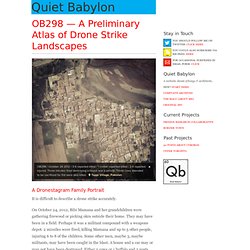
On October 24, 2012, Bibi Mamana and her grandchildren were gathering firewood or picking okra outside their home. They may have been in a field. Perhaps it was a militant compound with a weapons depot. 2 missiles were fired, killing Mamana and up to 5 other people, injuring 6 to 8 of the children. Some other men, maybe 3, maybe militants, may have been caught in the blast. Drones to patrol the skies above Olympic Stadium - Crime - UK. It is understood that the Metropolitan Police has taken part in discussions with the Civil Aviation Authority over whether they can use small radio controlled devices in heavily built-up areas, as part of efforts to increase their number of "eyes in the sky".

Next year's Olympics will be the largest security operation the Met has ever had to run, as tens of thousands of athletes and millions of spectators flock to the games in Stratford. The force's Air Support Unit already has three Eurocopter EC145 helicopters based at Lippitts Hill in Loughton, Essex. The aircraft are fitted with an array of high definition cameras and thermal imaging equipment, but officers believe small drones will give them the extra capacity to monitor multiple major events if needed.
The use of surveillance drones by Britain's police forces has had mixed results. Merseyside Police used a £13,000 helicopter drone fitted with surveillance cameras for four years. Drones Watch. The Future of Drone Warfare. Over half of Air Force UPT (undergraduate pilot training) grads are now assigned to pilot drones rather than a real aircraft.* The big question is why are drone pilots, guys that fly robots remotely from a computer terminal, going to a very expensive year of pilot training?

I can understand why the Air Force has chosen to send drone jockeys to pilot training: A shift to piloting drones rather than real aircraft is an assault on organizational culture of the Air Force. Ryan Calo: Ten Myths About Drones. Unmanned aerial vehicles (“UAVs”), often called “drones,” are coming to American skies.
In February, President Obama signed a law that requires the Federal Aviation Administration to pave the way for public agencies and, eventually, private companies, to fly drones within the United States. The proliferation of domestic drones has been preceded by a proliferation of news stories about the technology — and of some misconceptions regarding what drones are, and how they might be used. A law professor and a professor of electrical engineering, we’ve identified ten commonly held myths related to the technology and legal framework involved in drones and their use.
Surveillance drone industry plans PR effort to counter negative image. Companies seeking to enable the routine use of surveillance drones across Britain are planning a long-term public relations effort to counter the negative image of the controversial aircraft.

The Unmanned Aerial Vehicle Systems Association (UAVSA), a trade group that represents the drone industry to the UK government, has recommended drones deployed in Britain should be shown to "benefit mankind in general", be decorated with humanitarian-related advertisements, and be painted bright colours to distance them from those used in warzones, details from a UAVSA presentation show. A Swarm of Nano Quadrotors. The Drone Threat to National Security. Editor’s note: This is the first of a two-part series on security and privacy during the age of drone warfare.

Part two is available here. The year is 2020. Two Air Force officers sit in a darkened control center at an Air Force base in Nevada, carefully watching a bank of computer screens. The Drone Threat to Privacy. Editor’s note: This is the second of a two-part series on security and privacy during the age of drone warfare.
Part one is available here. Technology, as Supreme Court Justice Antonin Scalia wrote in a 2001 Supreme Court opinion, has the power "to shrink the realm of guaranteed privacy. " Teal Group Predicts Worldwide UAV Market Will Total Just Over $94 Billion. Details Published on Wednesday, 28 May 2008 08:38 Written by Tim Storey BERLIN, Germany, May 28, 2008 /PRNewswire/ -- Teal Group Corp. announced today at the ILA Berlin Air Show 2008 its revised figures for the Worldwide Mission Model survey of future space payloads.

The study encompasses 1,981 payloads proposed through 2008-2027. Global race on to match U.S. drone capabilities. Little is known about the actual abilities of the WJ-600 drone or the more than two dozen other Chinese models that were on display at Zhuhai in November. But the speed at which they have been developed highlights how U.S. military successes with drones have changed strategic thinking worldwide and spurred a global rush for unmanned aircraft. More than 50 countries have purchased surveillance drones, and many have started in-country development programs for armed versions because no nation is exporting weaponized drones beyond a handful of sales between the United States and its closest allies.
“This is the direction all aviation is going,” said Kenneth Anderson, a professor of law at American University who studies the legal questions surrounding the use of drones in warfare. “Everybody will wind up using this technology because it’s going to become the standard for many, many applications of what are now manned aircraft.” China on fast track. DIY Drones. Army Tracking Plan: Drones That Never Forget a Face. Perhaps the idea of spy drones already makes your nervous.
$230,000 For a Guard Dog: Why the Wealthy Are Afraid Of Violence From Below. July 29, 2011 | Like this article? Join our email list: Stay up to date with the latest headlines via email. “Violence in the streets, aimed at the wealthy. That’s what I worry about.” The Military Is About To Start Using Robotic Jellyfish For 'Surveying' Those drifting moon jellyfish at the aquarium may not seem like they have much purpose in life, but one group of researchers has been looking to make a jelly-inspired underwater robot that could go on search- and-rescue missions and survey for the military.
Now the team, funded by the U.S. Office of Naval Research, has created a silicon Robojelly that uses hydrogen and oxygen for fuel as it swims, so its only "exhaust" is heat and water. They published their findings March 20 in the journal Smart Materials and Structures. Robojelly's muscles are made of a shape-memory alloy, a metal invented by NASA that "remembers" its original shape. Personal recreation drones being developed. By Daily Mail Reporter Updated: 13:13 GMT, 8 November 2010.
Hackers Build Cheap Spy Drone that Rivals CIA Predator. August 10th, 2011 · 10 Comments Garage-built DIY drone plane can cause serious damage worldwideBy Erick Hansen. ElectriFly VFO EP ARF - Setup Techniques & Flying Tips. Aeryon Scout UAV in use with the Libyan Rebels. Danger Room. Aerial Vehicle Systems. Aeryon Small Unmanned Aerial Systems Why sUAS? Small Unmanned Aerial Systems (sUAS), also known as Unmanned Aerial Vehicles (UAV), provide immediate high-quality aerial intelligence. Aeryon sUAS are deployed in seconds in any weather environment and are easily controlled by ground personnel - for many applications, collection of aerial images and video from Aeryon sUAS is faster, safer, more accurate, and more cost-effective than satellites, manned aircraft, or ground-based alternatives.