
Google Image Result for. See-through church, Limburg/Belgium by Gijs Van Vaerenbergh. Project Details: Location: Limburg, Belgium Type: Cultural - Public Architects: Gijs Van Vaerenbergh - www.gijsvanvaerenbergh.com Photos: Kristof Vrancken / Z33 – Mine Daelemans photo by Kristof Vrancken / Z33 The church is a part of the Z-OUT project of Z33, house for contemporary art based in Hasselt, Belgium.
Z-OUT is an ambitious longterm art in public space project that will be realised on different locations in the Flemish region of Limburg over the next five years. photo by Kristof Vrancken The church is 10 meters high and is made of 100 layers and 2000 columns of steel. Online Architecture Degree. Online Architecture Degree & Education: If you want to study architecture online, read this article before you attempt to because unfortunately most articles written about available online architecture degrees are not up-to-date.
Many websites don’t update their sources, and many are deceiving. At last, advances in technology made it possible now to have a fully accredited online architecture degree. But, there is only one fully accredited online architecture degree available which will be accepted worldwide, especially in Canada and the United States. This degree is offered by a university which offers most of their courses through the internet while at the same time requiring students to work under the direct supervision of a registered architect in the local area. This is in addition to the traditional classroom design studio.
Studying architecture online can offer students the flexibility needed for such a demanding field. Distance Architecture Degree: Structure Of Tough Sea Urchin Spines May Inspire Engineers. February 16, 2012 A team of German scientists recently decoded the molecular structure of the unusually sturdy spines of sea urchins, a discovery that they believe could eventually prove useful in helping engineers construct stronger, more stable buildings.
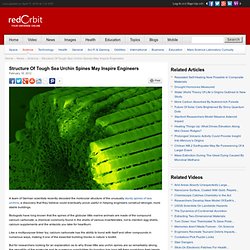
Biologists have long known that the spines of the globular little marine animals are made of the compound calcium carbonate, a chemical commonly found in the shells of various invertebrates, not to mention egg shells, calcium supplements and the antacids you take for heartburn. Like a multipurpose tinker toy, calcium carbonate has the ability to bond with itself and other compounds in numerous ways, making it one of the essential building blocks in nature´s toolkit. But for researchers looking for an explanation as to why those little sea urchin spines are so remarkably strong, the versatility of the molecule and its numerous possibilities for bonding has long left them scratching their heads. Image Caption: Inside a sea urchin spine. Wayfinding. Wayfinding is the organization and communication of our dynamic relationship to space and the environment.
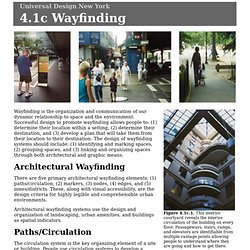
Successful design to promote wayfinding allows people to: (1) determine their location within a setting, (2) determine their destination, and (3) develop a plan that will take them from their location to their destination. The design of wayfinding systems should include: (1) identifying and marking spaces, (2) grouping spaces, and (3) linking and organizing spaces through both architectural and graphic means. Architectural Wayfinding. Wayfinding: Designing and Implementing Graphic Navigational Systems - Craig Berger.
The Wood Database. Emmanuelle moureaux architecture + design: sugamo shinkin bank shimura branch. Apr 26, 2011 emmanuelle moureaux architecture + design: sugamo shinkin bank shimura branch ‘sugamo shinkin bank’ by emmanuelle moureaux architecture + design, tokyo, japan images courtesy of emmanuelle moureaux architecture + design / nacasa & partners inc. japanese practice emmanuelle moureaux architecture + design has completed ‘sugamo shinkin bank’, a credit union located in shimura, japan. the design, an offset volume of rainbow-like layers, is the third branch designed by moureaux, with the first two located in tokiwadai and niiza. overall view stacked slabs in twelve saturated colors dominate the exterior facade and contrast the stark white panels that enclose the building. looking to create a refreshing atmosphere with a palpable sense of nature, the colors gently transition until they disappear into the sky. softly reflected onto the white surfaces, the hues create a warm and diffused exterior which provide a sense of ease and solitude.
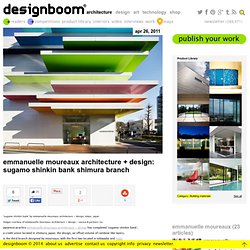
(left) entrance (right) detail. The Labyrinth. Home Repairs - 5min.com - Featured Today page2. Glow-in-the-dark mushroom rediscovered after 170 years. It's something you would never expect to go missing, but one of the world's brightest glow-in-the-dark mushrooms has been rediscovered after an absence of more than 170 years, according to USA Today. The bioluminescent shrooms had become a Brazilian legend of sorts. They were first spied in 1840 by an English botanist named George Gardner, who was alarmed after he saw some boys playing with a glowing object in the streets of Vila de Natividad, a village in the Goiás state in central Brazil. After that, no more sightings of the brightly glowing fungus had ever been reported. The mushroom was nearly forgotten until 2002, when Brazilian chemist Cassius Stevani came across Gardner's early reports. Then, in 2005, a breakthrough occurred. Izar and Fragaszy scooped up specimens and contacted Stevani, who later confirmed that the mushrooms were indeed Gardner's long lost species.
One thing researchers are certain of, however, is that these mushrooms are poisonous. CNC carpentry: the 'selfsupportingframework' Two students working on load-bearing systems in the architecture department at Kassel University, Mischa Proll and Andreas Günther, have taken advantage of the wide range of design techniques available and breathed new life into a one-hundred-year-old construction concept.
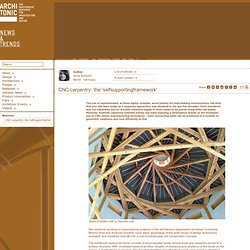
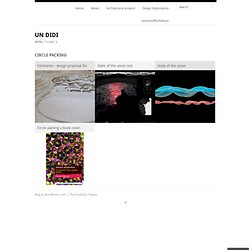
The traditional reziprocal frame consists of short wooden joists, whose ends are carpentry-joined to a surface structure. Beautiful Bathroom Ideas by Pearl Baths - new bathtub Ambrosia. Like this article? Share it: For beautiful bathroom ideas blend nature with minimalism, with the new Ambrosia bathtub by Pearl Baths, a division of popular bath staple Maax. Simple lines, sweet curves and a purist, plain palate of the bathtub, rustic flooring and natural water features are blended together to bring a sense of serenity to these beautiful bathrooms. While the modern Ambrosia bathtub is minimalist when it comes to looks, it maximizes indulgence with an array of five therapies. Garage Transformed into Beautiful Mini House - enpundit - StumbleUpon. Circle packing « un didi. Follow Get every new post delivered to your Inbox.
Join 50 other followers Powered by WordPress.com. Kokkugia. Architecture and design - StumbleUpon. - StumbleUpon.