
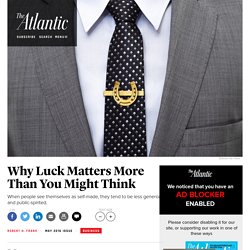
Luck Is a Bigger Contributor to Success Than People Give It Credit For. I’m a lucky man.
Perhaps the most extreme example of my considerable good fortune occurred one chilly Ithaca morning in November 2007, while I was playing tennis with my longtime friend and collaborator, the Cornell psychologist Tom Gilovich. He later told me that early in the second set, I complained of feeling nauseated. The next thing he knew, I was lying motionless on the court.
He yelled for someone to call 911, and then started pounding on my chest—something he’d seen many times in movies but had never been trained to do. What Do We Deserve? I often think of the good life I have.
By most common measures—say, type of work, income, health, leisure, and social status—I’m doing well. Despite the adage, “call no man happy until he is dead,” I wonder no less often: How much of my good life do I really deserve? Why me and not so many others? The dominant narrative has it that I was a bright student, worked harder than most, and competed fairly to gain admission to an Indian Institute of Technology, where my promise was recognized with financial aid from a U.S. university.
When I took a chance after graduate school and came to Silicon Valley, I was justly rewarded for my knowledge and labor with a measure of financial security and social status. The Boston bombing produces familiar and revealing reactions. ‘Lincoln’s Tragic Pragmatism,’ by John Burt. The Constitution: That Delicate Balance. Tip/Wag - Montpelier School District, TheAtlasphere.com & Florida Officials - The Colbert Report - 2013-23-01.
Alpha Dog of the Week - Virginia State Senate Republicans - The Colbert Report - 2013-23-01. LEOLR.png (PNG Image, 688 × 2614 pixels) Sam Harris: Science can answer moral questions. Jonathan Haidt: How common threats can make common (political) ground. Lawrence Lessig: We the People, and the Republic we must reclaim. Realtime Political Fact-Checking Becomes A Reality With WaPo’s ‘Truth Teller’ We are coming closer to a reality where no politician can ever spread well-known lies.

Today, exclusively with TechCrunch, The Washington Post has announced a fully automated fact-checking program, Truth Teller, that displays “TRUE” or “FALSE” in real time next to video of politicians and pundits as they speak. Given the fact that almost one-fifth of registered voters still believe Obama is a Muslim, a tool to curb widespread myths could benefit our democracy. Blame. The Brain on Trial. Advances in brain science are calling into question the volition behind many criminal acts.
Just Asking - David Foster Wallace. Are some things still worth dying for?
Is the American idea* one such thing? Business school and ethics: Can we train MBAs to do the right thing? Photograph by iStockphoto/Thinkstock.

A few years ago, Israeli game theorist Ariel Rubinstein got the idea of examining how the tools of economic science affected the judgment and empathy of his undergraduate students at Tel Aviv University. He made each student the CEO of a struggling hypothetical company, and tasked them with deciding how many employees to lay off. Some students were given an algebraic equation that expressed profits as a function of the number of employees on the payroll. Others were given a table listing the number of employees in one column and corresponding profits in the other. Simply presenting the layoff/profits data in a different format had a surprisingly strong effect on students’ choices—fewer than half of the “table” students chose to fire as many workers as was necessary to maximize profits, whereas three quarters of the “equation” students chose the profit-maximizing level of pink slips.
These acts are all done, by and large, unthinkingly.
Guns. Morgan Harris - Philip Zimbardo: Why ordinary people do evil ... or do good. Morality. Fables of Wealth. Three Minute Philosophy - Immanuel Kant. Frans de Waal: Moral behavior in animals. Three Minute Philosophy: Plato. John Lennon - Imagine. Morgan Harris - RSA Animate - The Power of Outrospection. Collected Quotations Of The Dread Pirate Roberts, Founder Of Underground Drug Site Silk Road And Radical Libertarian. 'The Honest Truth' About Why We Lie, Cheat And Steal. Chances are, you're a liar.
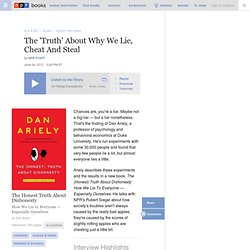
Maybe not a big liar — but a liar nonetheless. That's the finding of Dan Ariely, a professor of psychology and behavioral economics at Duke University. He's run experiments with some 30,000 people and found that very few people lie a lot, but almost everyone lies a little. Ariely describes these experiments and the results in a new book, The (Honest) Truth About Dishonesty: How We Lie To Everyone — Especially Ourselves. He talks with NPR's Robert Siegel about how society's troubles aren't always caused by the really bad apples; they're caused by the scores of slightly rotting apples who are cheating just a little bit.
Interview Highlights On the traditional, cost/benefit theory of dishonesty "The standard view is a cost/benefit view. On why the cost/benefit theory is flawed. Gaming The Games: The Rules That Got Bent In London : The Torch. Hide captionCameron van der Burgh of South Africa celebrates his gold medal in the men's 100m breaststroke.
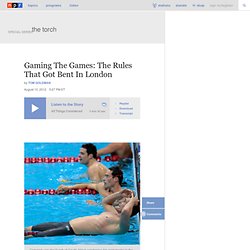
He later admitted that he took extra dolphin kicks during his swim, a violation of the rules. Adam Pretty/Getty Images Cameron van der Burgh of South Africa celebrates his gold medal in the men's 100m breaststroke. He later admitted that he took extra dolphin kicks during his swim, a violation of the rules. The London Summer Olympics are winding down, and by most accounts, the games have been a success. Mr. Fibb - The Daily Show with Jon Stewart - 01/15/13. Justice with Michael Sandel - Online Harvard Course Exploring Justice, Equality, Democracy, and Citizenship. Michael Sandel - The Colbert Report - 2012-25-04. Justice. Catharsis In A Cape: On Comic-Book Heroes And Real-World Violence : Monkey See. Red Dead Redemption (X360) Game Script by Shotgunnova. Grand Theft Auto IV (PS3) Game Script (Explicit Language) by InfernoSD. When Crime Pays: Prison Can Teach Some To Be Better Criminals. Hide captionPrison provides an opportunity for networking with more seasoned criminals. iStockphoto.com Prison provides an opportunity for networking with more seasoned criminals.
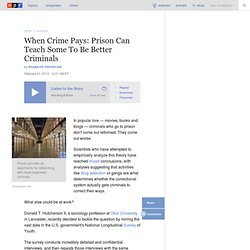
In popular lore — movies, books and blogs — criminals who go to prison don't come out reformed. They come out worse. Scientists who have attempted to empirically analyze this theory have reached mixed conclusions, with analyses suggesting that activities like drug addiction or gangs are what determines whether the correctional system actually gets criminals to correct their ways.