
Psychologie de la forme. Un article de Wikipédia, l'encyclopédie libre.
La théorie gestaltiste a été proposée au début du XXe siècle, notamment par Christian von Ehrenfels, et se base sur plusieurs postulats. Premièrement, les activités psychiques ont lieu dans un système complexe et ouvert, dans lequel chaque système partiel est déterminé par sa relation à ses méta-systèmes. Deuxièmement, un système est conçu dans la théorie gestaltiste comme une unité dynamique définie par les relations entre ses éléments psychologiques. Motivation. Un article de Wikipédia, l'encyclopédie libre.
La motivation est, dans un organisme vivant, la composante ou le processus qui règle son engagement pour une activité précise. Elle en détermine le déclenchement dans une certaine direction avec l'intensité souhaitée et en assure la prolongation jusqu'à l'aboutissement ou l'interruption. Intelligence émotionnelle.
L'intelligence émotionnelle (IE) est un concept proposé en 1990 par les psychologues Peter Salovey et John Mayer, qui réfère à la capacité de reconnaître, comprendre et maîtriser ses propres émotions et à composer avec les émotions des autres personnes.[1] Elle est proche du concept d'intelligence sociale.
The Problem of Perception. First published Tue Mar 8, 2005; substantive revision Fri Feb 4, 2011 Sense-perception—the awareness or apprehension of things by sight, hearing, touch, smell and taste—has long been a preoccupation of philosophers.
One pervasive and traditional problem, sometimes called “the problem of perception”, is created by the phenomena of perceptual illusion and hallucination: if these kinds of error are possible, how can perception be what it intuitively seems to be, a direct and immediate access to reality? The present entry is about how these possibilities of error challenge the intelligibility of the phenomenon of perception, and how the major theories of perception in the last century are best understood as responses to this challenge. 1.
Cognitive bias. Systematic pattern of deviation from norm or rationality in judgment Although it may seem like such misperceptions would be aberrations, biases can help humans find commonalities and shortcuts to assist in the navigation of common situations in life.[5] Some cognitive biases are presumably adaptive.
Cognitive biases may lead to more effective actions in a given context.[6] Furthermore, allowing cognitive biases enables faster decisions which can be desirable when timeliness is more valuable than accuracy, as illustrated in heuristics.[7] Other cognitive biases are a "by-product" of human processing limitations,[1] resulting from a lack of appropriate mental mechanisms (bounded rationality), impact of individual's constitution and biological state (see embodied cognition), or simply from a limited capacity for information processing.[8][9] Overview[edit] The "Linda Problem" illustrates the representativeness heuristic (Tversky & Kahneman, 1983[14]). List of cognitive biases. Systematic patterns of deviation from norm or rationality in judgment Cognitive biases are systematic patterns of deviation from norm and/or rationality in judgment. They are often studied in psychology, sociology and behavioral economics.[1]
How to Hack Your Brain. How we change what others think, believe, feel and do. 70 Reminders to Help You Break Any Barrier. I am pleased to introduce this guest article by a new friend John, the creator of HiLife2B, where he hopes to inspire people and to help them achieve their dreams.
Follow him on Twitter: @janyasor 1. Believe that even the smallest compliment can save someone’s life 2. Remember that one person can change an entire nation 3. 4. 5. 6. 7. 8. How Your Brain Corrupts Your Shopping Choices.
Maslow's hierarchy of needs. Maslow's hierarchy of needs, represented as a pyramid with the more basic needs at the bottom[1] Maslow's hierarchy of needs is a theory in psychology proposed by Abraham Maslow in his 1943 paper "A Theory of Human Motivation" in Psychological Review.[2] Maslow subsequently extended the idea to include his observations of humans' innate curiosity.
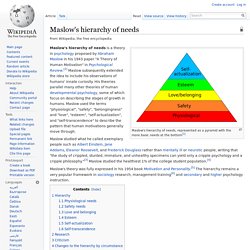
His theories parallel many other theories of human developmental psychology, some of which focus on describing the stages of growth in humans. Maslow used the terms "physiological", "safety", "belongingness" and "love", "esteem", "self-actualization", and "self-transcendence" to describe the pattern that human motivations generally move through. "Science and the taboo of psi" with Dean Radin. Carl Gustav Jung. Carl Jung Resources for Home Study and Practice.
Jung Carl Gustav - Site d'information et de ressources jungiennes cgjung.net. Carl Jung on Richard Wilhelm - School of Wisdom. I first met Richard Wilhelm at Count Keyserling's during a meeting of the "School of Wisdom" in Darmstadt.
That was in the early twenties. In 1923 we invited him to Zurich and he spoke on the I Ching (or Yi Jing) at the Psychology Club. Even before meeting him I had been interested in Oriental philosophy, and around 1920 had begun experimenting with the I Ching. One summer in Bollingen I resolved to make an all-out attack on the riddle of this book. Psychology studies relevant to everyday life from PsyBlog. Imagination active. Modality effect. The modality effect is a term used in experimental psychology, most often in the fields dealing with memory and learning, to refer to how learner performance depends on the presentation mode of studied items.

Description[edit] For serial recall, the modality effect is seen in an increased memory span for auditorally presented lists. Memory span is defined as the maximum number of items that participants correctly recall in 50% of trials. Typically, studies find these to be seven digits, six letters and five words.[3] In a study done by Drewnowski and Murdock, a visual list of English words was found to have an immediate recall of 4.82 words while an auditory representation of this same list led to a memory span of 5.36, a statistically significant variance.[4] Some studies use the term modality to refer to a general difference in performance based upon the mode of presentation.
Several terms have been used to refer to the modality effect on recency. A Better Way to Practice. Psychology Classroom at AllPsych Online. Annuaire de la psychologie et du coaching. Si vous vous sentez suicidaire, lisez-ceci. Si vous vous sentez suicidaire, arrêtez-vous pour lire ce qui suit.
Cela ne vous prendra que cinq minutes. Je ne veux pas vous dissuader de la réalité de votre souffrance. Je ne vous parlerai ici que comme quelqu'un qui sait ce que souffrir veut dire. Je ne sais pas qui vous êtes, ni pourquoi vous lisez cette page. Je sais seulement qu'en ce moment, vous la lisez, et c'est déjà une bonne chose. Psychology Wiki. PSYCHO-TEXTES: Bibliothèque de Psychologie. Consciousness. The Mind vs. Brain Debate (What is Consciousness?) Couteau de Lichtenberg. Un article de Wikipédia, l'encyclopédie libre. Paradoxe[modifier | modifier le code] La formule contient un paradoxe, car un couteau ne saurait se composer d'autre chose que d'une lame et d'un manche. Par conséquent, si les deux manquent, il ne reste plus rien que l'on puisse appeler couteau, si ce n'est le néant. Irrationalité[modifier | modifier le code] La locution ou la formule complète sont souvent utilisées, depuis leur invention, pour commenter et désavouer des propositions qui peuvent paraître cohérentes au premier abord mais qui perdent toute substance rationnelle lorsqu'elles sont étudiées de près.
Vertu. Dynamical Psychology » Dynamical Psychology: An International, Interdisciplinary Journal of Complex Mental Processes. The Convergence of Our Consciousness, The Singularity. Current directions in Black Psychology. The Top 10 Psychology Studies of 2010. The end of 2010 fast approaches, and I'm thrilled to have been asked by the editors of Psychology Today to write about the Top 10 psychology studies of the year. I've focused on studies that I personally feel stand out, not only as examples of great science, but even more importantly, as examples of how the science of psychology can improve our lives.
Each study has a clear "take home" message, offering the reader an insight or a simple strategy they can use to reach their goals , strengthen their relationships, make better decisions, or become happier. If you extract the wisdom from these ten studies and apply them in your own life, 2011 just might be a very good year. 1) How to Break Bad Habits If you are trying to stop smoking , swearing, or chewing your nails, you have probably tried the strategy of distracting yourself - taking your mind off whatever it is you are trying not to do - to break the habit.
J. 2) How to Make Everything Seem Easier J. Why People Believe Invisible Agents Control the World. Souls, spirits, ghosts, gods, demons, angels, aliens, intelligent designers, government conspirators, and all manner of invisible agents with power and intention are believed to haunt our world and control our lives. Why? The answer has two parts, starting with the concept of “patternicity,” which I defined in my December 2008 column as the human tendency to find meaningful patterns in meaningless noise. Consider the face on Mars, the Virgin Mary on a grilled cheese sandwich, satanic messages in rock music. Psychology News, Videos, Reviews and Gossip - io9. Social psychology. Social Psychology Network. Face Research ⇒ Experiments about face and voice preferences. 10 Psychological States You've Never Heard Of — And When You Experienced Them. Top 10 Unethical Psychological Experiments - Top 10 Lists.
Humans Psychology is a relatively new science which gained popularity in the early 20th century with Wilhelm Wundt. In the zeal to learn about the human thought process and behavior, many early psychiatrists went too far with their experimentations, leading to stringent ethics codes and standards. Though these are highly unethical experiments, it should be mentioned that they did pave the way to induct our current ethical standards of experiments, and that should be seen as a positive. There is some crossover on this list with the Top 10 Evil Human Experiments.
Three items from that list are reproduced here (items 8, 9, and 10) for the sake of completeness. The Monster Study The Monster Study was a stuttering experiment on 22 orphan children in Davenport, Iowa, in 1939 conducted by Wendell Johnson at the University of Iowa. The Aversion Project. Famous Psychology Experiments.
Big Five (psychologie) Links to hundreds of Psychology studies running on the internet. Encyclopedia of Psychology - Psychology Websites. Being Defensive. Rasoir d'Hanlon. Un article de Wikipédia, l'encyclopédie libre. Le rasoir d'Hanlon s'énonce : « Ne jamais attribuer à la malveillance ce que la stupidité suffit à expliquer. » Metapsychology Online Reviews. Conny Méndez. Juana María de la Concepción Méndez Guzmán, más conocida como Conny Méndez, nació en Caracas (Venezuela) el 11 de abril de 1898 y falleció en Miami (Estados Unidos) el 26 de noviembre de 1979, fue una artista y maestra esotérica venezolana.