
Jacques Raillane sur Twitter : "@Lili_etc nos journalistes devraient faire ça, il me semble, non ?"... North Korea’s Real Lessons for Iran. ’S defense of his emerging nuclear deal with as a “once in a lifetime opportunity” reminds his critics of an earlier landmark agreement, intended to end the threat of a nuclear-armed .
Prime Minister Benjamin Netanyahu of Israel and others have argued that the eventual collapse of that agreement, resulting in North Korea’s building , proves that a deal with Tehran is a big mistake. Those of us who negotiated the North Korea deal know that important lessons can be learned from that experience. But they are not the ones based on the critics’ fundamental misreading of history.
Faced with the prospect of a hostile, nuclear-armed North Korea in 1994, the Clinton administration reached a deal that required the North to give up its weapons program in return for energy assistance, the lifting of sanctions and better relations with the United States. In the late 1990s, however, we caught the North Koreans cheating and, early in the George W. We failed to do that with North Korea.
Russia and Iran broaden the cooperation in the peaceful uses of atomic energy. 11.11.2014 14:57 | Communications Department of ROSATOM On November 11 in Moscow on the premises of the State Atomic Energy Corporation ROSATOM has been signed set of documents broadening the cooperation of Russia and Iran in the field of the peaceful use of atomic energy.
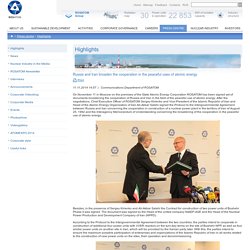
After the negotiations, Chief Executive Officer of ROSATOM Sergey Kirienko and Vice-President of the Islamic Republic of Iran and Head of the Atomic Energy Organization of Iran Ali-Akbar Salehi signed the Protocol to the Intergovernmental Agreement between Russia and Iran concerning the cooperation in construction of a nuclear power plant in the territory of Iran of August 25, 1992 and the Interagency Memorandum of Understanding concerning the broadening of the cooperation in the peaceful use of atomic energy. Besides, in the presence of Sergey Kirienko and Ali-Akbar Salehi the Contract for construction of two power units of Bushehr Phase II was signed. Nucléaire iranien : "L'accord répond à toutes les attentes occidentales"
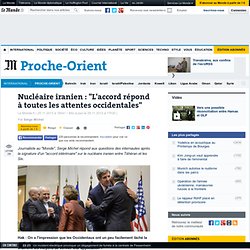
Le Monde.fr | • Mis à jour le | Par Serge Michel Journaliste au "Monde", Serge Michel répond aux questions des internautes après la signature d'un "accord intérimaire" sur le nucléaire iranien entre Téhéran et les Six.
Hak : On a l'impression que les Occidentaux ont un peu facilement lâché la partie. Iran insists on right to enrich, but not on others recognizing it. Top U.S. Intelligence Official: Iran Could Not Build Nuclear Bomb Without Being Detected. By Hayes Brown "Top U.S.

This Is What A Winning Negotiation With Iran Looks Like. By Joel Rubin "This Is What A Winning Negotiation With Iran Looks Like" Now is the right time for a nuclear deal that prevents an Iranian bomb.

We will not get all we want at the table with Iran — no negotiation ever sees one side get it all while the other gets nothing. And such a lopsided deal would only invite the loser to later cheat. The right kind of deal, however, would strengthen U.S. national security, increase regional stability in the Middle East and demonstrate that diplomacy — by using all aspects of American power — can secure core security objectives. Why Focus On Iran When It's North Korea That Has The Bomb? Iran is pursuing a nuclear program that clearly goes beyond peaceful, civilian purposes, though the U.S. intelligence community assesses that Tehran has not yet decided to build a bomb, only to have the capability to do so.
North Korea, on the other hand, has tested nuclear devices three times since 2006. So why do the United States and international community usually focus more attention on Iran than on North Korea? Two reasons explain this. First, the international community is more likely to affect Tehran’s calculus than Pyongyang’s. Putin: Iran's nuclear program peaceful. Russian President Vladimir Putin said on Tuesday he has no doubt that Iran is adhering to international commitments on nuclear non-proliferation while reiterating Moscow's opposition to Tehran developing a nuclear weapon.
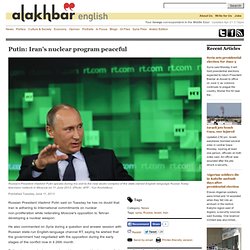
He also commented on Syria during a question and answer session with Russian state-run English-language channel RT, saying he wished that the government had negotiated with the opposition during the early stages of the conflict now in it 26th month. Putin, whose country is among six world powers seeking to ensure that Iran does not seek to develop nuclear weapons, also criticized Iran's threats to Israel. Iranian nuclear threat is ‘exaggerated,’ says Israel’s Olmert. Al Arabiya with Reuters Monday, 29 April 2013 Prime Minister Benjamin Netanyahu said on Monday Iran had not crossed the “red line” he set for its nuclear program, despite an assessment to the contrary by a former Israeli intelligence chief, Reuters reported.
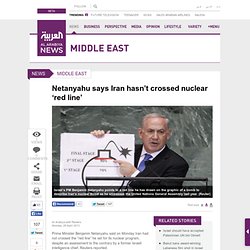
At the United Nations in September, Netanyahu drew a redline across a cartoon bomb to illustrate the point at which he said Iran will have amassed enough uranium at 20 percent fissile purity to fuel one nuclear bomb if enriched further. He saidt hen that Iran could reach that threshold by mid-2013. Last week, Amos Yadlin, a former chief of Israeli military intelligence, told a security conference in Tel Aviv that “the Iranians have crossed the red line” Netanyahu drew at the U.N. General Assembly. Iran - Nuclear issue (Q&A - Excerpt from the daily press briefing - 26.04.13) - France-Diplomatie - Pale Moon. Could a nuclear-armed Iran be contained?
On September 4, 1962, President John F.
Kennedy released a statement in response to intelligence reports of a Soviet arms buildup in Cuba. Kennedy said the United States did not have evidence "of the presence of offensive ground-to-ground missiles; or of other significant offensive capability either in Cuban hands or under Soviet direction and guidance. " However, he warned, "Were it to be otherwise, the gravest issues would arise. " Of course, the next month Kennedy found out that the Soviet Union was in fact deploying offensive missiles and nuclear warheads in Cuba, prompting a deep crisis that brought the planet within a hair's breadth of nuclear catastrophe. Historian Michael Dobbs writes that Kennedy later regretted making his September statement, as "[h]e was compelled to take action, not because Soviet missiles on Cuba appreciably changed the balance of military power, but because he feared looking weak.
" Fast forward 50 years to March 4, 2012. Cirincione : Bibi agrees that it would take ... - Pale Moon... The James Martin Center for Nonproliferation Studies (CNS) Senior Research Associate, Washington DC Office Activities Gaukhar Mukhatzhanova is a Senior Research Associate at the CNS Washington, DC office.
Areas of Research. Iran might let diplomats visit suspected nuclear site. IAEA Suspicious Of Iran's Parchin Military Base. The International Atomic Energy Agency believes Iran has something significant to hide at Parchin. The suspicion is that Iran used the site to test explosions involving uranium metal, which is used in developing a nuclear weapon. Talks with Iran on its controversial nuclear program are set to intensify in the coming days. Copyright © 2012 NPR. For personal, noncommercial use only. See Terms of Use. This is MORNING EDITION from NPR News. Six Ways to Measure Progress in the Iran Nuclear Talks. Iranian Nuclear Danger Not Immediate: Intel.
PrintShareEmailTwitterFacebookLinkedIn Iran possesses no nuclear armament, has not committed to constructing such a weapon and would likely require years to develop an atomic explosive transportable to a target, according to U.S., European and Israeli intelligence assessments reported by Reuters on Friday (see GSN, March 22). The findings -- described by acting and retired U.S. and European government insiders informed of intelligence on Iran -- differed sharply in tone from public discussions over potential Israeli military action aimed at curbing Iranian atomic activities, according to Reuters.
Tel Aviv and Western capitals all fear that Iran's atomic efforts might enable the Persian Gulf regional power to acquire a nuclear-weapon capability, but Tehran insists its nuclear ambitions have always been strictly nonmilitary in nature. The Middle Eastern nation is now operating no clandestine uranium enrichment facilities, according to assertions by present and past U.S. government insiders. L'Iran se dit prêt à négocier l'enrichissement d'uranium avec l'Occident. Le porte-parole de la diplomatie iranienne Ramin Mehmanparast a déclaré que Téhéran était prêt à faire preuve de souplesse pour apaiser l'inquiétude de la communauté internationale au sujet du programme nucléaire iranien et à mener des négociations sur l'enrichissement d'uranium, a annoncé samedi la chaîne de télévision iranienne Press TV.
Selon le porte-parole, ces négociations pourraient avoir lieu si Téhéran se voit garantir des livraisons d'uranium enrichi pour son programme nucléaire civil. Why Iran May Be Ready to Deal. "L'Iran ne cherche pas la bombe atomique" Crying wolf about an Iranian nuclear bomb. Carnegienpp : Iran expels Britain's amba... CIA arrests in Iran? Allegations point to smoldering covert war with US. A smoldering covert war pitting the United States against Iran took a new turn this week as Iranian officials announced the arrests of a dozen “CIA spies” they said were targeting the country’s nuclear program. Skip to next paragraph Subscribe Today to the Monitor Click Here for your FREE 30 DAYS ofThe Christian Science MonitorWeekly Digital Edition Iranian officials, including the country’s intelligence minister, did not release the identities or nationalities of the alleged spies, but intelligence analysts say they are probably Iranians working as informants for Western intelligence services.
NTI: Global Security Newswire - U.S. Should Accept Iran’s Latest Uranium Enrichment Offer, Experts Say. On Iran's Nuclear Program, Science Contradicts Rhetoric - Ali Vaez & Charles Ferguson - International. New data on the controversial program suggests it to be far milder than either Tehran or Washington portrays it to be Ali-Akbar Salegi, then Iranian Atomic Energy Chief and now Foreign Minister, speaks at a December 2010 ceremony to take delivery of locally produced yellowcake, a uranium concentrate powder, at a plant in Isfahan / Reuters September is a big month for Iran.
President Mahmoud Ahmadinejad will travel to the UN General Assembly meeting next week, Iran finally launched its long-delayed nuclear plant at Bushehr this week, and on September 2 the International Atomic Energy Agency, the UN's nuclear watchdog agency, published their quarterly report on the Iranian nuclear program. The latest report has fueled the usual rhetoric from Tehran and Washington, with each side interpreting it to suit their political agendas.
Iran Eats Nuclear Scientist Rezaie's Assassination as the Cost of Doing Business. The killing of the third Iranian scientist thought to be part of Iran’s nuclear program since 2009, in this case Darioush Rezaie, is most likely the work of either the CIA and Mossad. (Another suspicious incident occurred not long ago when a civilian aircraft crashed in Russia killing everyone on board, including several Russian nuclear scientists who worked in Iran for a time.) While it’s true that U.S. forces recently struck deep into Pakistan to attack bin Laden’s compound, in Rezaie’s case a Western security agency probably used a proxy. Likely candidates are Iranian opposition groups – and terrorists in their own right — the Mujahedin-e Khalk (MEK) or Jundallah. What’s especially intriguing, though, is how Iran responds to these events. At Reuters, Andrew Hammond reports: Afshon Ostovar, an Iran analyst based in Washington, accepts that How different from the United States, which, if a foreign nation engineered an attack on its soil, would be reeling around as if mortally wounded.
Iran urges Russia to launch Bushehr nuclear plant in "specified deadline" TEHRAN, July 24 (Xinhua) -- A senior Iranian lawmaker urged Russia to launch Bushehr nuclear power plant within the specified deadline, the English language satellite Press TV reported Sunday. The Islamic Republic will accept no excuses from Russia, if Moscow fails to launch Bushehr nuclear power plant within the specified deadline, Deputy Chairman of Foreign Policy and National Security Commission of Iran's Majlis (parliament) Hossein Ebrahimi said. "According to the contract, the Russian company is bound to fulfill its undertakings with respect to the completion and launch of the plant," Ebrahimi was quoted as saying on Saturday. "The Islamic Republic will no longer accept any ambiguity or justification (for delay) with regard to the launch of Bushehr nuclear plant, and nuclear-generated electricity should enter the grid at the specified time," he said.
The spokesman said Bushehr would start operating "in the nearest future," but the exact date of the launch was still unclear. Corralling Iran: New U.N. Report Confirms Nuclear Sanctions Are Working. Michael Oren: What If Gadhafi Had Gone Nuclear? Seized Sensitive Cargo Was Bound For Iran, Malaysia Says. Iran trying to buy nuclear missile parts: Norway. Clash over Iran's capability. Iranian Nuke Capability Seen in 2012-2013. PrintShareEmailTwitterFacebookLinkedIn Iran could in one to two years achieve a capability to produce nuclear armaments, the International Institute for Strategic Studies said in a report published today (see GSN, Feb. 2). Available information indicates "beyond reasonable doubt" that Tehran was pursuing the ability to establish a nuclear deterrent should it determine one is necessary, Reuters quoted the report, titled "Iran's Nuclear, Chemical and Biological capabilities," as saying.
The United States and Western powers have expressed concern that Iran's nuclear program is geared toward weapons development, but the Middle Eastern state has maintained it atomic intentions are strictly civilian in nature. Suggestions that Iran has pursued banned chemical or biological warfare programs "cannot be determined from the available public information and may have been exaggerated," the report says. The company "has never wished or intended to contravene any U.N. prohibition,” the statement adds.
Wisp of nuclear deal could slip away. Steps Toward a Deal on Enhanced Safeguards for Iran’s Nuclear Program. Charles D. Iran agrees to more nuclear talks in Istanbul - Laura Rozen. December 07, 2010. The Nuclear Vault: The Iranian Nuclear Program, 1974-1978 - Mozi. Washington, D.C., January 13, 2009 - During the 1970s the Shah of Iran argued, like current Iranian leaders today, for a nuclear energy capability on the basis of national "rights," while the Ford and Carter administrations worried about nuclear weapons possibilities, according to newly declassified documents published today by the National Security Archive for the first time. Nucléaire : Ce qu'attend l'Iran d'Obama. - Chroniques orientales. « Les négociations sur le nucléaire doivent se faire sans conditions préalables »
FAS: New FAS podcast highlights... Timeline of Iran's Nuclear Activities. Semira N. Nikou. Iran's Nuclear Program. Iran to Start Nuclear Plant Next Week. Iran Starts Fueling Bushehr Reactor. Iran Yet to Prove Peaceful Nuclear Intentions, IAEA Says. Iran Could Field Advanced Centrifuges, U.S. Official Warns. Iran could be making nuclear warhead, director of UN watchdog sa. Unfreeze for Unfreeze « Talking Warheads. Nucléaire iranien : le geste symbolique de Pékin.