
SEO Friendly WordPress in 12 Steps. SEO Friendly WordPress in 12 Steps. Internal Linking: You Must Guide the Little Spider. SEO Needs Regular Analysis and Optimisation. Why you should place regular analysis at the heart of your SEO In this article I will review the importance of regular analysis to help SEOs learn what is and isn’t working on their website, helping to inform optimisation and testing programs.

Why is regular analysis required? The world around us is forever changing which impacts online behaviour. The key reasons for this are: 1. This is driven by several factors, including social trends and fads. 15 Critical On-Page Optimization Factors for Sustainable SEO. SEO Theory. Are You Setting Up WordPress For SEO Success? The author's posts are entirely his or her own (excluding the unlikely event of hypnosis) and may not always reflect the views of Moz.
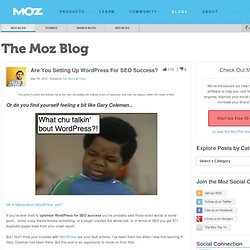
Or do you find yourself feeling a bit like Gary Coleman... He is talking about WordPress, yes? If you've ever tried to optimize WordPress for SEO success you've probably said those exact words at some point... some crazy theme breaks something, or a plugin crashes the whole site, or in terms of SEO you get 971 duplicate pages back from your crawl report. But I don't think your troubles with WordPress are your fault entirely. The New SEO Process (Quit Being Kanye) The author's posts are entirely his or her own (excluding the unlikely event of hypnosis) and may not always reflect the views of Moz.
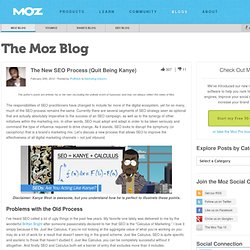
The responsibilities of SEO practitioners have changed to include far more of the digital ecosystem, yet for so many, much of the SEO process remains the same. Currently there are several segments of SEO strategy seen as optional that are actually absolutely imperative to the success of an SEO campaign, as well as to the synergy of other initiatives within the marketing mix. In other words, SEO must adopt and adapt in order to be taken seriously and command the type of influence required to drive change. As it stands, SEO looks to disrupt the symphony (or cacophony) that is a brand’s marketing mix. The Essential Guide to Meta Descriptions that Will Get You Found Online.
How to Design Your Blog for Awesome SEO. 8 Simple SEO Tricks That’ll Help You Rank Above the Fold and Increase Your CTR. Perfecting Keyword Targeting & On-Page Optimization for SEO. (Last Updated: October 24, 2014 by Rand) How do I build the perfectly optimized page?

This is a challenging question for many in the SEO and web marketing fields. There are hundreds of "best practices" lists for where to place keywords and how to do "on-page optimization," but as search engines have evolved and as other sources of traffic — social networks, referring links, email, blogs, etc. — have become more important and interconnected, the very nature of what's "optimal" is up for debate. My perspective is certainly not gospel, but it's informed by years of experience, testing, failure, and learning alongside a lot of metrics from Moz's phenomenal data science team. I don't think there's one absolute right way to optimize a page, but I do think I can share a lot about the architecture of how to target content and increase the likelihood that it will: larger version In the old days of SEO, "on-page optimization" referred merely to keyword placement.
Uniquely valuable Keyword-targeted. 301 Redirects and www/non-www Canonical Problems. There’s quite a bit of confusion over 301 redirects and how they effect SEO and a sites rankings.

I’ve extensively used permanent 301 redirects on both my own and SEO client sites and in this SEO tutorial I’ll explain how to use 301 redirects for a Linux Apache server and what you should expect SEO wise. I’ve NOT included a redirect tutorial for Windows Server 301 Redirects since they don’t use a .htaccess file like you use with Apache servers. Also note adding 301 redirects using a .htaccess file is not the only way to add 301 redirects for a website running under Linux, there’s PHP redirects and server side redirects added via Apache config files, so this is just one of a number of ways to solve the SEO problem of www and non-www canonical URLs.
First some basic information for those new to permanent redirects. A 301 or permanent redirect basically tells a browser (or search engine spider) that the site or page it is accessing has moved permanently. SEO Tutorials. Wake Up SEOs, the New Google is Here. The author's views are entirely his or her own (excluding the unlikely event of hypnosis) and may not always reflect the views of Moz.

I must admit that lately Google is the cause of my headaches. No, not just because it decided I was not going to be not provided with useful information about my sites. And neither because it is changing practically every tool I got used since my first days as an SEO (Google Analytics, Webmaster Tools, Gmail…). And, honestly, not only because it released a ravenous Panda. No, the real question that is causing my headaches is: What the hell does Google want to go with all these changes? The New SEO. Although the use of keywords on website pages and in the anchor text of inbound links remains important for SEO, search engines are increasingly using a site’s branding, visitor behavior and social data.

This is The New SEO, introduced here by Mark Nunney in an edited extract from his new book, SEO for Profit. Google's new Panda update has changed SEO and it appears to include user behavior and (possibly) branding data. But even if they aren’t considered at all by Panda, these factors are considered by Google's main algorithm. So you must consider them in your SEO planning. Videos/geo-targeting-sniper-technique. 16 Insights into Google's Rating Guidelines. Last week, when the SEO world was distracted by revelations that Google was blocking keyword referral data and nostalgic mania over MC Hammer’s search engine, Search Engine Land released a leaked Google document outlining Google's official guidelines for quality raters.

I read the 125-page document out of curiosity, and I decided to share some valuable insights it contains into the mind of Google. Sorry, No Secrets Here. URL Rewrites and 301 Redirects - How Does It All Work? URL rewrites and 301 redirects... you talk about them, you recommend them, but do you truly understand how they work?
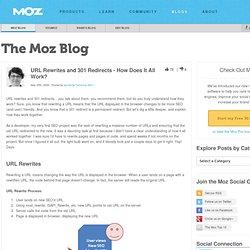
Sure, you know that rewriting a URL means that the URL displayed in the browser changes to be more SEO (and user) friendly. And you know that a 301 redirect is a permanent redirect. But let's dig a little deeper, and explain how they work together. As a developer, my very first SEO project was the task of rewriting a massive number of URLs and ensuring that the old URL redirected to the new. The Responsibilities of SEO Have Been Upgraded. The author's views are entirely his or her own (excluding the unlikely event of hypnosis) and may not always reflect the views of Moz.

When I started in the SEO field (circa 2003), the job responsibilities weren't easy, but the list was relatively small. Over the next 5 years, those responsibilities increased, but it was primarily in tactical and knowledge sorts of ways. A 2003 vs. 2008 rundown might look something like: (Notes on image above: There's some over-simplification in this list, and some items cross the artificial 2003 barrier a bit) The last 2.5 years, however, have made for some fairly substantive changes. Top 10 Negative Google News Ranking Factors. Last week, I released the results of a survey of Google News Ranking Factors with some of the top news SEOs in the business. While there has been plenty of response regarding the Top 10 Most Important Factors, I thought it would be helpful to take a closer look at the Top Negative Factors. In my work with local news publishers, I have seen many of them doing a lot of things which hurt their rankings. 1.
Duplicate Content Just as in traditional Web SEO, duplicate content was determined to be the biggest negative factor. Google is getting better at determining the original source of the content and degrading the rankings of the sites that “borrow” it. 2. This is a fancy way of saying headlines that don’t target specific high value keywords. If you can write a headline like that, then go for it, but everyone else should stick to “Spitzer Caught With Hooker”. 3. SEO Project Management Using Basecamp. Google's Secret Ranking Algorithm Exposed. Rankings Explained.
Any Questions? *click to enlarge* Last year, some people from the academic community who hadn’t been snatched up yet by Google or Bing did a really interesting study. Rather than simply researching factor correlations to rankings, as SEOMoz does a great job of doing every so often, they used machine learning techniques to create their own search engine, and trained it to reproduce results similar to Google. After the training process, they extracted the ranking factors from their trained engine and published them and presented on them at an industry conference.
How the Study was Done In their paper “How to Improve Your Google Ranking: Myths and Reality“, they detail what the actual weightings were for the various ranking factors. (5/1) What is the best boilerplate SEO strategy. Speeding up Your Website for SEO. Posted on April 28th, 2011 Faster is Better. My 1980 Honda CB750 with modifications for speed and style. Google apparently has begun looking at page speed/load times as a ranking factor in the search results. So if you want to stay competitive with your SEO, speeding up your site can help you keep a technical edge over your competition. Especially in the realm of local small businesses who’s websites I often find full of bloated redundant code and hosted on slower shared server environments. Improved load times also leads to happier site visitors who tend to stick around longer and view a few more pages of the site, potentially leading to higher conversion rates. Get Your Current Baseline Speed. (5/1) What is the best SEO secret that you know.