
Google. The Neuroscience Of Optimism - The Huffington Post. Ask a bride before walking down the aisle “How likely are you to get divorced?”
And most will respond “Not a chance!” Tell her that the average divorce rate is close to 50 percent, and ask again. How people become monsters ... or heroes. Behaviorism. Neuroscience. Madonna–whore complex. In sexual politics the view of women as either Madonnas or whores limits women's sexual expression, offering two mutually exclusive ways to construct a sexual identity.[4] The term is also used popularly, often with subtly different meanings.
Causes[edit] Freud argued that the Madonna–whore complex is caused by oedipal castration fears which arise when a man experiences the affection he once felt for his mother with women he now sexually desires. In order to manage this anxiety, the man categorizes women into two groups: women he can admire and women he finds sexually attractive. Whereas the man loves women in the former category, he despises and devalues the latter group.[5] Psychoanalyst Richard Tuch suggests that Freud offered at least one alternative explanation for the Madonna–whore complex: According to Freudian psychology, this complex often develops when the sufferer is raised by a cold and distant mother.
In popular culture[edit] See also[edit] References[edit] Notes Literature John A. Behaviourism. How to Detect Lies - body language, reactions, speech patterns. Personality Test Site. Perception puzzles, Visual Perception, Optical illusions and Paradoxes.
This page illustrates that our visual perception cannot always be trusted.

The components of an object can distort the perception of the complete object. Brain Teasers, Puzzles, Riddles, Trivia and Games. Optical Illusions and Visual Phenomena. Personality Test Site. Perception puzzles, Visual Perception, Optical illusions and Paradoxes. 10 Certified Fresh Psychological Thrillers. Color Psychology. By David Johnson.

Best Ways to Beat Depression Without Drugs. The Phobia List. How to Keep Bad Moods From Taking You Over. Photo by r.f.m II Well, it happens sometimes.
I find myself in a lousy mood. Hard to say where it started, but it certainly has something to do with not getting much sleep Saturday night. I had big plans for Sunday, but the day was compromised by my zombie state. Get Anyone to Like You – Instantly – Guaranteed. Get anyone to like you - Instantly - Guaranteed If you want people to like you, make them feel good about themselves.

This golden rule of friendship works every time - guaranteed! The principle is straightforward. If I meet you and make you feel good about yourself, you will like me and seek every opportunity to see me again to reconstitute the same good feeling you felt the first time we met. Unfortunately, this powerful technique is seldom used because we are continually focused on ourselves and not others. The simple communication techniques that follow will help you keep the focus of the conversation on the person you are talking to and make them feel good about themselves. The Big Three. Watch Free Documentaries Online. The Complexity of the Creative Personality. Researcher Mihaly Csikszentmihalyi includes in his books and other writings descriptions of the diversity and multiple characteristics of creative people.
In a post of hers, Juliet Bruce, Ph.D. notes that Mihaly Csikszentmihalyi (pronounced me-high chick-sent-me-high-ee) wrote, “If there is one word that makes creative people different from others, it is the word complexity. Instead of being an individual, they are a multitude.” “Like the color white that includes all colors, they tend to bring together the entire range of human possibilities within themselves. The free five minute personality test! Your Existing Situation "Is stubborn and strong-willed, once her mind is made up it is impossible to change it. she does not ask for much, so she feels when she does ask her needs should be met.
" Your Stress Sources. The Top 10 Psychology Studies of 2010. The end of 2010 fast approaches, and I'm thrilled to have been asked by the editors of Psychology Today to write about the Top 10 psychology studies of the year. I've focused on studies that I personally feel stand out, not only as examples of great science, but even more importantly, as examples of how the science of psychology can improve our lives. Each study has a clear "take home" message, offering the reader an insight or a simple strategy they can use to reach their goals , strengthen their relationships, make better decisions, or become happier. How to Detect Lies - body language, reactions, speech patterns. Body Language Basics - Syncrat Publishing. Throughout history it has been an advantage if an individual can read body language.
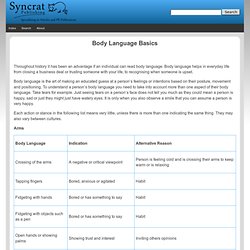
Body language helps in everyday life from closing a business deal or trusting someone with your life, to recognising when someone is upset. Body language is the art of making an educated guess at a person’s feelings or intentions based on their posture, movement and positioning. To understand a person’s body language you need to take into account more than one aspect of their body language. 10 Simple Postures That Boost Performance. Psychological research suggests simple actions can project power, persuade others, increase empathy, boost cognitive performance and more… We tend to think of body language as something that expresses our internal states to the outside world.
But it also works the other way around: the position of our body also influences our mind. As the following psychological research shows, how we move can drive both thoughts and feelings and this can boost performance. 1. 25 Acts of Body Language to Avoid. Our body language exhibits far more information about how we feel than it is possible to articulate verbally. All of the physical gestures we make are subconsciously interpreted by others. This can work for or against us depending on the kind of body language we use. Some gestures project a very positive message, while others do nothing but set a negative tone.
10 Psychological States Youve Never Heard Of & And When You Experienced Them - StumbleUpon. Science & Nature - Human Body and Mind - Body - Senses Challenge - StumbleUpon. Mind-blown from icanhasinternets.com - StumbleUpon. What Does Your Body Language Say About You? How To Read Signs and... - StumbleUpon.
Art by LaetitziaAs we all know, communication is essential in society. Advancements in technology have transformed the way that we correspond with others in the modern world. Because of the constant buzz in our technological world, it's easy to forget how important communicating face-to-face is. When conversing old-school style, it's not only speech we verbalize that matters, but what our nonverbal gestures articulate as well. Body language is truly a language of its own. Cravings1.jpg from freeformfitness.ca - StumbleUpon. Personality Test Site - StumbleUpon. Psychology studies relevant to everyday life from PsyBlog - StumbleUpon. Face Research & Psychology experiments about preferences for faces and... - StumbleUpon.
Discovering Psychology: Updated Edition. 1. Past, Present, and Promise This introduction presents psychology as a science at the crossroads of many fields of knowledge, from philosophy and anthropology to biochemistry and artificial intelligence. With Dr. Mahzarin Banaji of Harvard University and Dr. Emanuel Donchin of the University of Illinois. Personality Quiz. Identify a Lie with 6 Simple Questions. Post written by: Marc Chernoff Email. 5 Psychological Experiments That Prove Humanity is Doomed. Personality & Psychological Profiling Instruments. Lucid Dreaming/Using - Wikibooks, open books for an open world - StumbleUpon. Dream stabilization[edit] Psychological Profiling.
Watch Free Documentaries Online. What our language choices reveal about our personalities. In his new book, The Secret Life of Pronouns: What Our Words Say About Us , social psychologist James W.Pennebaker, chairman of the department of psychology at the University of Texas at Austin, looks at the hidden psychological messages our language choices reveal. Top 10 Sites to Help Develop Your Creative Side.