
Relativistic Electrostatics => Magnetism. The effects of magnetism follow from the fact that moving charges see current-carrying wires as charged, due to relativistic length contraction which upsets the wire's apparent charge balance.
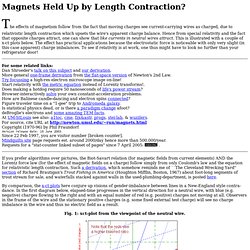
Hence from special relativity and the fact that opposite charges attract, one can show that like currents in neutral wires attract. This is illustrated with a couple of x-ct plots below. The effect has practical applications because the electrostatic force is noticeable with only very slight (in this case apparent) charge imbalances. To see if relativity is at work, one thus might have to look no further than your refrigerator door!
For some related links: Dan Shroeder's talk on this subject and our derivation. If you prefer algorithms over pictures, the Biot-Savart relation (for magnetic fields from current elements) AND the Lorentz force law (for the effect of magnetic fields on a charge) follow simply from only Coulomb's law and the equation for relativistic length contraction. Lanl.arxiv.org e-Print archive mirror. Bell's Theorem. Click here to go to the Physics Virtual Bookshelf In 1975 Stapp called Bell's Theorem "the most profound discovery of science.
" Note that he says science, not physics. Quantum Entanglement and Information. First published Mon Aug 13, 2001; substantive revision Thu Aug 26, 2010 Quantum entanglement is a physical resource, like energy, associated with the peculiar nonclassical correlations that are possible between separated quantum systems.

Entanglement can be measured, transformed, and purified. A pair of quantum systems in an entangled state can be used as a quantum information channel to perform computational and cryptographic tasks that are impossible for classical systems. The general study of the information-processing capabilities of quantum systems is the subject of quantum information theory. 1. In 1935 and 1936, Schrödinger published a two-part article in the Proceedings of the Cambridge Philosophical Society in which he discussed and extended a remarkable argument by Einstein, Podolsky, and Rosen. Bell Theorem. This make no sense.
If you had the objective facts, you will not need induction. It will be deductive and you will never have a probability other than 0 or 1. A question about nonlocality. It sounds to me as if he was just using "metaphysical" to talk about the idea that the outcome of each measurement is determined by preexisting hidden variables--if the variables are assumed to be "hidden" then this isn't really an ordinary physical hypothesis, so one can call it metaphysical.
What do you mean by "mathematical properties that are not easy to imagine"? Experimental Basis of Special Relativity. Physics is an experimental science, and as such the experimental basis for any physical theory is extremely important.
The relationship between theory and experiments in modern science is a multi-edged sword: It is required that the theory not be refuted by any undisputed experiment within the theory's domain of applicability. It is expected that the theory be confirmed by a number of experiments that: cover a significant fraction of the theory's domain of applicability. examine a significant fraction of the theory's predictions. At present, Special Relativity (SR) meets all of these requirements and expectations. There are literally hundreds of experiments that have tested SR, with an enormous range and diversity, and the agreement between theory and experiment is excellent. Radius of a black hole. George Jones has probably already answered the question but here's a few equations that you might find of interest- In all cases a=J/mc and M=Gm/c2 Horizon to crunch distance for an object falling radially from rest at infinity (rain frame) for a static black hole- \tau_{rain}(2M \rightarrow 0)=\frac{4}{3}M.
The Rindler Horizon. Gravitational Time Dilation. Click here to go to the UPSCALE home page.Click here to go to the JPU200Y home page.Click here to go to the Physics Virtual Bookshelf.
Author This document was written in February 2002 by David M. Harrison, Dept. of Physics, Univ. of Toronto, mailto:harrison@physics.utoronto.ca. This document is Copyright © 2002 David M. Relativistic Velocities. [Physics FAQ] - [Copyright] Updated by Terence Tao 1997.
Original by Philip Gibbs 1996. Suppose an object A is moving with a velocity v relative to an object B, and B is moving with a velocity u (in the same direction) relative to an object C. Mass increase at relativistic speeds. Britney Spears' Guide to Semiconductor Physics - Lasers and Optoelectronics. AC Circuits. Alternating current Direct current (DC) circuits involve current flowing in one direction.
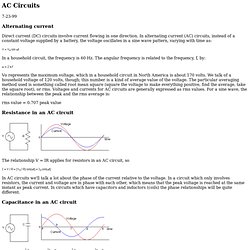
In alternating current (AC) circuits, instead of a constant voltage supplied by a battery, the voltage oscillates in a sine wave pattern, varying with time as: In a household circuit, the frequency is 60 Hz. The angular frequency is related to the frequency, f, by: Vo represents the maximum voltage, which in a household circuit in North America is about 170 volts. Rms value = 0.707 peak value Resistance in an AC circuit The relationship V = IR applies for resistors in an AC circuit, so In AC circuits we'll talk a lot about the phase of the current relative to the voltage.
Capacitance in an AC circuit.