
Tap Water Database 2009. New Report: Unregulated Contaminants Common In Drinking Water. Traces of 18 unregulated chemicals were found in drinking water from more than one-third of U.S. water utilities in a nationwide sampling, according to new, unpublished research by federal scientists.
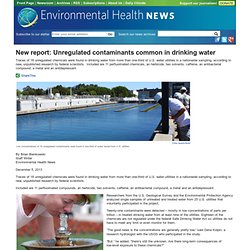
Included are 11 perfluorinated chemicals, an herbicide, two solvents, caffeine, an antibacterial compound, a metal and an antidepressant. ShareThis By Brian Bienkowski Staff Writer Environmental Health News December 5, 2013 Traces of 18 unregulated chemicals were found in drinking water from more than one-third of U.S. water utilities in a nationwide sampling, according to new, unpublished research by federal scientists.
Included are 11 perfluorinated compounds, an herbicide, two solvents, caffeine, an antibacterial compound, a metal and an antidepressant. Researchers from the U.S. Local Drinking Water Information. Jump to main content or area navigation.
Filtering Water. Protecting Springs: Alternative To Spring Boxes (PDF) Protecting Water Supply Springs. DIY Water Pumps & Wells. DIY Water Projects - Catching It, Saving It, Treating It ... Water Procurement & Purification Methods. 24 Purification Methods. Add A DIY Faucet To Any Plastic Tank Or Barrel. To make the hole at the bottom of the tank, you can use a hole saw that is the same diameter as the threaded portion of the male adapter.
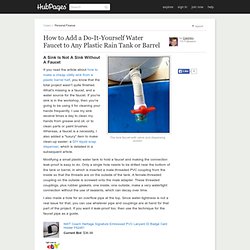
A spade bit would work as well. Try to make the hole just slightly smaller than the PVC coupling so that the adapter threads into the hole. Doing so, will increase your chances for a tighter seal. Next, you have to make two gaskets. The first one you slip over the male threads before placing the coupling into the hole from inside of the tank. At this point it would be helpful to have a third hand, but it's not absolutely necessary. Use PVC cement on both the male and female threads. If you don't have PVC cement or it's just not working for you, then you might be able to get a watertight seal on the coupling threads using plumbers putty or teflon tape.
DIY Utility Sink From A Plastic Barrel Half. Cutting the curve on the coupling is the trickiest part of the whole project.
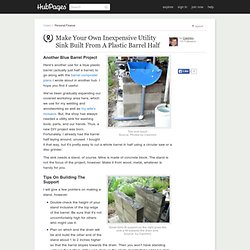
You could do it with a saw if you clamp the piece in a good vise, but I chose to use the coarse wheel on my bench grinder to carve away the coupling above the line. This method proved to be quick and easy, but if you do it this way be sure to wear safety goggles and a filter mask as it does create fumes and little bits of plastic. You'll notice that I also carved out a flat "key" on one side of the coupling. In hindsight, I don't think this is necessary. I was trying to give the drain a little resistance to turning in the socket, but by the time I'm done describing this project you'll see why it's probably not needed. The WaterWheel — Wello Water. In September 2011, the Wello team arrived in India with the goal of answering one big question: “How might we improve the experience of collecting, storing, and using water?”
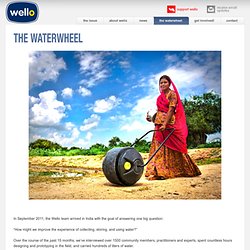
Over the course of the past 15 months, we’ve interviewed over 1500 community members, practitioners and experts, spent countless hours designing and prototyping in the field, and carried hundreds of liters of water. We developed a wide range of concepts and designs in collaboration with the WaterWheel’s intended users, identified the features that were most important to them, and developed a prototype. We’re thrilled to introduce you to the WaterWheel 2.0! It’s…CONVENIENT. It’s…HYGIENIC The WaterWheel’s cap-in-cap design prevents recontamination at the point of use. It’s…HIGH QUALITY. It’s..AESTHETICALLY PLEASING. AND it’s…AFFORDABLE.
Survival: Emergency Water. Dew Collection For Survival Water. Besides air, water is of primary importance if you hope to stay alive longer than a few days in a survival situation.
Natural Swimming Pools & Ponds: About. How To Make A Natural Swimming Pond. Homemade pH Indicator – DIY Experiments. Abstract Make your own homemade pH indicator!
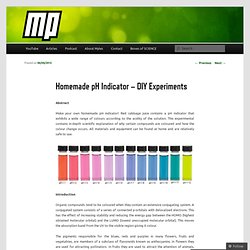
Red cabbage juice contains a pH indicator that exhibits a wide range of colours according to the acidity of the solution. This experimental contains in-depth scientific explanation of why certain compounds are coloured and how the colour change occurs. All materials and equipment can be found at home and are relatively safe to use. Introduction Organic compounds tend to be coloured when they contain an extensive conjugating system. The pigments responsible for the blues, reds and purples in many flowers, fruits and vegetables, are members of a subclass of flavonoids known as anthocyanins. Red cabbage contains one of these colour changing compounds and can be easily extracted using the following equipment. Materials and Equipment Red cabbageknifeboiling waterLarge bowlpipetsmall glasses (shot glasses are perfect)Samples to test Experimental Procedure.
Free Books: Water Sanitation Books. Soil & Water Conservation Society. Understanding Wild Water. Understanding and Working with Wilderness Water Systems Summary:Understanding how nature processes and reuses "wastes" is a prerequisite not only to camping responsibly, but to designing any ecological wastewater system.
This article will benefit anyone who spends much time outdoors. An understanding of these principles ideally would be required of anyone who designs water or wastewater systems. An article which includes: Natural purification and water cycle primer Low impact, effective wilderness washing techniques for dishes, hands, body & hair, clothes & equipment How to wash with materials available in nature Information on which cleaners can be used directly in a river or lake How and where to responsibly dispose of biodegradable cleaners near streams, creeks, lakes or the ocean List of suggested biocompatible and biodegradable cleaners, focusing on natural cleaners available in the wilderness.
All files have a 30 day unconditional money back guarantee. Water Resources Of The U.S. - Geological Survey. Water is one of seven science mission areas of the U.S.
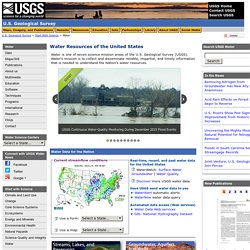
Geological Survey (USGS). Water's mission is to collect and disseminate reliable, impartial, and timely information that is needed to understand the Nation's water resources. USGS Continuous Water-Quality Monitoring During December 2015 Flood Events. Water Topics: Clemson University. Water. Distilled Water How-to.