
www.toutalego.com/2014/08/le-brevet-de-feminisme-ou-le-mythe-de.html?spref=tw. Quand on se déclare féministe (ce qui n’est toujours pas simple en 2014), c’est un peu la double peine : il y a ceux qui vous traitent immédiatement d’hystérique/de poilue/de mal-baisée.
Et ceux qui vous déclarent mauvaise féministe. Enfin, je devrais écrire « celles » car très souvent, d'après ma propre expérience, cette accusation émanait de femmes. Les féministes aiment-elles le sexe ? Pourquoi nous ne pouvons pas attendre. L’un de vos arguments fondamentaux est que notre action se produit à un mauvais moment.
Certains ont demandé : « Pourquoi ne pas avoir donné aux nouveaux élus le temps d’agir ? Du communautarisme des minorités. Je lisais quelqu'un expliquer doctement qu'il ne fallait pas que les musulmans tombent dans le communautarisme et que la France n'avait "jamais laissé s'installer un communautarisme très fort" (oh la menace !
). Ayant en même temps découvert ce texte, c'est vous dire que j'étais d'excellente humeur. Le communautarisme. Ce mot inventé par un groupe dominant pour qualifier les initiatives de rassemblement des minorités. I was a Teenage Sexist. Editor’s Note: This post originally contained a screen-grab of the repellent game Beat Up Anita Sarkeesian.
We have since removed the disturbing image, and we apologize for not alerting our readers to graphic content in advance. I raised my hand. Professor Wiman nodded at me. Non-feminist 'more hostile' towards men than feminists, study finds. By Jess McCabe // 31 July 2009, 17:26 One of the hoary stereotypes about feminists is that we are 'man-haters'.
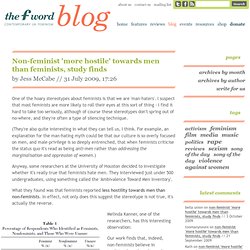
I suspect that most feminists are more likely to roll their eyes at this sort of thing - I find it hard to take too seriously, although of course these stereotypes don't spring out of no-where, and they're often a type of silencing technique. (They're also quite interesting in what they can tell us, I think. How Most Things You Know About Feminists Are Vicious Conservative Lies. Given the mission of feminism, people (men and women alike) who are invested and conditioned to keep sexism and patriarchy alive have fought to distort feminism for the public.
Conservatives have done a very effective job of making feminism a “dirty word” so that many women and almost all men do not want to say they’re a feminist regardless if they agree with feminism or not. They’ve kept people so focused on trying to not be a feminist so we don’t see all the sexist policies the conservatives are pushing. Here are a few popular quotes from popular conservative leaders: “Feminism was established to allow unattractive women easier access to the mainstream.” – conservative radio host Rush Limbaugh Feminism “encourages women to leave their husbands, kill their children, practice witchcraft, destroy capitalism and become lesbians” - television evangelist Pat Robertson.
Plaidoyer pour l’extrémisme. S’il y a bien une chose qui m’énerve dans les discussions que je peux avoir ou dont je suis témoin, ce sont les manœuvres d’évitement.
Man haters? Last week, 16-year-old Alice Dunn wrote a blog for the Independent asking "Can feminism survive the next generation?
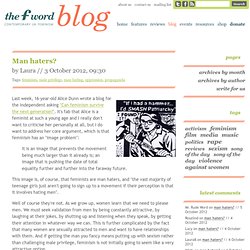
". [French] 15 mauvaises raisons de ne pas être féministe. Publié initialement le 23 juillet 2011 Parce que parfois, on a l’impression que tous les prétextes sont bons… « Je ne suis pas d’accord avec les féministes » Sauf si tu es contre les droits des femmes, ça va être compliqué de ne pas être d’accord avec les féministes, tout simplement parce que leurs positions sont incroyablement variées. That Is Not Feminism. The Art of Mansplaining. You May Be A Mansplainer If… – Thus Spake Zuska. Mansplaining.
We’ve all had to endure it, on the internets or IRL, so frequently we are often overwhelmed with the desire to hork up serious chunks on the mansplainer’s shoes. And yet, you can’t always do that. Maybe the mansplainer is your boss. Maybe he’s mansplaining on your blog or your Facebook page, and you just can’t get at his shoes. What to do? First, some clarification. [French] Bingo féministe et “mansplaining”
Hier, Sophie Gourion, une féministe que j’apprécie et que je suis sur Twitter, a eu un long débat à propos du marketing genré. Elle a écrit, il y a quelques mois, un article pour Slate sur cette stratégie "qui consiste à segmenter l’offre produit en fonction du sexe","une façon indirecte de démultiplier les intentions d’achat, deux produits sexués devant ainsi se substituer à un seul produit mixte au sein d’un ménage". Une des personnes avec qui elle discutait n’y voyait pas de sexisme et, surtout, pas un sujet de préoccupation pour les féministes; d’où ce tweet (écrit par un homme): @Sophie_Gourion le vrai combat du féminisme est dans l’égalité des droits, pas dans l’uniformité des produits ni de la comm.— [Anonyme] Juillet 13, 2012 Précisons que cette personne, avec qui j’ai discuté ensuite, se considère comme féministe et que mon objectif n’est pas de lui contester cette appellation.
Men Who Know Things. Last week, I wrote about the authority society gives to the white male voice. Many men, I have found, believe that because people Pay Attention to Them When They Say Things it means that they automatically know more about stuff than women and people of color. Sometimes, it doesn't cross their minds that women and people of color are intelligent beings who know things too. Smearing of feminism – a history through illustrations « GenderBen! Cartoons have been sources of entertainment, political point-making, and propaganda for centuries.
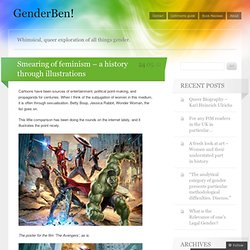
When I think of the subjugation of women in this medium, it is often through sexualisation. Betty Boop, Jessica Rabbit, Wonder Woman, the list goes on. I’m not a feminist, but— Did you ever start a sentence with “I’m not a feminist, but—”? Do you sometimes ridicule feminists because they’re so extreme/illogical/irrelevant? Do you feel that being described as a feminist would be insulting? [French] "Je ne suis pas féministe...-Mozilla Firefox. “I’m Not a Feminist, But…” “As you know in fashion, one day, you’re in, and the next day, you’re out,” Heidi Klum has ominously told the cast of Project Runway with every new episode. [French] [Chiennes de garde] (In)Visibilité de la lutte contre le sexisme. Maxim's "How to cure a feminist" La convergence. Twitter promet de très belles rencontres, ouais, mais aussi de se manger de sacrées surprises moins géniales. La semaine dernière, avec son 8 mars et son cortège de remise en question du féminisme et de sa légitimité, a été un festival de déni.
Vraiment trop bien, les féministes de tout poil (haha) ont eu droit à tout : la culture du viol est un mythe, en France on a plus rien à revendiquer, y'a des problèmes plus importants, et j'en passe et des meilleures (sans oublier les blagues sur la vaisselle sans quoi le 8 mars ne serait pas complet). J'ai même appris, dis donc, que le patriarcat était mort en 68 et que du coup les féministes luttaient sans doute contre des fantômes.
Exorcisons une féministe "fear le patriarcaaaaaarrgh" Dans le torrent de merde, j'ai dégoté des faux alliés parmi les twittos que je suis. Il y aurait des luttes prioritaires, on pourrait résumer ça comme ça. Le Capitalisme. Straw Feminist. Feminism 101: Myths and Facts. Dear Readers, Now that my Christmas preparations are done and I have more time to devote to my daily entries, I have turned my attention to some popular misconceptions and myths of modern feminism. Since I am a practicing feminista and spend a great deal of time writing about feminist issues, I often find myself in encounters with folks are not too familiar with our ways. The uniniated tend to recoil in horror by what seems to be such alien practices and belief systems. Over the years, I have dutifully collected a variety of misapprehensions and darn right myths about the feminista.
So, if you will allow me, dear reader, today I intend to demystify and enlighten you. Feminazi. Feminazi is a derogatory term used against feminists to remove power and portray them as irrational, ill-guided and dangerous militants. The term was coined by Tom Hazlett and popularized by the racist, misogynist, anti-intellectual radio-talk-show host Rush Limbaugh. The implications of the term are that feminist critiques of society are akin to Nazism: that is, that feminists are seeking an oppressive regime, particularly one that is anti-free speech. See political correctness. Tropes vs. Women: #6 The Straw Feminist. This is the last of a six part series created for Bitch Magazine. Tropes vs. m9x6yf. 341. Straw-feminist.
Angry feminist mob. The angry feminist mob is a rhetorical device sometimes used to discredit feminists in online (and offline) discussions. It occurs when feminists say something fairly mild, and a non-feminist observer reports the feminists' statements as having been much more aggressive than they actually were. For example, during the Mark Shuttleworth at Linuxcon incident, Skud posted an open letter ending with the following request: I’d like to invite you to think about the message you’re sending to women in the Linux community, and, if you didn’t mean to convey the message that we’re technical illiterates and hard to educate, consider apologising publicly. This request was referred to variously as "hounding" Mark Shuttleworth, going in "with guns blazing", "bayonets fixed", or calling for a "lynching" -- all physically violent descriptions at odds with the fairly measured statement.