
Car tracking device. Disney RFID bracelet. RFID to speed up queues. Printer HD. The FBI Can’t Find Many of Its GPS Trackers. App to spy on your weight. Smart Pills tracking. NY court upholds GPS tracker on worker's car. Nestle plant GPS tracker on choc bars. School RFID tracking. Privacy: What Does Microsoft Know About You? Privacy and Security Fanatic: Creepy RFID Tracking Coming Soon to Human Embryos. Some radio-frequency identification (RFID) uses seem cool, while others seem downright creepy.

We've previously seen that RFID can be used to track people from the cradle to the grave, but now there are plans to start tracking at pre-birth when babies are only embryos. EU Surveillance Studies Disclosed By Pirate Party. Google Scribe Predicts What You're Going to Type. Google has a Google Labs project available called Google Scribe.

Google Scribe provides text autocompletion as you type. It provides related word or phrase suggestions, using information you’ve already typed into a document. Roadmap to solving security and privacy concerns in RFID systems. 12 min ago | ChinaTechNews.com Alibaba Throws Money At Internet Privacy Hu Xiaoming, Alibaba's vice president for small- and micro-financial group and chief risk officer, announced in Beijing that the company will invest CNY40 million to establish a security fund.

Trending on the Topix Network 12 min ago | ComputerWorld Dropbox angling for larger corporate share Dropbox on Tuesday unveiled a new version of its data storage and sharing service for business claimed to provide IT administrators with more control by separating work and personal files. Legal Blog Watch. « 'It’s Only a Dream Until You Write It Down, and Then It Becomes a Goal' | Main | Thursday's Three Burning Legal Questions » Schools Use Technology to Track Exact Whereabouts of Buses and Each Child.

County gives jerseys with tracking microchips to preschoolers. On the first day of preschool in Richmond, students received crayons, writing paper and tracking microchips embedded into jersey tops.
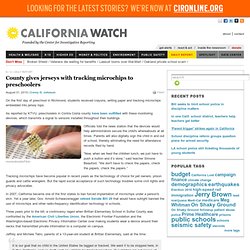
As reported by KTVU, preschoolers in Contra Costa county have been outfitted with these monitoring devices, which transmits a signal to sensors installed throughout their buildings. momentimedia/Flickr Officials told the news station that the devices would help administrators secure the child's whereabouts at all times. U.S. schools: grooming students for a surveillance state. Schools are increasingly invading student privacy both in school and outside of school.

Even without cookies, a browser leaves a trail of crumbs. Those with no technical knowledge generally believe that they are anonymous when simply browsing the Web.
Those who know more might recognize that IP addresses can be used to do some rough targeting, while browser cookies can be used to track someone across sessions and across IP addresses. But what if your browser itself—even with cookies off and IP addresses out of the picture—was leaving a digital fingerprint at every site you visit? Blog of Rights: Official Blog of the American Civil Liberties Union » Don't Let Schools Chip Your Kids. On Tuesday, preschoolers in Richmond, California showed up for school and were handed jerseys embedded with Radio Frequency Identification (RFID) tags.
RFID tags are tiny computer chips that are frequently used to track everything from cattle to commercial products moving through warehouses. Lawsuit: Disney, others spy on kids with zombie cookies. Disney, Ustream, SodaHead, Warner Bros., and a number of other websites are spying on kids' Internet use, according to a lawsuit filed recently by a group of parents and their children.

The suit accuses ad widget company Clearspring Technologies of enabling these sites to track kids all over the Internet, and not just on Clearspring partner sites, leaving them in violation of numerous federal and California state privacy laws. According to the complaint, each of the Clearspring affiliates independently and knowingly authorized the company to track users, even on non-Clearspring affiliated sites. Tour / Flowtown. This post was written by Jenny Urbano, our Social Media Manager.
Here at Demandforce, we love seeing and celebrating your ideas! And more than that, we love to hear from YOU. We want to bridge the gap between us and you, so that’s why we’re offering a once in a lifetime opportunity to win a trip to San Francisco, sightsee in this amazing city, visit Demandforce headquarters and share your ideas with us! 6 winners, and a guest of their choice will be flown out to San Francisco, California on March 12-14th, 2014, where they will stay in Union Square, spend a day at Demandforce, have dinner with the team, and explore the lovely City by the Bay!
For contest rules, and how to enter, please visit our post in the Generation Demandforce Community here. 24 Hour Fitness gyms using fingerprints to identify members - latimes.com. With gym memberships down across the fitness industry, the giant 24 Hour Fitness chain is taking a new cost-cutting approach to identifying its gym members — fingerprints. The 428-gym chain, which issued more than 1 million plastic membership cards and key ring IDs last year, is converting to a system that identifies members by scanning the individual ridges on fingertips.
The San Ramon, Calif., company is characterizing the move as a green initiative, but Wally Boyko, publisher of the National Fitness Trade Journal, says it's a new way for gyms to cut costs — and fraud — in a tough economy. "Nothing has been done like this before, but it's a very different time right now for the industry, and what you're seeing is membership drop off, people not renewing or even canceling their contracts," Boyko said. "This system will save money on plastic. "
Infographic of the Day: How Your Favorite Websites Spy on You. We all know, vaguely, that the websites we visit are tracking us with cookies and whatnot, silently scraping data on how and where we surf. But when you see the facts all laid out for you, it's gobsmacking. The Wall Street Journal just published the results of an investigation they did into tracking habits at the Web's top 50 websites, and summed up the results in this superb infographic. Basically, the top half shows the Web's top 50 websites; the bottom half shows the tracking companies whose software can be found on those sites.
Big Data is a big opportunity—but are you ready? Researcher warns of risks from rogue iPhone apps. Lax security screening at Apple's App Store and a design flaw are putting iPhone users at risk of downloading malicious applications that could steal data and spy on them, a Swiss researcher warns. Apple's iPhone app review process is inadequate to stop malicious apps from getting distributed to millions of users, according to Nicolas Seriot, a software engineer and scientific collaborator at the Swiss University of Applied Sciences (HEIG-VD). Once they are downloaded, iPhone apps have unfettered access to a wide range of privacy-invasive information about the user's device, location, activities, interests, and friends, he said in an interview Tuesday.
In a talk scheduled for Wednesday at the Black Hat DC security conference, Seriot will explain how an innocent-looking app could be designed to harvest personal data and send it to a remote server without the user knowing it. The rogue app could be hidden within an innocent-looking app, such as a game. Retrievable iPhone numbers mean potential privacy issues. I admit, sometimes I forget the iPhone is a phone. When a couple voicemails didn’t show up recently, I thought nothing of it until a friend asked me if I’d gotten his message—people just don’t call me that often.
But a phone it is, as some users are reportedly being reminded when they get phone calls from the publishers of a free app they’ve downloaded from the App Store. Black Hat: Most browsers can be made to give up personal data - Computerworld. Tire pressure monitor systems could reveal driver location. News By Joab Jackson August 9, 2010 01:09 PM ET IDG News Service - Researchers from Rutgers University and University of South Carolina have found that wireless communications between new cars and their tires can be intercepted or even forged.
Cleveland residents get RFID-equipped recycling. 7 elements of radically simple OS migration. Microsoft Researchers Propose Privacy Sensor ‘Widget’ « Resource. The Pants That Stalked Me on the Web - Advertising Age - DigitalNext.