What potential does 3D printing have for developing economies? Alastair Parvin: Architecture for the people by the people. Libraries of the Future: Tod Colegrove at TEDxReno. Fab Lab - What is it in essence - International Fab Lab Association. Video by Susarottenmeier, 2009.
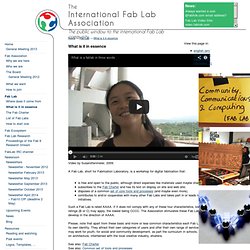
A Fab Lab, short for Fabrication Laboratory, is a workshop for digital fabrication that: is free and open to the public, although direct expenses like materials used maybe charged;subscribes to the Fab Charter and has its text on display on site and web site;disposes of a common set of core tools and processes (and maybe even more);contributes to and/or cooperates with many other Fab Labs and takes part in or leads network initiatives.
Such a Fab Lab is rated AAAA. If it does not comply with any of these four characteristics, lower ratings (B or C) may apply, the lowest being CCCC. The Association stimulates these Fab Labs to develop in the direction of AAAA. Please, note that apart from these basic and more or less common characteristics each Fab Lab has its own identity. How 3D Printing helps Coventry University. Coventry University’s Department of Industrial Design has gained worldwide recognition for its educational leadership, thanks to its use of Objet Geometries’ 3-D printing technology and its other educational innovations.
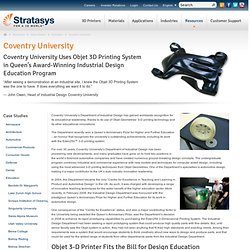
The Department recently won a Queen’s Anniversary Prize for Higher and Further Education – an honour that recognizes the university’s outstanding achievements, including its work with the Eden250™ 3-D printing system. For over 30 years, Coventry University’s Department of Industrial Design has been pioneering new developments, and many graduates have gone on to hold key positions in the world’s foremost automotive companies and have created numerous ground-breaking design concepts.
The future of higher education: reshaping universities through 3D printing. Earlier this year, the building's DeLaMare Science and Engineering Library became one of the first academic libraries in the United States to provide 3D scanning and printing to all students and faculty, as well as the public.

The move is part of a plan by director Tod Colegrove to transform the facility from a typical library that promotes knowledge through books to one that also encourages creative thought and discussion via hands-on technology. With 3D printers jumping from the realm of geek fantasy to something more accessible, Colegrove thought the devices would serve as the perfect vehicle for promoting education and pushing DeLaMare's evolution. "If you look back at libraries over 2,000 years -- including the Library of Alexandria -- you'll see that they were involved in buying technology that many people cannot afford and making them more accessible," Colegrove said. Paper or plastic? As great as 3D printers sounded, however, the library still faced one challenge: cost. Publications - Young People in Changing Societies - Summary.
Teenagers and Abstract Thinking: Unclear on the Concept? The frustrations teenagers experience with school are more a case of statistics and lack of experience than that of work ethic or "attitude" problems.
These statistics are not tied to socioeconomic status, weight or time spent in a seat; they're genetic and experiential. We have a bell curve of abstraction and experience, and we're only beginning to think about how to honor that. My working, classroom definition of abstraction is the ability to simultaneously consider multiple states of a system in order to analyze it for patterns, behavior and predictability. It's something like the difference between solving an equation for a specific value of x and being able to suggest different slopes and intercepts that would model data well. Piaget1 explained this stage as "Formal Operational," and he claimed this abstract level of thinking begins to develop in the early teen years. Anecdotal Evidence Well, maybe he could have . . . Abstraction Pedagogy He responded: Sources. Empowering Teachers and Students to Solve Authentic Problems Using Design » Partnership for Change. Last year Partnership for Change Fellows and Implementation Teams started researching best education practices in order to support the mission of the two school districts to create more innovative, rigorous, equitable and student-centered learning environments.
Design Thinking was one of the strongest levers of change to carry forward this vision and mission identified by former Community Based Learning Fellow Dov Stucker, Steering Committee Member Rich Nadworny and the Community Based Learning Implementation Team. Publications. Schooling ≠ Education. Online Learning: A More Innovative Experience for College Students by mkaufman Harrison College, which is a higher education school serving students both in the United States and internationally, is on the cusp of the future of education.
Harrison has established a web-based form of the classroom, called KnowU. KnowU begins with the community, seeking to establish relationships among its students, professors, and administrators. It utilizes many social media outlets in order to bring people together even before they reach the learning environment. This method of education is innovative because it is not limited by time, place, or topic. Robert W. Innovations in online education must begin with changing the relationship between the university, the establishment, and the students themselves. Lastly, online education must diversify the methods it has for reaching students. The Independent Project This says it all. Publications - You can narrow or expand your search by using more or fewer search criteria.