25 Mind-Twisting Optical Illusion Paintings By Rob Gonsalves. The beautiful and mind-bending illusions in Canadian artist Robert Gonsalves’ paintings have a fun way of twisting your perception and causing you to question what in his paintings, if anything, is real.
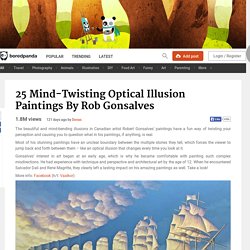
Most of his stunning paintings have an unclear boundary between the multiple stories they tell, which forces the viewer to jump back and forth between them – like an optical illusion that changes every time you look at it. Gonsalves’ interest in art began at an early age, which is why he became comfortable with painting such complex misdirections. He had experience with technique and perspective and architectural art by the age of 12. Science in the clouds: Seeing is believing? An optical illusion that challenges decades-old assumptions. Our brains are wired to make things up.
To make sense of the physical world around us, the brain takes bits of information received from the senses and, like an artist painting a landscape, creates a unique mental picture shaped by its experiences. Holy Crap These Four Images Are Actually Just One Single Picture. Feeling blue, seeing gray. Depression has long been associated with vision – and to colour perception in particular – and the link between them is evident in everyday language.
Depression is, of course, often referred to as “feeling blue”, and those who suffer from it are sometimes told to “lighten up”. The link can be found in art, too – Picasso’s so-called “Blue Period,” for example, which was brought on by the suicide of his close friend Carlos Casagemas, is characterised by a series of striking paintings in shades of cold blue, which express the deep melancholy he felt at the time. Although the association between depression and colour is largely metaphorical, there is actually some evidence that they are closely linked. The most recent comes from a new study by German researchers published in the journal Biological Psychiatry.
The study shows that depressed people have reduced sensitivity to contrast, and therefore that they may perceive the world differently from others. Reference: Bubl, E., et al. (2010). Blind brain receives 'visual' cues to identify shape. By Communications StaffFebruary 15, 2013 Share this: A significant number of blind humans, not unlike bats and dolphins, can localize silent objects in their environment simply by making clicking sounds with their mouth and listening to the returning echoes.

Some of these individuals have honed this skill to such a degree they are not only able to localize an object, they are able to recognize the object’s size and shape – and even identify the material it is made from. Researchers at Western’s Brain and Mind Institute (BMI) used functional magnetic resonance imaging (fMRI) to study the brain of renowned blind echolocator Daniel Kish as he listened to recordings of his own mouth clicks and the echoes reflected back from different objects. AndSFaulkn: This #illusion made my head... The Human Brain is Sensitive to Light, Breakthrough Findings From... HELSINKI and BERGEN, Norway, August 11, 2011 /PRNewswire/ -- Valkee ( inventor of the world's first bright-light headset, and scientists from the University of Oulu will present new findings on human brain's photosensitivity at the Scandinavian Physiology Society Annual Meeting 2011, August 12-14.
Do you see what I see? 8 August 2011Last updated at 11:31 Colour does not actually exist... what exists is light Roses are red, violets are blue - or are they?
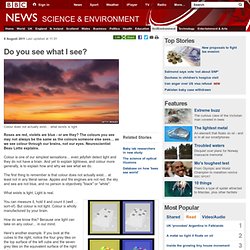
The colours you see may not always be the same as the colours someone else sees… as we see colour through our brains, not our eyes. Neuroscientist Beau Lotto explains. Colour is one of our simplest sensations… even jellyfish detect light and they do not have a brain. The first thing to remember is that colour does not actually exist… at least not in any literal sense. Brain's map of space falls flat when it comes to altitude. Animal's brains are only roughly aware of how high-up they are in space, meaning that in terms of altitude the brain's 'map' of space is surprisingly flat, according to new research.
In a study published online today in Nature Neuroscience, scientists studied cells in or near a part of the brain called the hippocampus, which forms the brain's map of space, to see whether they were activated when rats climbed upwards. The study, supported by the Wellcome Trust, looked at two types of cells known to be involved in the brain's representation of space: grid cells, which measure distance, and place cells, which indicate location. Human echolocation activates visual parts of the brain : Neurophilosophy. Retinal cells thoughts to be the same are not: study.
The old adage "Looks can be deceiving" certainly rings true when it comes to people.
But it is also accurate when describing special light-sensing cells in the eye, according to a Johns Hopkins University biologist. In a study recently published in Nature, a team led by Samer Hattar of the Department of Biology at the Krieger School of Arts and Sciences and Tudor Badea at the National Eye Institute found that these cells, which were thought to be identical and responsible for both setting the body's circadian rhythm and the pupil's reaction to light and darkness, are actually two different cells, each responsible for one of those tasks. Eagle-Eyed Autism? No. An interesting and refreshing paper from Simon Baron-Cohen's autism group from Cambridge.
The results themselves are pretty boring - they found that people with autism have normal visual acuity. But the story behind it is rather spicy. Back in 2009, a Cambridge group - different authors, but led by "SBC", published a report claiming that people with autism have exceptionally acute vision. Neuroscientists find famous optical illusion surprisingly potent (w/ video) (Medical Xpress) -- Scientists have come up with new insight into the brain processes that cause the following optical illusion: