
Lose A Memory, Use Energy. Science Feature: Newton’s Collapsing Universe. Sir Isaac Newton was possibly the greatest scientist who ever lived.
But even great men can make mistakes – it’s just that their errors are more interesting than other people’s. LHC antimatter anomaly hints at new physics - physics-math - 23 November 2011. Read full article Continue reading page |1|2.
Why Does Our Universe Have Three Dimensions? Why does our universe look the way it does?
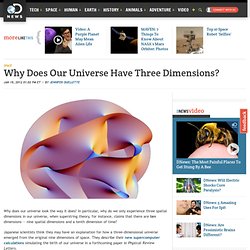
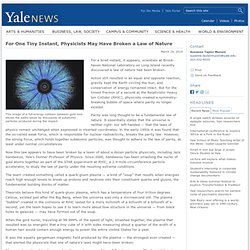
In particular, why do we only experience three spatial dimensions in our universe, when superstring theory, for instance, claims that there are ten dimensions — nine spatial dimensions and a tenth dimension of time? Crystals May Be Possible In Time As Well As Space. For One Tiny Instant, Physicists May Have Broken a Law of Nature. This image of a full-energy collision between gold ions shows the paths taken by thousands of subatomic particles produced during the impact.
For a brief instant, it appears, scientists at Brookhaven National Laboratory on Long Island recently discovered a law of nature had been broken. Action still resulted in an equal and opposite reaction, gravity kept the Earth circling the Sun, and conservation of energy remained intact. Researchers now able to stop, restart light. By William J.
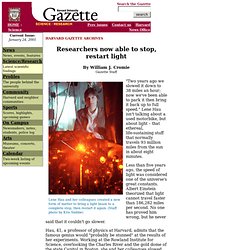
Cromie Gazette Staff "Two years ago we slowed it down to 38 miles an hour; now we've been able to park it then bring it back up to full speed. " Lene Hau isn't talking about a used motorbike, but about light – that ethereal, life-sustaining stuff that normally travels 93 million miles from the sun in about eight minutes. New kind of light created in physics breakthrough. Physicists have created a new kind of light by chilling photons into a blob state.
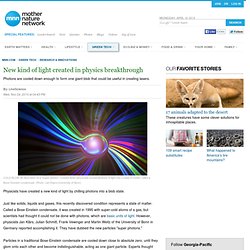
Just like solids, liquids and gases, this recently discovered condition represents a state of matter. Called a Bose-Einstein condensate, it was created in 1995 with super-cold atoms of a gas, but scientists had thought it could not be done with photons, which are basic units of light. Physicists Create Light From Nothingness. Quantum Entanglement Links Two Diamonds. Diamonds have long been available in pairs—say, mounted in a nice set of earrings.
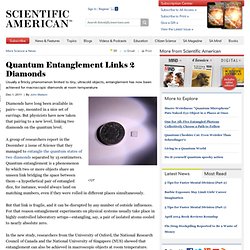
But physicists have now taken that pairing to a new level, linking two diamonds on the quantum level. A group of researchers report in the December 2 issue of Science that they managed to entangle the quantum states of two diamonds separated by 15 centimeters. Quantum entanglement is a phenomenon by which two or more objects share an unseen link bridging the space between them—a hypothetical pair of entangled dice, for instance, would always land on matching numbers, even if they were rolled in different places simultaneously. The accidental universe: Science's crisis of faith—By Alan P. Lightman. A Universe from Nothing: Einstein, the Belgian Priest and the Puzzle of the Big Bang.
Much Ado about Nothing. Why is there something rather than nothing?
This is one of those profound questions that is easy to ask but difficult to answer. For millennia humans simply said, “God did it”: a creator existed before the universe and brought it into existence out of nothing. But this just begs the question of what created God—and if God does not need a creator, logic dictates that neither does the universe. Science deals with natural (not supernatural) causes and, as such, has several ways of exploring where the “something” came from. Multiple universes. M-theory. Quantum foam creation. Cosmologists Try to Explain a Universe Springing From Nothing. Unknown "Structures" Not Tugging on the Universe After All?
Mysterious, unseen structures on the outskirts of creation most likely aren't tugging on our universe, according to a new study. The paper reexamines "dark flow"— an unusual, one-way motion of matter —using measurements of supernovae and the existing laws of physics. In 2008, a team of scientists took measurements of hundreds of galaxy clusters and calculated that everything in the visible universe—and likely beyond—is flowing at 2 million miles (3.2 million kilometers) an hour in the same direction.
The data couldn't be explained by the distribution of matter in the known universe, so the scientists suggested that chunks of matter had been pushed out shortly after the big bang , and their gravity is now pulling on everything around us. In 2010 the same team released a second study with data on twice as many galaxy clusters as their 2008 work. (Also see "Other Universes Finally Detectable? " No Place Like Home, After All Supernova "Candles" Light Up Dark Flow. The Case for Parallel Universe. Editor's note: In the August issue of Scientific American, cosmologist George Ellis describes why he's skeptical about the concept of parallel universes.
Here, multiverse proponents Alexander Vilenkin and Max Tegmark offer counterpoints, explaining why the multiverse would account for so many features of our universe—and how it might be tested. Welcome to the Multiverse By Alexander Vilenkin The universe as we know it originated in a great explosion that we call the big bang. For nearly a century cosmologists have been studying the aftermath of this explosion: how the universe expanded and cooled down, and how galaxies were gradually pulled together by gravity. The nature of the bang itself has come into focus only relatively recently. Inflation is a period of super-fast, accelerated expansion in early cosmic history.
What Do You Mean, the Universe Is Flat? Part II: In Which We Actually Answer the Question. Stand up.
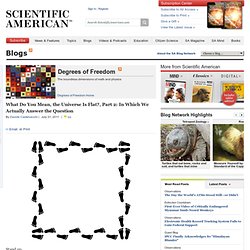
Walk 10 feet straight ahead. Turn left by 90 degrees. Walk another 10 feet. Again, turn left by 90 degrees. Do it for a third time: walk. then turn left. Now the next time you walk 10 feet ahead, you’ll trace the fourth and last side of a square, and you’ll end up where you started. This seems intuitively obvious, even tautological—if you trace a square on the ground, well, you trace a square on the ground—but it is actually an empirical fact.
One universe among many? Research may open the way for a conceptual shift of Copernican proportions The Tarantula Nebula: the panorama that astronomers can observe could be a tiny part of the aftermath of our Big Bang An astonishing concept has entered mainstream cosmological thought: physical reality could be hugely more extensive than the patch of space and time traditionally called “the universe.”
We’ve learnt that we live in a solar system that is just one planetary system among billions, in one galaxy among billions. But there are signs that a further Copernican demotion confronts us. The Strange Physics—and Singular Sights—Inside Black Holes. It is late December and snow is swirling as Andrew Hamilton coasts up to his office at the University of Colorado’s Boulder campus, in the foothills of the Rockies.
On a blustery day like today, most of his colleagues arrive in SUVs or at least in cars shod with all-season tires. Hamilton rides in on his Cannondale mountain bike. What Is Reality? - The Homepage of Andrew Thomas. Quantum life: The weirdness inside us - life - 03 October 2011. Read full article Continue reading page |1|2|3. Testing the Copenhagen interpretation: a matter of live and dead cats. Are There Mysterious Forces Lurking in Our Atoms and Galaxies? Four forces control the entire universe?
This is a pretty astonishing claim. In fact, putting aside microscopic processes happening inside atoms, everything we see can be accounted for in terms of particles interacting through just gravity and electromagnetism. From the orbits of the planets to the flexing of your muscles, every movement in the macroscopic world arises from the interplay of these two aspects of nature. At least, that’s the current picture. If that’s not right, all bets are off. The answer is, we can look for them. If you want to invent a new force of nature, you have to specify three things: which particles feel the force, how strong it is, and the range over which it interacts.
Electromagnetism also has an infinite range, and it is much stronger than gravity. The nuclear forces are short-range only, so we can ignore them in the macroscopic world. After Eötvös, many people assumed the question was settled. So far, nothing. Superstuff: When quantum goes big - physics-math - 16 January 2012. Read full article Continue reading page |1|2|3. Quantum theorem shakes foundations.
Collaborative physics: String theory finds a bench mate. The Cutting-Edge Physics of a Crumpled Paper Ball. Is Supersymmetry Dead? For decades now physicists have contemplated the idea of an entire shadow world of elementary particles, called supersymmetry. It would elegantly solve mysteries that the current Standard Model of particle physics leaves unexplained, such as what cosmic dark matter is. Meet the mother theory. Quantum Gravity in Flatland. Beyond space-time: Welcome to phase space - space - 08 August 2011.
Time need not end in the multiverse - physics-math - 11 August 2011. Next Step Infinity. 1. It is logically possible for a finite spatial region to evolve into a space that is both uniform and spatially infinite. Brian Greene: Welcome to the Multiverse. Where Do Space and Time Come From? New Theory Offers Answers, If Only Physicists Can Figure It Out. What is time? "Time Crystals" Could Be a Legitimate Form of Perpetual Motion. Ten Things Everyone Should Know About Time. Center for Integral Science. The Emperor, Darth Vader, and the Ultimate Ultimate Theory of Physics. New Data Support Einstein On Accelerating Universe.