
Kvasaarit ja BL Lac -kohteet - Metsähovin radiotutkimusasema - Aalto-yliopisto. Tutkimusryhmämme on vastuussa sekä ennen satelliitin lähettämistä tehtävästä valmistelevasta työstä sekä satelliitin tekemien havaintojen käyttämisestä.
Planck-satelliitti tulee mittaamaan koko taivaan kahteen kertaan korkeilla radiotaajuuksilla. Soft Nanostructured Films with an Ultra-Low Volume Fraction of Percolating Hard Phase - Chenal - 2013 - Macromolecular Rapid Communications. Is this the theory of everything? Nassim Haramein - Sacred Geometry & Unified Fields. New way to produce antimatter-containing atom. Public release date: 11-Jul-2011 [ Print | E-mail Share ] [ Close Window ] Contact: Iqbal Pittalwalaiqbal@ucr.edu 951-827-6050University of California - Riverside RIVERSIDE, Calif. – Physicists at the University of California, Riverside report that they have discovered a new way to create positronium, an exotic and short-lived atom that could help answer what happened to antimatter in the universe, why nature favored matter over antimatter at the universe's creation.
Positronium is made up of an electron and its antimatter twin, the positron. It has applications in developing more accurate Positron Emission Tomography or PET scans and in fundamental physics research. Recently, antimatter made headlines when scientists at CERN, the European Organisation for Nuclear Research, trapped antihydrogen atoms for more than 15 minutes. Antimatter belt around Earth discovered by Pamela craft. 7 August 2011Last updated at 10:54 The antiprotons lie sandwiched between the inner and outer Van Allen belts (in red) around the Earth A thin band of antimatter particles called antiprotons enveloping the Earth has been spotted for the first time.
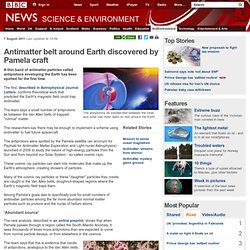
The find, described in Astrophysical Journal Letters, confirms theoretical work that predicted the Earth's magnetic field could trap antimatter. Electron is Stunningly Spherical, Scientists Discover - FoxNews.com. Fusion Experiment Faces New Hurdles. Hard... soft... New nanomaterial switches properties. (PhysOrg.com) -- A world premiere: a material which changes its strength, virtually at the touch of a button.
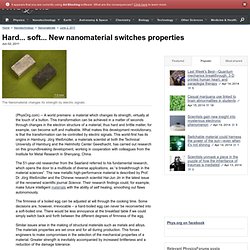
This transformation can be achieved in a matter of seconds through changes in the electron structure of a material; thus hard and brittle matter, for example, can become soft and malleable. What makes this development revolutionary, is that the transformation can be controlled by electric signals. This world-first has its origins in Hamburg. Jörg Weißmüller, a materials scientist at both the Technical University of Hamburg and the Helmholtz Center Geesthacht, has carried out research on this groundbreaking development, working in cooperation with colleagues from the Institute for Metal Research in Shenyang, China.
National Science Foundation (NSF) Discoveries - Researchers Control Collective Spin States Electrically at Room Temperature. DiscoveryResearchers Control Collective Spin States Electrically at Room Temperature Breakthrough paves way to store and process information in novel spin-electronics August 16, 2010 Processing large amounts of information in today's electronics requires large amounts of power, which results in heating.
Heat can ruin modern electronics by potentially damaging the stuff that makes them work--the ever smaller and denser structures in a computer's "brain," the microprocessor that incorporates all of its logic functions.
Physics Ed. Physics Flash Animations. Complicated Mechanisms Explained in simple animations. Matrix mechanics. Matrix mechanics is a formulation of quantum mechanics created by Werner Heisenberg, Max Born, and Pascual Jordan in 1925.
Matrix mechanics was the first conceptually autonomous and logically consistent formulation of quantum mechanics. It extended the Bohr Model by describing how the quantum jumps occur. It did so by interpreting the physical properties of particles as matrices that evolve in time. It is equivalent to the Schrödinger wave formulation of quantum mechanics, and is the basis of Dirac's bra-ket notation for the wave function. Development of matrix mechanics In 1925, Werner Heisenberg, Max Born, and Pascual Jordan formulated the matrix mechanics representation of quantum mechanics. Physics.org.
Thermodynamics. Dynamics. Quantum Physics. WAVE the theory of everything ! Physics Simulations and Artwork. Light. TOP UNSOLVED PROBLEMS IN PHYSICS. Interactive Web Physics - iwphys.org. The Electromagnetic Spectrum. Homepage - Large Hadron Collider. LHC Machine Outreach. The Large Hadron Collider (LHC) is built in a circular tunnel 27 km in circumference.
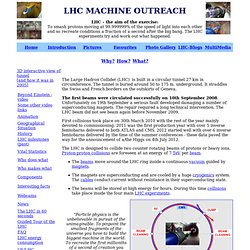
The tunnel is buried around 50 to 175 m. underground. It straddles the Swiss and French borders on the outskirts of Geneva. The first beams were circulated successfully on 10th September 2008. Unfortunately on 19th September a serious fault developed damaging a number of superconducting magnets. The repair required a long technical intervention. CERN: The Standard Model Of Particle Physics. The Nature of Reality. Physics.
Einstein for Everyone. Einstein for Everyone Nullarbor Press 2007revisions 2008, 2010, 2011, 2012, 2013 Copyright 2007, 2008, 2010, 2011, 2012, 2013 John D.
Norton Published by Nullarbor Press, 500 Fifth Avenue, Pittsburgh, Pennsylvania 15260 with offices in Liberty Ave., Pittsburgh, Pennsylvania, 15222 All Rights Reserved John D. An advanced sequel is planned in this series:Einstein for Almost Everyone. Einstein's Theory Of Relativity Made Easy. Albert Einstein Relativity: The Special and General Theory. Albert Einstein Relativity The Special and General Theory Written: 1916 (this revised edition: 1924) Source: Relativity: The Special and General Theory © 1920 Publisher: Methuen & Co Ltd First Published: December, 1916.
Amusing physics. Hurricane Balls 1. HyperPhysics. Physics Chem.