
Department of Political Science. The political science department at Brown is a dynamic community of scholars and students investigating some of the largest, most pressing challenges of political life today.
Our faculty are at the leading edge of research in all the traditional subfields of political science: American politics, comparative politics, international relations, and political theory. We study many different regions of the world, and we engage a wide variety of methods and intellectual approaches. We have a vibrant PhD program that trains graduate students for careers in academia and advanced research. Our undergraduate major is one of the largest on campus, although most of our classes are small and allow students to work closely with faculty members. What is IPE? Monopoly capital: an essay on the American economic and social order - Paul A. Baran, Paul Marlor Sweezy.
Stagnation and the financial explosion - Harry Magdoff, Paul Marlor Sweezy. Counterhegemony in the Colony and Postcolony. Capitalism seems to have conquered the world.
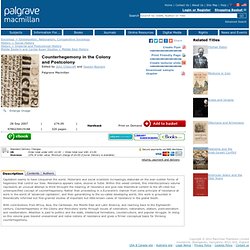
Historians and social scientists increasingly elaborate on the ever-subtler forms of hegemony that control our lives. Resistance appears naIve, elusive or futile. Within this vexed context, this interdisciplinary volume represents an unusual attempt to think throught the meaning of resistance and give new theoretical content to the oft-cited but underspecified concept of counterhegemony. Rather than proceeding in a Eurocentric manner from some principle of resistance at work in the world of 'advanced capitalism', and then generalizing to the so-called developing world, this work is grounded in theoretically informed but fine-grained studies of important but little-known cases of resistance in the global South.
JOHN CHALCRAFT is Lecturer in Imperialism at the London School of Economics and Political Science (LSE), UK. The Anglosphere: A Genealogy of a Racialized Identity in International Relations - Srdjan Vucetic. "The Anglosphere brings the study of international relations into the twenty-first century, paradoxically, by returning to the past.
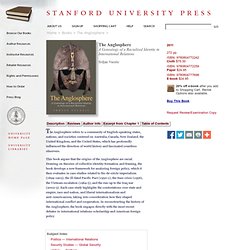
Vucetic analyzes the now officially forgotten racial-in-origin identification of Anglo-Saxon peoples and shows how it still matters in the close alignment of policies among the US, Great Britain, Canada, Australia, and New Zealand. He wants us all to think harder about racialization as a force in world politics. "—Robert Vitalis, University of Pennsylvania "Relying on the toolkit of social science and informed by a sure grasp of international relations theory, this audaciously brilliant book inquires into the racial and post-racial foundations of the liberal core of the international system.
My recommendation is simple. "International relations theory remains remarkably resilient in its refusal to accord race a fundamental place in its vocabulary or explanations. Empire...
Modern Political Economics: Making Sense of the Post-2008 World. To sort. Pomeranz, K.: The Great Divergence: China, Europe, and the Making of the Modern World Economy. The Great Divergence brings new insight to one of the classic questions of history: Why did sustained industrial growth begin in Northwest Europe, despite surprising similarities between advanced areas of Europe and East Asia?
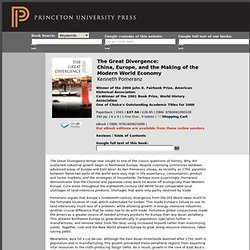
As Ken Pomeranz shows, as recently as 1750, parallels between these two parts of the world were very high in life expectancy, consumption, product and factor markets, and the strategies of households. Perhaps most surprisingly, Pomeranz demonstrates that the Chinese and Japanese cores were no worse off ecologically than Western Europe. Core areas throughout the eighteenth-century Old World faced comparable local shortages of land-intensive products, shortages that were only partly resolved by trade. Pomeranz argues that Europe's nineteenth-century divergence from the Old World owes much to the fortunate location of coal, which substituted for timber. Meanwhile, Asia hit a cul-de-sac. Review: Exhaustively researched and brilliantly argued. . . .
Endorsement: Series: The Great Transformation, by Karl Polanyi. Foreword by Robert M.
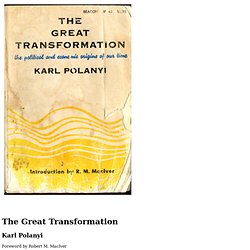
MacIver Beacon Press Boston Copyright 1944 by Karl Polanyi First Beacon Paperback edition published in 1957 by arrangement with Rinehart & Company, Inc. The Modern World System in the Longue Duree. In this book prominent scholars from around the world debate two major themes: the past and future of the capitalist world-economy, and the ways in which a capitalist economy shapes Western research, the academy, and broader knowledge structures.
Putting the two themes together, they also analyze the relationship between scholarship and the rest of the world. The book is published to commemorate the 25th anniversary of the Fernand Braudel Center. Contributors are Samir Amin, Christopher Chase-Dunn, Bart Tromp,. Claudia von Werlhof, Giovanni Arrighi, Pablo Gonzalez-Casanova, Marcel van der Linden, Randall Collins, Mahm ood Mamdani, Boaventura de Sousa Santos, Michel-Rolph Trouillot, Janet Abu-Lughod, Maurice Aymard, and Immanuel Wallerstein. Contributors: Samir Amin, Christopher Chase-Dunn, Bart Tromp,. The Great Transformation: The Political and Economic Origins of Our Time: Amazon.co.uk: Karl Polanyi.
Great Transformations. Economic Ideas and Institutional Change in the Twentieth Century Mark Blyth, The Johns Hopkins University Publication date:October 2002 300pages Dimensions: 228 x 152 mm Weight: 0.61kg. Drazen, A.: Political Economy in Macroeconomics. Originally, economics was called political economy, and those studying it readily accepted that economic decisions are made in a political world.
But economics eventually separated itself from politics to pursue rigorous methods of analyzing individual behavior and markets. Recently, an increasing number of economists have turned their attention to the old question of how politics shape economic outcomes. To date, however, this growing literature has lacked a cogent organization and a unified approach. Here, in the first full-length examination of how political forces affect economic policy decisions, Allan Drazen provides a systematic treatment, organizing the increasingly influential "new political economy" as a more established field at the highly productive intersection of economics and political science. Review: "Very well written and concise. . . "[A] magnificent new book. . . . Endorsement: More Endorsements. International Monetary Power - David M. Andrews.
Most economists and political scientists assume that efficiency, the invisible hand, is the preeminent factor in monetary decisions; questions of power and the role it plays in monetary policy are largely neglected.
This pathbreaking book redirects attention to monetary power and provides an original framework for assessing its role in relations between sovereign states. UC berkeley - Barry Eichengreen - Globalizing Capital: A History of the International Monetary System. Economist Barry Eichengreen offers great insights into the workings of the international monetary system from 1850-2008 in the second edition of Globalizing Capital.
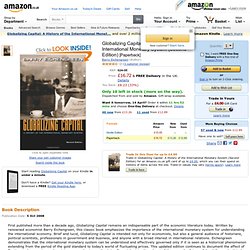
This book shows the strong influence that the monetary system has had on the world economy at various points in history. The most dramatic example began in 1929, as nations' rigid reliance on the gold standard facilitated the spread of the Great Depression from country to country. Under the gold standard, the major countries of the world were linked by a common policy whereby nations pledged to convert their currency into gold at a fixed price upon demand by anyone who would present it for such an exchange. Gilpin, R.: Global Political Economy: Understanding the International Economic Order. This book is the eagerly awaited successor to Robert Gilpin's 1987 The Political Economy of International Relations, the classic statement of the field of international political economy that continues to command the attention of students, researchers, and policymakers.
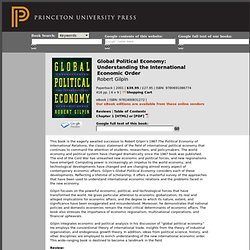
The world economy and political system have changed dramatically since the 1987 book was published. The end of the Cold War has unleashed new economic and political forces, and new regionalisms have emerged. Computing power is increasingly an impetus to the world economy, and technological developments have changed and are changing almost every aspect of contemporary economic affairs. Gilpin's Global Political Economy considers each of these developments. Walter, A. and Sen, G.: Analyzing the Global Political Economy. Global Capitalism: Its Fall and Rise in the Twentieth Century. Jeffrey Frieden, a Harvard professor specializing in international trade and finance, has written a masterly and comprehensive history of capitalism from 1870 to the present.
His history of globalization reminds us that it is not a recent develpment and that its current success is not guaranteed. The first era of globalization (1870 to 1914) had many of the same characteristics as today's. There was an unprecedented cross-border movement of goods, capital, and labor. (Labor more so in the first era.) During these years huge amounts of capital moved overseas to America, Canada, and Argentina mainly due to the reduced costs of communication and transportation. The main thing that distinguishes the present globalization from the first is what happened in between.
In 1980, when our current era of globalization begins, capital began to move overseas again in order to find countries with lower labor and social costs. Harvard University - Department of Government. The Political Economy of the World Trading System: Bernard M. Hoekman. The Political Economy of the World Trading System is a comprehensive textbook account of the economics, institutional mechanics and politics of the world trading system. This third edition has been expanded and updated to cover developments in the World Trade Organisation (WTO) since its formation, including the Doha Round, presenting the essentials of trade negotiations and the WTO's rules and disciplines.
The authors focus in particular on the WTO's role as the primary organisation through which trading nations manage their commercial interactions and the focal point for cooperation on policy responses to the rapidly changing global trading environment. Advanced International Trade: Theory and Evidence. Debating Varieties of Capitalism: Paperback: Bob Hancké. Carbon Democracy: Political Power in the Age of Oil. As tumultuous events in Egypt unfold at speed, with former President Morsi currently in custody, we present Verso's updated reading list of key titles and articles addressing the challenges facing Egypt and the Middle East.
Columbia University. Timothy Mitchell is a political theorist who studies the political economy of the Middle East, the political role of economics and other forms of expert knowledge, the politics of large-scale technical systems, and the place of colonialism in the making of modernity. Educated at Queens' College, Cambridge, where he received a first-class honours degree in History, Mitchell completed his Ph.D. in Politics and Near Eastern Studies at Princeton University in 1984. He joined Columbia University in 2008 after teaching for twenty-five years at New York University, where he served as Director of the Center for Near Eastern Studies. Capital as Power. A Study of Order and Creorder. Capital as Power. 20090522_nb_casp_full_indexed.