
Prefectures of Japan. Prefectures of Japan The chief executive of each prefecture is a directly-elected governor (知事, chiji?).
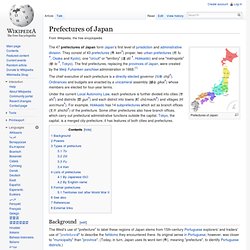
Ordinances and budgets are enacted by a unicameral assembly (議会, gikai?) Whose members are elected for four-year terms. Under the current Local Autonomy Law, each prefecture is further divided into cities (市, shi?) And districts (郡, gun?) Background[edit] The West's use of "prefecture" to label these regions of Japan stems from 15th-century Portuguese explorers' and traders' use of "prefeitura" to describe the fiefdoms they encountered there.
Those fiefs were headed by a local warlord or family, and despite that those fiefs have long since been dismantled, merged, and reorganized numerous times over, and given legislative governance and oversight, the rough translation stuck. In 2003, then-Prime Minister Junichiro Koizumi proposed that the government consolidate the current prefectures into about 10 regional states. Powers[edit] Japan is a unitary state. Cambodia - Provinces. Cambodia is divided into 24 provinces (Khmer: ខេត្ត, khaet, singular and plural, The capital Phnom Penh is not province but a special administrative area and is included as the 25th province since it is administered at the same level as the other 24 provinces.

The name of the provinces are the same as that of their respective capital cities, except for Banteay Meanchey, Kandal, Mondulkiri, Oddar Meanchey, Rattanakiri, Koh Kong, Kampong Thom, Takeo, Kampong Speu, and Tboung Khmum. Phnom Penh has both the highest population and the highest population density. The largest province by area is Mondulkiri and the smallest Phnom Penh. Philippines - Provinces. The provinces of the Philippines (Filipino: Mga Lalawigan ng Pilipinas) are the primary political and administrative divisions of the Philippines.

There are 81 provinces at present, further subdivided into component cities and municipalities. The National Capital Region, as well as independent cities, are independent of any provincial government. Each province is governed by an elected legislature called the Sangguniang Panlalawigan and by an elected governor. The provinces are grouped into 17 regions based on geographical, cultural, and ethnological characteristics. Fourteen of these regions are designated with numbers corresponding to their geographic location in order from north to south. Each province is a member of the League of Provinces of the Philippines, an organization which aims to address issues affecting provincial and metropolitan government administrations.[1] Government[edit] A provincial government is autonomous of other provinces within the Republic. Vietnam - Provinces & Districts. South Korea - 1st Admin.
South Korea is divided into 8 provinces (do), 1 special autonomous province (teukbyeol jachido), 6 metropolitan cities (gwangyeoksi), and 1 special city (teukbyeolsi).

These are further subdivided into a variety of smaller entities, including cities (si), counties (gun), districts (gu), towns (eup), townships (myeon), neighborhoods (dong) and villages (ri), as explained below. Note on translation: although the terms "Special City", "Metropolitan City", "Province", and "City" are commonly used on English-language government websites, the other translations — "county", "town", "district", etc. — are not official translations, and are only intended to serve as useful illustrations of each entity's meaning. Local government[edit] Official Revised Romanization of Korean spellings are used. Bangladesh - 1st/2nd level. Upazilas of Bangladesh The districts of Bangladesh are divided into subdistricts called Upazila (Bengali উপজেলা upojela) or Thana.

Upazilas are similar to the county subdivisions found in some Western countries. Bangladesh, at present, has 500 upazilas and 509 administrative thanas[1][citation needed] for a total of 1009 subdistricts. The upazilas/thanas are the second lowest tier of regional administration in Bangladesh. The administrative structure consists in fact in Divisions (7), Districts (64), Upazila/Thana and Union Parishads (UPs). Below UPs, villages (gram) and para exist, but these have no administrative power and elected members. Administration[edit] Each Upazila Parishad (or council) has a chairman, a vice chairman and a woman vice chairman. There is a non-elected administrative Upazila Nirbahi Officer (UNO, or Upazila Executive Officer; Bengali: উপজেলা নির্বাহী কর্মকর্তা) in each Upazila.
On 22 January 2010 the first election in 18 years of Upazila Porishod was held.[3] Indonesia - Provinces. A province (Indonesian: provinsi) is the highest tier of local country government subdivisions in Indonesia.
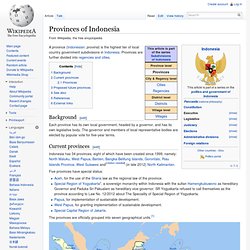
Provinces are further divided into regencies and cities. Background[edit] Nigeria - States. Nigeria is divided into 36 states and Abuja, the federal capital territory.

The states are further divided into 774 Local Government Areas.[1] Current states and the Federal Capital Territory. [edit] Former state boundaries[edit] The Federal Capital Territory (now called Abuja) was established in 1991. 1991-1996[edit] During this period, there were 30 states and Abuja, the Federal Capital Territory.