
We Media. Notice: Trying to get property of non-object in /nfs/c02/h04/mnt/28080/domains/hypergene.net/html/wemedia/pmMedia21x/lib/weblog.fns.php on line 892 About "We Media" We are at the beginning of a Golden Age of journalism — but it is not journalism as we have known it.
Media futurists have predicted that by 2021, "citizens will produce 50 percent of the news peer-to-peer. " However, mainstream news media have yet to meaningfully adopt or experiment with these new forms. Historically, journalists have been charged with informing the democracy. This report details the important considerations when exploring a collaborative effort between audience and traditional media organizations. How Social Media is Replacing Traditional Journalism for Breaking News. Mainstream media. Mainstream media (MSM) are those media disseminated via the largest distribution channels, which therefore represent what the majority of media consumers are likely to encounter.
The term also denotes those media generally reflective of the prevailing currents of thought, influence, or activity.[1] Large news conglomerates, including newspapers and broadcast media, which underwent successive mergers in the U.S. and elsewhere at an increasing rate beginning in the 1990s, are often referenced by the term. Citizen journalism. The concept of citizen journalism (also known as "public", "participatory", "democratic",[1] "guerrilla"[2] or "street" journalism[3]) is based upon public citizens "playing an active role in the process of collecting, reporting, analyzing, and disseminating news and information.
"[4] Similarly, Courtney C. Radsch defines citizen journalism "as an alternative and activist form of newsgathering and reporting that functions outside mainstream media institutions, often as a response to shortcomings in the professional journalistic field, that uses similar journalistic practices but is driven by different objectives and ideals and relies on alternative sources of legitimacy than traditional or mainstream journalism. Corporate media. Corporate board interlocks between various U.S. corporations/institutions, and four of the major media/telecom corporations (circled in red), in 2004.
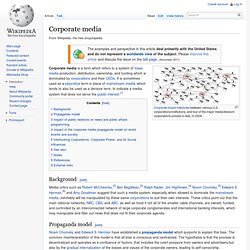
Corporate media is a term which refers to a system of mass media production, distribution, ownership, and funding which is dominated by corporations and their CEOs. It is sometimes used as a pejorative term in place of mainstream media, which tends to also be used as a derisive term, to indicate a media system that does not serve the public interest.[1] Background[edit] Media critics such as Robert McChesney,[2] Ben Bagdikian,[3] Ralph Nader, Jim Hightower,[4] Noam Chomsky,[5] Edward S. Are bloggers journalists? Judge rules 'no' in TechnoBuffalo Shield Law case. January 13, 2012 (CHICAGO) (WLS) -- Journalists have certain legal protections when it comes to revealing sources.
But do those same protections extend to bloggers? That question keeps popping up with increasing frequency in courts across the country, and there's no single answer. But in a Cook County case, a judge ruled that the authors of a popular California-based website do not have the same rights reporters do. Last August, the website TechnoBuffalo published an image of a manual for Motorola's new Droid bionic smartphone before the manual was publicly released. TechnoBuffalo said the image had come from an anonymous tipster. Johns-Bryne, a Chicago area company that printed the manual went to court demanding that the web-site reveal its source. "He is with a website that gets over a million hits a month, it has a following. Paul Lewis: Crowdsourcing the news.
What Makes Mainstream Media Mainstream, by Noam Chomsky. Part of the reason why I write about the media is because I am interested in the whole intellectual culture, and the part of it that is easiest to study is the media.
It comes out every day. You can do a systematic investigation. You can compare yesterday’s version to today’s version. There is a lot of evidence about what’s played up and what isn’t and the way things are structured. We the Media. April 11, 2005 Book Published in Taiwan The Taiwanese edition has been published, and today's China Times has a review.
Dan Gillmor (@dangillmor) sur Twitter. Center for Citizen Media. (This is the seventeenth in a series of postings about citizen media business issues.
See the introduction here. All of these entries are considered to be in “beta” and will be revised and refined as they find a home on a more permanent area of the Center for Citizen Media web site. Pressthink. Jay Rosen (jayrosen_nyu) FT: Old media must embrace the amateur march7,2006. Jarvis: Networked journalism july5th2006. I think a better term for what I’ve been calling “citizen journalism” might be “networked journalism.”
“Networked journalism” takes into account the collaborative nature of journalism now: professionals and amateurs working together to get the real story, linking to each other across brands and old boundaries to share facts, questions, answers, ideas, perspectives. It recognizes the complex relationships that will make news. @jeffjarvis. Citizen Journalism Projects and Typologies: Part I July 31, 2006. [This is a draft of something bigger, so reader feedback is highly appreciated.]
With all the buzz abut Jay Rosen's latest brainstorm, New Assignment.net, I thought it might be useful to take a step back and typologize some of the citizen's journalism projects that have either existed in the past and continue to exist today. There have already been some overviews of the types of CJ projects that could exist, along with some examples that flesh out the speculations, but it still might be interesting to look at what has existed, starting from the "beginning," more or less.
Here goes: I. Citizen Journalism Projects and Typologies: Part II. (Read Part One) 11 Layers of CitizenJournalism May31,2005. What You Had to Say About ‘Citizen Journalism’ My recent article here on Poynter Online, “The 11 Layers of Citizen Journalism,” generated a lot of e-mail back to me — comments, feedback, and tips about projects and trends I didn’t mention. In the spirit of the topic, I’m including the great information that people sent me on this webpage. The information significantly adds to the discussion already underway in the feedback area.
And as the citizen-journalism ethos demands, the writer of an article does not know it all; readers should be able to add what they know, in order to enhance and supplement the original piece. (I decided not to rewrite the original article with reader follow-up information, because I felt that would be too confusing. Subsequent readers of the “11 Layers” article will be pointed here. Guide to Citizen Journalism Sept27,2006. From time to time, I’ll give an overview of one broad MediaShift topic, annotated with online resources and plenty of tips. The idea is to help you understand the topic, learn the jargon, and hopefully consider trying it out — even if it’s all new to you. @mediatwit MarkGlaser. J. D. Lasica: What is Participatory Journalism? Participatory journalism is a slippery creature. Everyone knows what audience participation means, but when does that translate into journalism? Alas, there's no simple answer. In a segment on PBS's "NewsHour" last April that asked, "Is blogging journalism?
" Joan Connell, an executive producer at MSNBC.com, suggested that independent bloggers aren? T journalists because no editor comes between the author and reader. Yet in the same segment, reporter Terence Smith pointed to "opinion journalism Weblogs, like instapundit.com and andrewsullivan.com, that can and have made a difference in the public policy arena. " @jdlasica. CITIZEN MEDIA INITIATIVES LIST - CyberJournalist.net - Online News Association - Citizen Media Monitor. So many citizen journalism initiatives are cropping up now it's hard to keep track, so CyberJournalist.net has begun keeping a list.
Here are some of the more ambitious citizen's media efforts that have launched or are in the works. Click on the links for more information and to post your comments about each one. (This list will continue to be updated) Know of others? Post them here. Discussion. J-Lab — Igniting news ideas that work. Pew Center for Civic Journalism: Doing Civic Journalism. Doing Civic Journalism. Independent Media Center. @indymedia. Public Journalism Network: Charter Declaration. A Declaration for Public Journalism Written by the Charter Members of the Public Journalism NetworkKennesaw, Georgia, January 25, 2003 The Public Journalism Network is a global professional association of journalists and educators interested in exploring and strengthening the relationship between journalism and democracy. Tools for citizen journalism. Tools for citizen journalism enable people other than traditional mass media professionals to gather, edit and share information through internet and other low-cost publishing systems.
Bibliography Updated Dec. 23, 2010 Citizen / Public Journalism. Citizen journalism. How Citizen Journalism Is Reshaping Media and Democracy. Layla Revis is vice president of digital influence at Ogilvy PR Worldwide. Her specialties include international affairs, tourism and multicultural marketing. “So long as the dominant culture’s images of the world continue to be sold to others as the image of the world, image makers are being unethical.” — Jay Ruby. Livestreaming Journalists Want to Occupy the Skies With Cheap Drones. Livestreaming journalist Tim Pool shows off his modified drone, dubbed the Occucopter, intended to make aerial coverage available to citizen reporters.
Photo: Sean Captain. Citizen-journalism. Citizen Journalism. News.me. "Grote verwachtingen over burger journalistiek zijn niet ingelost" - Interview.