
Watch all the exoplanets orbit their stars simultaneously / Boing Boing. The Kepler telescope has found 685 systems with 1705 exoplanets, and you can watch them whirr around together in this mesmerizing animation by astrocubs.

The data is from the NASA Exoplanet Archive. I made the visualization in Python: source code available here. The fact that the worlds and systems we've observed are so different from our own is a limitation of our observations, not of the universe. The orbits are shown to scale, but the planets are much larger than the orbits would suggest. Otherwise you wouldn't be able to see them.
Look at Saturn's magnificent moon Titan! NASA just released this beautiful composite infrared view of Saturn’s moon Titan. Pay what you want for the “White Hat Hacker” training bundle Practice the digital dark arts for the good guys, and make more than an honest living as a White Hat Hacker. 3-D model lets you "fly through" a 300-year-old supernova. Mesmerizing Videos of Northern and Southern Lights Seen From Space.
Earth's atmosphere creates glow-in-the-dark light show. Whoa, NASA captures a nova exploding on video. Perpetual Ocean. The green fire of the aurora, seen from space. Infinity Imagined. How A Solar Storm Sounds – Particle Sonification Video. Neil deGrasse Tyson Supercut Demands We Dream of Space Again. Q&BA: The Science of Science Fiction. If this video doesn't make your heart swell, there's a decent chance you don't have a heart. Regardless of how you feel about his politics, the man had more vision than most Presidents do.
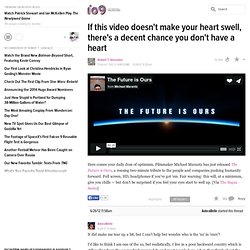
In fact, maybe none until Obama has had anything close. It's ironic to start a video saying that I shouldn't be pessimistic about the prospect of nuclear war and then following it with footage of Ronald Reagan. It's bizarre to try to inspire me with quotes from notable scientists and then showing me a quote from a man who continually cut funding from education.
It's ridiculous to show me a bunch of hype about individuals pushing humanity forward and then touting the accomplishments of corporations. Why is Reagan in this video? Or maybe I don't want to remember an era of crushing poverty, cutbacks in schools, "ketchup as a vegetable," continual war, and the recurring fear of global thermonuclear obliteration. Reagan had *vision*??? How Does Fire Behave In Space? NASA's first time-lapses found ... 60's.
Full rotation of Jupiter. Video: Massive Blasts of Plasma Swirl on Sun’s Surface. Amazing Videos of Earth at Night from Space. Apollo 13 Emergency Radio Transmission — History.com Audio. Incredible Time-Lapse Video Gives an Astronaut’s View of Earth. If you were an astronaut, this could be the view each day from your office window.
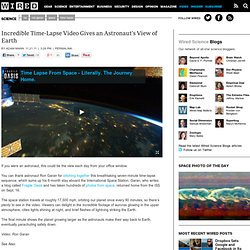
You can thank astronaut Ron Garan for stitching together this breathtaking seven-minute time-lapse sequence, which sums up his 6-month stay aboard the International Space Station. Garan, who writes a blog called Fragile Oasis and has taken hundreds of photos from space, returned home from the ISS on Sept. 16. The space station travels at roughly 17,500 mph, orbiting our planet once every 90 minutes, so there’s plenty to see in the video. NASA Supercomputers & Universe Structure, History & Evolution. Scientists have generated the largest and most realistic simulations of the evolving universe to date with the aid of NASA's powerful supercomputer, dubbed Pleiades.
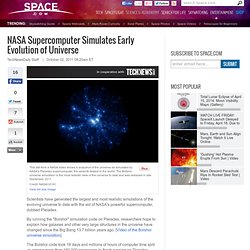
By running the "Bolshoi" simulation code on Pleiades, researchers hope to explain how galaxies and other very large structures in the universe have changed since the Big Bang 13.7 billion years ago. [Video of the Bolshoi universe simulation] Astronaut Video Shows Spectacular Auroras From Space. Stunning NASA videos are giving an astronaut's-eye view of spectacular aurora displays in the Southern Hemisphere. One video stitches together photos taken by astronauts aboard the International Space Station on Sept. 17, as the orbiting lab cruised over the Indian Ocean near Australia and Madagascar.
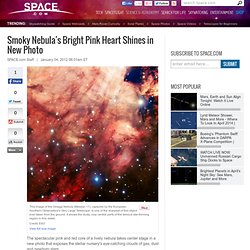
It shows the aururoa australis, also known as the southern lights — the counterpart to the northern lights. Video Show: A Blueprint of the Universe. Over Earth: Day & Night from ISS. Smoky Nebula's Bright Pink Heart Shines in New Photo. The spectacular pink and red core of a lively nebula takes center stage in a new photo that exposes the stellar nursery's eye-catching clouds of gas, dust and newborn stars.
Titan's Surprisingly Earth-like Surface Revealed - in Color. Pluto, You Have A Twin! Eris Accurately Sized-Up. Station Boost Proves Newton's Laws - All 3 of Them! The Sun's Magnetic Field (Simplified Animation) [720p] Alien Planet's Auroras: Beautiful And Frightening. Japanese "Tourist Camera" In Space Snaps Lightning & Auroras. Comet Lovejoy From the International Space Station. 2011 - An Exciting Year of Discoveries. #Egypt #Israel #FromSpace we are all neighbors A sneak peak a. Most Amazing Time Lapse Video of Milky Way Ever Made. Seriously.
Time-lapse Tuesday: Milky Way forms in fine detail. Sandrine Ceurstemont, video producer.

Born to be Viral: How to walk on Mars. MacGregor Campbell, consultant When the first people set foot on Mars, what will be the most efficient gait for them to use?

To find out, Australian artist Adam Norton is strapping people into his Martian gravity simulator and getting them to perform laps (see video above). The design is based on NASA lunar gravity simulators used before the Apollo moon landings to investigate how astronauts should safely move around in low gravity. They found that it was easier to bounce than walk. Since mass and horizontal inertia are the same as on Earth, but the force pulling down is much less, you don't need to take as many steps to get around.
Videos show giant solar flares, ensuing aurora borealis. People who wouldn't normally see auroras are being treated to stunning sights today thanks to the largest solar radiation storm since 2005.

Hubble videos reveal what it would really be like to fly into a nebula. And now, Apollo 17 astronauts singing. On the Moon. Una gran bola de fuego bajo en el cielo peruano. International Space Station Time Lapse Over Earth. Funny Videos, Free Games, & Funny Pictures Sign up | Login.
Peering Inside the Flame: Fusion Imaging of the Final Space Shuttle Launch. Peering Inside the Flame: Fusion Imaging of the Final Space Shuttle Launch Click image for full resolution.
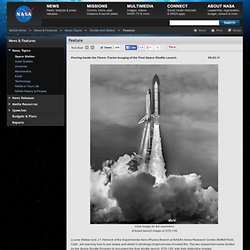
A fused launch image of STS-135. Louise Walker and J.T. Heineck of the Experimental Aero-Physics Branch at NASA's Ames Research Center, Moffett Field, Calif., are learning how to see shape and detail in blindingly bright plumes of rocket fire. Incredible time lapse: Milky Way over Africa. Q&BA: What happens if you are exposed to the vacuum of space?
Turn up your speakers and take a wild ride on a Shuttle solid rocket booster. On Google+, Michael Interbartolo — who worked for ten years on the Space Shuttle Program in Mission Control in Houston — just posted about this amazing video from cameras mounted on the Shuttle solid rockets as they rode into space. We’ve seen videos from rocketcams before, but this is very clear, and has enhanced sound that’ll rock your speakers: Makes sure you have it set to HD and crank up the volume! There’s a lot to see here! The Moon’s history of violence. Peering Inside the Flame: Fusion Imaging of the Final Space Shuttle Launch. Neil deGrasse Tyson: The Pluto Files. Bio Laura Danly Dr. Laura Danly is Curator at the Griffith Observatory, where she develops all educational, theatrical, gallery, and telescope programs.
She holds a Ph.D. in Astronomy, and is a spectroscopist specializing in ultraviolet observations from space satellites. Neil deGrasse Tyson Neil deGrasse Tyson was born and raised in New York City where he was educated in the public schools clear through his graduation from the Bronx High School of Science. To download this program become a Front Row member. ZOOM IN: Learn more with related books and additional materials. Encyclopædia Britannica Article Pluto. Station Crew Answers Your Questions in SPACE.com Interview. NASA Television in High Definition on UStream. The Gateway to Astronaut Photography of Earth. From Night to Day to Night Again This video was taken by the crew of Expedition 34 on board the International Space Station. The sequence of shots was taken on January 3, 2013 from 11:43:46 to 15:49:31 GMT, on a pass from northwestern Australia, making two complete orbits to eastern Quebec, near the Gulf of St.