
The World is Full of People - Overpopulation Videos. A glimpse of just how busting to the seams most countries are through their trains, metro and packed streets.

One of the often forgotten luxuries of living in the First World is the relative absence of crowds. A third of the world’s population is Chinese or Indian and in most poor countries it’s almost impossible to ever be alone. We tracked down some videos to give you a graphic feel of what it means to live with overpopulation as your daily reality. Bombay Trains There are places in Bombay where there are more than a million people for every square kilometer. Would you go to work on a train like this one? More on Bombay trains Tokyo Metro It’s hard to count the population of the world’s biggest cities because who decides when a suburb becomes a town in its own right or vice-versa. The normally reserved and isolated Japanese are obliged to get physically intimate… Walk Like an Egyptian. Overpopulation. The population of the entire world could fit shoulder-to-shoulder in a space about the size of Jacksonville, Florida.
Ninety-seven percent of the earth’s land surface is empty. If you allotted to each person 1,250 square feet (which is quite a bit), all the people in the world would fit into the state of Texas. According to the Food and Agriculture Organization, world food supplies exceed requirements in all world areas, amounting to a surplus approaching 50% in 1990 in the developed countries, and 17% in the developing regions. Problems commonly blamed on ‘overpopulation’ are the result of bad economic policy.
For example, Western journalists blamed the Ethiopian famine on ‘overpopulation,’ but that was simply not true. 98.07.02: The Population Explosion: Causes and Consequences. In the past, infant and childhood deaths and short life spans used to limit popula-tion growth.
In today's world, thanks to improved nutrition, sanitation, and medical care, more babies survive their first few years of life. The combination of a continu-ing high birth rate and a low death rate is creating a rapid population increase in many countries in Asia, Latin America and Africa and people generally lived longer. Over-population is defined as the condition of having more people than can live on the earth in comfort, happiness and health and still leave the world a fit place for future generations.1 What some people now believe that the greatest threat to the future comes from overpopulation. Indian Train : Crazy train full of people on the roof. Over Population. To view this page, you should have the most recent Java installed 32-bit JRE (Java Runtime Environment) 1.8.0.
Humans are now the most numerous mammal on the planet. There are more humans than rats or mice. Humans have a huge ecological footprint, magnified by their technology. Dr. David Suzuki (born: 1936-03-24 age: 78) What are the pros and cons of population growth. Think about it!

For whom? What is a pro for some might be a con for others. In what context? Short term or long term? Some examples: 1. But if you reduce the world population drastically, it is going to be a major shock to everyone now alive. An alternative is to reduce the birth-rates so that they are much less than replacement levels all over the world. People are already worried with workers per dependent expected to fall to just over 1. The Environmental Benefits of Population Growth? Gary Becker has posted a concise optimistic statement on his blog that all “Oil Drummers” should read.
“Neo-Malthusians who fear larger populations typically stress the effects on pollution and on the demand for non-renewable resources, like oil and natural gas. Clearly, the demand for fossil fuels and other non-renewable resources grows with population as well as with economic development. However, during the past 150 years, the real price of fossil fuels like coal and oil fell rather than increased as world population exploded, and additional economies prospered.
More efficient use of fossil fuels and discoveries of new reserves of these fuels, and innovations that produce alternate sources of energy, like nuclear power, explain why prices of fossil fuels did not rise along with population and industrialization. Population growth: What is desirable and sustainable, what is inevitable? Revisiting Carrying Capacity: Area-Based Indicators of Sustainability. Loop by William E.
Rees, The University of British Columbia Please address correspondence to Dr. Rees, The University of British Columbia, School of Community and Regional Planning, 6333 Memorial Road, Vancouver, BC, Canada V6T 1Z2. Population and Environment: A Journal of Interdisciplinary Studies Volume 17, Number 3, January 1996 @ 1996 Human Sciences Press, Inc. According to Garrett Hardin (1991), "carrying capacity is the fundamental basis for demographic accounting. " This article sides solidly with Hardin. Population growth: People, how many of us are going to make it? « geiasousuperman. The purpose of this post is to reflect my knowledge of the impact of population growth to the environment, the economy and generally the every-day life.

Moreover, this topic should trigger the reader to think more thoroughly by reconsidering his actions of consumption, affluence and his usage of technology. Climate Change -Earth’s Carrying Capacity -Population Question- and the Pied Piper. Population Control and Consequences in China. Ranking of most overpopulated states (countries) Population Research Institute. 8 October 2007 Vol. 9 / No. 37 On September 27-28, the University of La Sabana, a Catholic University located in Bogota, Colombia, convened a conference on "Population, Life, and Development.

" Steven Mosher told the assembly, which included senior government officials, that Colombia was not overpopulated. Like other Baby Boomers, I lived through the unprecedented doubling of the global population in the second half of the 20th century. Never before in human history had our numbers increased so far, so fast: from 3 billion in 1960 to 6 billion in 2000. But our numbers didn't double because we suddenly started breeding like rabbits. Colombia: TransMilenio bus protests paralyse Bogota. 9 March 2012Last updated at 20:46 ET More than 1,000 police were deployed to deal with the protests Public transport in the Colombian capital Bogota has been paralysed by protests for improved services and lower fares on the main bus network.
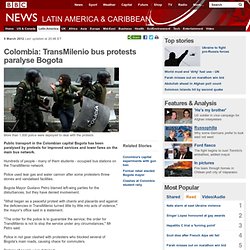
Hundreds of people - many of them students - occupied bus stations on the TransMilenio network. Police used tear gas and water cannon after some protesters threw stones and vandalised facilities. Bogota Mayor Gustavo Petro blamed left-wing parties for the disturbances, but they have denied involvement. America's Population Set to Top 300 Million. Clicking upward at a rate of one person every 11 seconds, the U.S. population will officially surpass 300 million in the next week or so.