
Privacy_and_Security_Enforcement_Tracker_March_2015-V2.
Taking picture. CJCE definition of PD. Dropbox and users' privacy. US privacy 2013 overview. Drone / privacy. Six degrés de séparation. Teens, Social Media, and Privacy. Deal for transferring payments data from the EU to US should be suspended, say MEPs. The European Parliament agreed a non-binding resolution on Wednesday that calls for the EU's Terrorist Finance Tracking Program (TFTP) agreement with the US to be suspended amidst concerns that a US intelligence agency is accessing the data outside of the agreed framework.
The TFTP allows, in accordance with certain protocols, US law enforcement bodies access to European data held by the Society for Worldwide Interbank Financial Telecommunications (SWIFT), which co-ordinates payments between financial institutions based across the world. Press reports earlier this year suggested, though, that the US National Security Agency (NSA) has been "tapping into EU citizens' personal financial data handled by ... SWIFT", a statement by the Parliament said. "The US authorities' access to these financial data is strictly limited by the TFTP deal," the Parliament said. "If proven, such activities would constitute a clear breach of the EU-US agreement. " How secure is your iPhone 5S fingerprint? 12 min ago | ChinaTechNews.com Alibaba Throws Money At Internet Privacy Hu Xiaoming, Alibaba's vice president for small- and micro-financial group and chief risk officer, announced in Beijing that the company will invest CNY40 million to establish a security fund.
Trending on the Topix Network. Www.alexanderhanff.com. So today I was working on some code for a new web site I am about to launch for one of my privacy projects.
I wanted a way to be able to log some statistics about my site visitors without retaining any information which might be considered as private, identifying or could be used to track them; these statistics are important for attracting sponsors. As a rule, I always disable logging everything apart from the date/time, requested page and result (whether or not the page was retrieved successfully) in Apache's access log - but this is a little cumbersome to navigate and create meaningful information from.
So I decided I wanted to save some statistical data to a database which I can then access and display in a number of useful ways such as tables & charts. I then sent myself the following text link via a DM in TweetDeck (I have multiple Twitter accounts): Hundreds of Pages of NSA Spying Documents to be Released As Result of EFF Lawsuit. Metropolitan Police launches campaign to tackle rising iPhone theft. More than 5,000 iPhones – and 7,000 mobile phones overall – are stolen in the capital every month, according the Metropolitan Police Service (MPS).
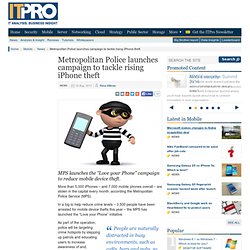
In a big to help reduce crime levels – 3,500 people have been arrested for mobile device thefts this year – the MPS has launched the “Love your Phone” initiative. People are naturally distracted in busy environments, such as cafés, bars and pubs, so we are working with the owners, giving crime prevention advice and information about local criminals to help them keep their customers safe and keep the thieves out. As part of the operation, police will be targeting crime hotspots by stepping up patrols and educating users to increase awareness of and, ultimately reduce, robbery incidents. Around 70 per cent of all thefts in the capital involve mobile phones – with 80 per cent of those targeting iPhones. The MPS launched “Operation Ringtone” in five London boroughs (Camden, Hackney, Islington, Lambeth and Westminster).
Internal audit shows NSA often breaks privacy rules, made thousands of violations a year. The Washington Post today published several big scoops related to the National Security Agency's surveillance programs.
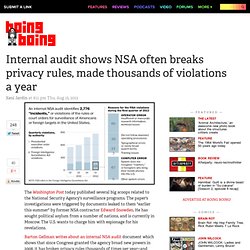
The paper's investigations were triggered by documents leaked to them "earlier this summer" by former NSA contractor Edward Snowden. He has sought political asylum from a number of nations, and is currently in Moscow. The U.S. wants to charge him with espionage for his revelations. E-mail's Big Privacy Problem: Q&A With Silent Circle Co-Founder Phil Zimmermann.
US, Britain Must Show Moral Leadership on Internet Privacy. Allegations of mass, indiscriminate government surveillance have sparked a global spat about its proper limits.
In defending their programs, the United States and Britain have exposed a troubling, two-tiered approach to the right to privacy in the digital age. Neither government seems willing to recognize the privacy interests of people outside its borders. One thing is clear: as our lives become more connected through the Internet, the right to privacy has never been under a greater global threat. You May Have 'Nothing to Hide' But You Still Have Something to Fear. This post was first published on MSNBC.com.
In the wake of recent news that the NSA is spying on Americans, I have been particularly struck by the argument that "if you've got nothing to hide, you've got nothing to fear. " At first blush, this argument might seem sound – after all, if the government is merely conducting anti-terrorism surveillance, non-terrorists shouldn't be affected, right? But if you look more closely, you'll see this idea is full of holes.
The "nothing to hide" argument mistakenly suggests that privacy is something only criminals desire. In fact, we choose to do many things in private – sing in the shower, make love, confide in family and friends – even though they are not wrong or illegal. How you're tracked digitally all day (and what you can do about it) On the show Devin Coldewey TODAY Aug. 1, 2013 at 9:10 AM ET Our daily habits — when we wake up, how we get to work, what we like to watch when we get home — are being tracked by dozens of interconnected systems, from cell carriers to traffic cameras.
Together, they could form a picture of your day in disturbingly high fidelity. It's not just high-priority targets and would-be terrorists that leave a digital trail as they go about their business — millions of Americans each produce gigabytes of data associated with themselves just by walking down the street, browsing the Internet, and using their mobile phone. Everything we thought we knew about privacy needs rethinking. Could health authorities force us to publish every detail of our daily activities by insisting we all carry smartphones with monitoring apps revealing not just how long we slept, but where?

And not just health authorities: your environmental authority may be interested in using such facilities for measuring your personal resource consumption and waste output, using such factors as your carbon footprint and environmental impact in order to calculate your taxes and benefits entitlements. About rethinking how we do privacy Long before the provision of any of this private data is insisted upon, we could find ourselves revealing it unintentionally, simply because we fail to consider the fact that voluntarily allowing others to monitor us for our own benefit does not mean that we are obliged to automatically release whatever is recorded, irrespective of the relevance to the benefit we are seeking.
About Deborah Estrin She is on the advisory board of TTI/Vanguard. Online privacy: How did we get here?
School holidays increase the risk of cyber bullying. Foreign VPNs offer protection against US government spying. Foreign providers of virtual private networks trying to cash in on recently uncovered U.S. government surveillance can increase the level of secrecy of Web activity, experts say.
However, no VPN vendor, foreign or domestic, sells a bulletproof defense against government snooping, given the resources and sophistication of spy agencies. However, using a service outside the U.S. does make the task of tracking and logging someone's Web activity more difficult. Privacy jitters reached new heights last month following reports that the U.S. National Security Agency is collecting massive amounts of private data on citizens from telephone and Internet companies, such as Verizon, Google, Facebook, and Microsoft. The court-approved data gathering is legal under the post-9/11 Patriot Act. A VPN is essentially an encrypted tunnel between a computer and the service provider, which effectively hides the customer's IP address and Web activity. ICANN says Article 29 letter does not give EU registrars privacy opt-out.
Registrars based in the European Union won’t immediately be able to opt out of “illegal” data retention provisions in the new 2013 Registrar Accreditation Agreement, according to ICANN. ICANN VP Cyrus Namazi on Saturday told the Governmental Advisory Committee that a recent letter from the Article 29 Working Party, which comprises the data protection authorities of EU member states, is “not a legal authority”. Article 29 told ICANN last month that the RAA’s provisions requiring registrars to hold registrant data for two years after the domain expires were “illegal”.
20130606_Letter_to_ICANN. ICANN says Article 29 letter does not give EU registrars privacy opt-out. Twitter Yields to Pressure in Hate Case in France. Never, EVER, Trust Facebook. I stopped using Facebook a long time ago, but I didn’t want to remove my account and have no visibility on how or what Facebook might be showing about me or someone using my name.
So I decided to simply remove all my Facebook content. Just over a year and a half ago, on January 30, 2012, I deleted every single Wall post I had ever made. By hand. One. Where “nothing to hide” fails as logic. Every April, I try to wade through mounds of paperwork to file my taxes. Like most Americans, I’m trying to follow the law and pay all of the taxes that I owe without getting screwed in the process. I try and make sure that every donation I made is backed by proof, every deduction is backed by logic and documentation that I’ll be able to make sense of three to seven years later. Because, like many Americans, I completely and utterly dread the idea of being audited. Law - June 2013 Privacy Law Scholars Conference. How Privacy is Lost. April 28th, 2013 at 17:45 UTC by Ross Anderson On Friday I went to a fascinating lobbying meeting on the new EU data protection regulation.
Europe is by default the world’s privacy regulator, as America doesn’t care and no-one else is big enough to matter; so this is really important. Some 3000 amendments have been proposed and the regulation is in the final stages of the committee process; the rapporteurs of the various parties are negotiating compromise amendments which should be ready for a vote within weeks. So the pressure is really on. Friday was extraordinary because all the lobbyists came together in one room to argue their cases. I am posting my notes of the meeting here, as it’s a good case history of how lobbying works, as well as of how our privacy is being lost. Sarah Ludford DPR meeting, 3–6 PM, 26/4/13, Europa House, Smith Square. Sarah says the shadows’ meeting has not so far gone through the articles in order but cherry-picked; started with articles 2, 3, 81, 83. 1. ..
Data privacy: What your zip code reveals about you - Apr. 18, 2013. All that is needed to match the information data brokers compile with what you buy is your full name — obtained when you swipe a credit card — and a zip code, according to data privacy experts. NEW YORK (CNNMoney) TSA to remove controversial X-ray scanners due to privacy concerns. Would You Crowd-Source Your Email To Save Time? We’re all busy and getting busier, which doesn’t fit well with a list of unread email that refuses to stop growing. Now, a team of researchers has developed a crowd-sourced email valet system — but would you share your inbox to streamline your life?
New Scientist reports that academics from Stanford University have developed a new system called GmailValet. Using oDesk, a crowd-labour web platform, it draws on a pool of online workers to crunch through your email for you. FTC releases landmark update to child online privacy laws. FTC Demands Companies Disclose How They Gather, Use Consumer Data.
The Lawsuits Are Already Filed: Create Your Mobile Privacy Policy Now! What Instagram's New Terms of Service Mean for You. Médias & Publicité : « Les particuliers seront informés en cas de faille de sécurité sur Internet » Sen. Franken Wants Apps To Get Explicit Permission Before Selling Your Whereabouts To Random Third Parties. V. ODNI. Top News Supreme Court Upholds Residents-Only Provision in Virginia Open Records Law: The Supreme Court ruled today that Virginia's freedom of information law, which allows only Virginia residents to pursue open government requests, does not violate the U.S.
Constitution. Privacy2012. U.N. Office on Drugs and Crime report reveals international protocol for tracking terrorists online. Photo by Bodo Marks/AFP/Getty Images In the shadowy world of electronic surveillance, tactics used by law enforcement agencies are rarely revealed. But now an international protocol about how to best monitor and track people online has been disclosed for the first time—offering a unique insight into covert police methodology. Ryan Gallagher is a journalist who reports on surveillance, security, and civil liberties. Follow Buried in a recent 158-page U.N. report on how terrorists use the Internet is the so-called “protocol of a systematic approach.”
Privacy Watchdog Seeks ‘Urgent’ Details of Facebook Changes. Privacy law can't keep up with digital age. Judge Accepts $22.5 Million Google Fine in Safari Privacy Case CIO. Email Users Can't Count on Privacy Protections. Hogan Lovells Senior Policy Advisor Leads Harvard Law Review Privacy Symposium. Data Mining a Major Challenge to Personal Privacy. EFF Raises Questions on Privacy Leaks in Ubuntu. Verizon Spying Controversy Confuses Executive, Implies Personal Privacy Is Gone.
Canadian, German data protection watchdogs join forces. Highest Court in the European Union To Rule On Biometrics Privacy. California-ag-publicly-shames. Google is ordered to pay violation charge – 250.000 NOK = 34.000 EURO!!! Facebook's new ad tracking partnership stokes privacy concerns. Update: GAO Report Recommends Government Address Privacy Issues With Drones. Ethics charges for two lawyers over. #PrivChat. Your Old Tweets Resurface with Twitter’s Data Reseller Partners.
UK ISPs to filter. LinkedIn Pulled A Facebook And Messed With Y. What the Search Giants Know About You, Part. EU/US internet privacy. Do U know whos watching you. Privacy Nutrition Labels. Privacy in academia. No privacy for corporations. Your most dangerous possession? Your smartph. Annotated Bibliography SNS and privacy. No balance in privacy. Personal privacy tool. Self distructible message. Privacy and wikileaks. Microsoft Kinect eavesdropping. IP Address / Privacy. Body scanner. Biometrics. Right to be forgotten. CopyR/privacy in conflict with FoE/press.
Sécurité et vie privée. Facebook-1. School laptops camera.