
Money in Politics Is Taxation Without Representation Today, April 15, is Tax Day.

Most of us will dutifully pay our taxes to a government that no longer represents us. Policy decisions on nearly every issue, regardless of public opinion, are decided in favor of a select few who can afford to write massive checks, host campaign fundraisers, and hire armies of lawyers and lobbyists. That might read as an exaggeration to some, but it's a verifiable fact of the American political system. A new analysis of 1,779 recent policy outcomes by researchers at Princeton and Northwestern found that "economic elites and organized groups representing business interests have substantial independent impacts on U.S. government policy," while average citizens -- the people in "We, the People" -- "have little or no independent influence. " Why? Another recent study by researchers at Yale and UC Berkeley found that members of Congress were four times as likely to take a meeting with a prospective donor than with a regular constituent.
The End of the Capitalist Era, and What Comes Next The capitalist era is passing... not quickly, but inevitably.
A new economic paradigm — the Collaborative Commons — is rising in its wake that will transform our way of life. We are already witnessing the emergence of a hybrid economy, part capitalist market and part Collaborative Commons. The two economic systems often work in tandem and sometimes compete. They are finding synergies along each other’s perimeters, where they can add value to one another, while benefiting themselves. At other times, they are deeply adversarial, each attempting to absorb or replace the other. 2014: Investing in a World of Hyper-aggressive Monetary Policy. The growth of the U.S.'s bigger and broader productive economy has been stunted by bad policies and bank bailouts benefiting rent-seeking financiers siphoning off an outsized percentage of the nation's gross domestic product (GDP).
Rent-seeking companies lobby Congress for subsidies for activities that do not benefit society. S.bsd.net/stuff/default/page/-/Downloads/MovieScripts/SoCap%26Trade_Annotated_Script.pdf. The Most Disturbing Part Of The JPMorgan News Is That It's Not Shocking At All. No one who has spent more than a little time in China can be shocked by the latest blockbuster from The New York Times about the means through which the family of former Premier Wen Jiabao traded access to power for personal gain.
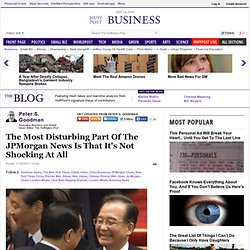
The company at the center of this most recent story makes for particularly compelling reading: JPMorgan Chase, the ultimate "too big to fail" institution, lately embroiled in enough scandals to make Goldman Sachs look like Mother Theresa. The same bank still accounting for its craven abuses in mortgage markets, its London Whale derivatives debacle, and its manipulation of the key index known as Libor now stands accused of essentially funneling funds to Wen Jiabao's only daughter to win business in China, bringing a federal probe.
When foreign companies enter China -- the world's largest potential market for damn near everything -- they tend to adapt to local conditions. This seems to be the thinking at work at JPMorgan. James Howard Kunstler: The Era of Giant Chain Stores Is Over. Back in the day when big box retail started to explode upon the American landscape like a raging economic scrofula, I attended many a town planning board meeting where the pro and con factions faced off over the permitting hurdle.
The meetings were often raucous and wrathful and almost all the time the pro forces won -- for the excellent reason that they were funded and organized by the chain stores themselves (in an early demonstration of the new axioms that money-is-speech and corporations are people, too!). The chain stores won not only because they flung money around -- sometimes directly into the wallets of public officials -- but because a sizeable chunk of every local population longed for the dazzling new mode of commerce.
Tom Engelhardt: The U.S. Intelligence Community's New Year's Wish. Megatrends, Game-Changers, Black Swans, Tectonic Shifts, and a World Not That Different From 2012 Cross-posted with TomDispatch.com Think of it as a simple formula: if you’ve been hired (and paid handsomely) to protect what is, you’re going to be congenitally ill-equipped to imagine what might be.
And yet the urge not just to know the contours of the future, but to plant the Stars and Stripes in that future has had the U.S. Bill Maher: Won Direction. Cross-posted on HBO's Real Time With Bill Maher site.
New Rule: Now that he's been reelected, President Obama must get back at all those right wing hacks who tried to paint him as an angry black man pushing a liberal agenda by becoming an angry black man who's pushing a liberal agenda. Now, I have been mostly holding my tongue about the president this past season, because I didn't want to muddy the waters in a country where you only get two choices, but Mr. President, there are two ways to look at your 51 to 48 percent victory: One is, we love you.
The other is, we like you three percent better than Mitt Romney. The Critical Thinking Crisis. Commentary from Stephen Whitley You'd think someone who earns admission into college is ready to handle the work they are assigned.
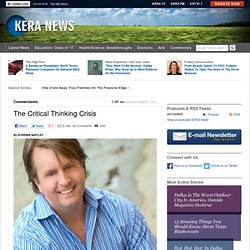
But commentator Stephen Whitley doesn't agree. While driving through the university campus where I attend graduate school and work as the Director of the Writing Center, I saw lots of new students moving into dorms. They come with hopes and dreams and ideas about what a university education will help them achieve. But many of these students are not prepared for the important task of critical thinking and analysis that is required for college level work.
John Henry Newman describes the university as “a place for the communication and circulation of thought, by means of personal intercourse,” yet most of our students don’t see the university as a way to learn more about the world. Inside Intellectual Ventures, the most hated company in tech. BELLEVUE, Wash. -- To many in the high-tech business, a troll plots his schemes in a white office building on a hill in this leafy suburb of Seattle.
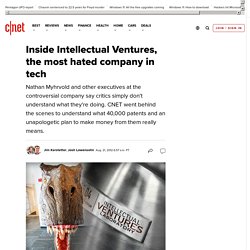
This is the home of Intellectual Ventures, which, depending on whom you ask, is either the biggest, most aggressive patent troll on the planet or a pioneering company that's helping inventors get their fair share. The question of "whom you ask" is a big one, of course. Since it was founded in 2000 by Microsoft veterans Nathan Myhrvold and Edward Jung, Intellectual Ventures has -- through $5 billion in investment funds and its own brainstorming efforts -- collected nearly 70,000 "intellectual assets" on technologies ranging from nuclear power to camera lenses. It currently controls about 40,000 intellectual assets. In the process, Intellectual Ventures has become a boogieman for aspiring entrepreneurs and big tech companies alike. John R. Talbott: Economics and Business: Tell Your Professors to Speak Up. Economists, finance professors, options and derivatives experts and business school professors have dropped the ball completely when it comes to the financial crisis.
Not only did less than a handful see it coming, the silence coming from the rest today is deafening as they avoid speaking out on the economy's ills, real bank reform, controlling derivative and systemic risk, the damage that corporate lobbying is doing to our country or the risks to the middle class in the U.S. and Europe of free and unfettered trade with very low wage countries such as China. Of course there are one or two who have carried the load such as Simon Johnson of MIT and Anat Admati of Stanford who have tried their hardest to push congress and regulators to enact meaningful bank reforms, but most professors are laying low so as not to offend the very banks and corporations who pay them for speeches, wine and dine them, employ them in joint ventures, hire them as expert witnesses and fund their universities.
Noam Chomsky: Plutonomy and the Precariat. On the History of the U.S. Economy in Decline Cross-posted with TomDispatch.com The Occupy movement has been an extremely exciting development. Unprecedented, in fact. Jared Bernstein: What's Fair? Five (or Six) Principles of Tax Fairness. This word "fairness" keeps coming up around tax day, particularly in discussions around the Buffett rule.
Many have questioned what I and others mean by "fair. " I've got five answers. A fair tax system should be: Bill McKibben: Payola for the Most Profitable Corporations in History. And Why Taxpayers Shouldn’t Stand for It Any More Cross-posted with TomDispatch.com Along with “fivedollaragallongas,” the energy watchword for the next few months is: “subsidies.” Last week, for instance, New Jersey Senator Robert Menendez proposed ending some of the billions of dollars in handouts enjoyed by the fossil-fuel industry with a “Repeal Big Oil Tax Subsidies Act.”
It was, in truth, nothing to write home about -- a curiously skimpy bill that only targeted oil companies, and just the five richest of them at that. Left out were coal and natural gas, and you won’t be surprised to learn that even then it didn’t pass. Still, President Obama is now calling for an end to oil subsidies at every stop on his early presidential-campaign-plus-fundraising blitz -- even at those stops where he’s also promising to “drill everywhere.” Whether or not the bill passes, those subsidies are worth focusing on. Robert Reich: The Defining Issue: Not Government's Size, But Who It's For. The defining political issue of 2012 won't be the government's size. It will be who government is for. Americans have never much liked government. After all, the nation was conceived in a revolution against government. But the surge of cynicism now engulfing America isn't about government's size. It's the growing perception that government isn't working for average people.
Dean Baker: Economic Conflicts With China and Class War in the United States. The Commerce Department's release of trade figures last week showed another large deficit with China for October, albeit slightly lower than the record hit the previous month. This figure will renew the calls for stronger action against China. Unfortunately the debate over China is often buried in confusion, leading to a situation that is not conducive to effective action. A major reason for this confusion is that there is not a common U.S. interest against China. The interests of the 99 percent differ greatly from the interests of the 1 percent.
How Big Car Services Use Legislation to Drive Over Competition. NASHVILLE, Tenn.-- In June 2010 the Nashville Metropolitan City Council passed legislation raising the city's minimum fee for limo and sedan rentals, bumping it from $25 to $45. Drivers were prohibited by law from charging less. Other new regulations forbid limo companies from using leased vehicles, require cars to be dispatched only from the place of business, compel companies to wait 15 minutes before picking up a client, and ban parking in front of hotels and bars to wait for customers. More laws that take effect in January 2012 would also require companies to replace all sedans and SUVs over seven-years-old, and all limos 10-years-old and older. Vehicles older than five years cannot enter into service. Robert Reich: The Most Important Economic Speech of His Presidency. Dylan Ratigan: Bought Justice and the Supreme Court. The Supreme Court looms over our political landscape like a giant, immovable object.
Americans have traditionally respected the court's purview, believing that it serves justice, dispassionately. Dylan Ratigan: Bought Justice. Corporate Citizenship: How Public Dissent In Paris Sparked Creation Of The Corporate Person.
Ian Fletcher: It's the Free Trade, Stupid. One point seems largely to have been missed in recent weeks, amid all the excitement over the Federal budget and the sovereign-debt crises in Europe: free trade is largely the root cause of all these problems. So let's trace the causation for a minute. Start with the Federal budget. Federal revenues are derived from the underlying economy, and therefore, if the underlying economy were larger, revenues would be, too -- even without any tax increases. As a result, anything that causes the U.S. economy to be smaller, tends to widen any gap between expenditures and revenues. Enter free trade. For it is thanks to America's embrace of free trade (whether genuinely free or not; that's another issue) that we have been running giant trade deficits for years.
The Economic Strategy Institute, a Washington think tank, estimated in 2001 that the trade deficit was shaving at least one percent per year off our economic growth. That's an economic hole larger than the entire Canadian economy. Friedman. Leo Hindery, Jr.: A Vision for Economic Renewal. America is facing a catastrophic jobs crisis. Not since the Great Depression has official unemployment hovered above nine percent -- where it is today -- for more than 20 months. Millions of American have given up looking for a job altogether. Martin Ford: Could We Have Civil Unrest and Riots in the U.S. as a Result of Extreme Inequality? John R. Talbott: The New High Tech Bubble. Facebook has been valued recently at $80 billion while Google has a current public market value of $195 billion and Apple has a market capitalization of $350 billion. Nathan Newman: The Cost Of Lost Privacy, Part 1: How Google and Data-Mining Drive Economic Inequality in Our Nation.
Ian Fletcher: The Coming Upheaval in Republican Economics. The Five Myths of the Hydrogen Fueled Vehicle. Census Bureau Home Page. US federal deficit: how much does China own of America's debt? Johann Hari: Factory Farming Is Manufacturing Superbugs. Ian Fletcher: How China Plans to Leapfrog the American Economy (And it's Not What You Think) Noam Chomsky: Is the World Too Big to Fail? The Contours of Global Order. Of the 1%, by the 1%, for the 1% Robert Scheer: The Peasants Need Pitchforks.
Robert Reich: How Democrats Can Become Relevant Again (And Rescue the Nation While They're At It) Ian Fletcher: Why Have Nations at All? The Case for Economic Borders. Ian Fletcher: The Obama Administration's Clueless Trade Diplomacy. Steven Hill: The China Superpower Hoax. Dean Baker: If Progressives Wanted to Win. Trying to understand income inequality, the most profound change in American society in your lifetime. - By Timothy Noah. The Century of the Self - 1 of 4 - Happiness Machines. Howard Schweber: Laffer Curves and Tax Cuts: What Does It Take to Kill a Zombie?
Chris Weigant: Democracy's Drawback. Hu Visit A Reminder Of One Way China Leaves U.S. In The Dust. Tom Engelhardt: A World Made by War: How Old Will You Be When the American War State Goes Down? Leo Hindery, Jr.: Let the Screaming Begin. Breaking the chain: The antitrust case against Wal-Mart, By Barry C. Lynn.