
Surfing the Web in class? Bad idea. Even the smartest college students suffer academically when they use the Internet in class for non-academic purposes, finds new research by Michigan State University scholars.
The study, funded by the National Science Foundation, speaks to typical lecture-hall culture in which professors compete for students' attention with laptops and smartphones. "Students of all intellectual abilities should be responsible for not letting themselves be distracted by use of the Internet," said Susan Ravizza, associate professor of psychology and lead investigator on the study. Ravizza and colleagues studied non-academic Internet use in an introductory psychology class at MSU with 500 students. The working theory: Heavy Internet users with lower intellectual abilities -- determined by ACT scores -- would perform worse on exams.
Past research suggests smarter people are better at multitasking and filtering out distractions. But surprisingly, that wasn't the case. Modern myths of learning: The creative right brain. First published on TrainingZone, 03/06/2009 Tweet this If you like this you may also like:Modern myths of learning: You only use 10% of your brain “Creative (Right-Brain) people can attain their goals!”
“Creative people use the RIGHT side of their brains more than the LEFT” “Do you get bored when teachers lecture too much? … If so, you may be right-brain dominant” All typical statements about the brain drawn from the internet… All based on a myth. There’s a modern myth of learning that certain complex mental tasks are dealt with exclusively by one side of the brain or the other. Left brain, right brain… it’s a no brainer Like previously examined myths (You only remember 10% of what you read, and you only use 10% of the brain) this has a pseudo-scientific aura about it. The problem is that interpreting the results of this surgery is more complex than carrying out the initial operation, as neurophysiologist Professor William H Calvin points out in his essay ‘The Throwing Madonna’.
Tweet this. ABC Active Memory: Fun, personalised program of brain games. ABC Active Memory: Fun, personalised program of brain games. Active Memory's structured brain training program is based on robust science and breakthrough statistical modelling.
There are a growing number of studies that demonstrate positive benefits flowing from brain training games. However, most of these studies have been conducted with small samples and don't always include the controls needed for definitive conclusions. The largest study conducted so far is the BBC study of 11,000 players in the UK, which led to the conclusion that braining training games lead to better performance on…braining training games. However, this pioneering study had many limitations. Smaller studies without the same limitations are finding more positive results for the use of memory and other cognitive functions in tasks beyond brain training. Brain exercises, mastery and motivation We know brain games can be difficult, and failure is often part of the process of mastery.
Active Memory does this in two ways. The Progressive Mastery algorithm Professor Robert Wood PhD. Cognitive Training, Brain Test - The IMPACT Study. A landmark study with dramatic resultsWith 487 participants, the IMPACT study is the largest clinical trial ever to examine whether a specially designed, widely available cognitive training program significantly improves cognitive abilities in adults.
Led by distinguished scientists from Mayo Clinic and the University of Southern California, the IMPACT study proves that people can make statistically significant gains in memory and processing speed if they do the right kind of scientifically designed cognitive exercises. The study was conducted on the original Posit Science Brain Fitness Program, which contains six of the auditory exercises in BrainHQ: Sound Sweeps (previously called High or Low?) , Fine Tuning (previously called Tell Us Apart), Memory Grid (previously called Match It!)
, Syllable Stacks (previously called Sound Replay), To-do List Training (previously called Listen and Do), and In the Know (previously called Story Teller). Study Design (pdf) | Study Results (pdf) The lesson you never got taught in school: How to learn! A paper published in Psychological Science in the Public Interest evaluated ten techniques for improving learning, ranging from mnemonics to highlighting and came to some surprising conclusions.
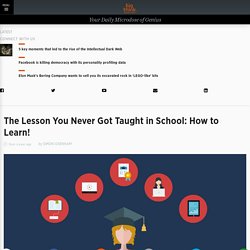
The report is quite a heavy document so I’ve summarised the techniques below based on the conclusions of the report regarding effectiveness of each technique. Be aware that everyone thinks they have their own style of learning (they don't, according to the latest research), and the evidence suggests that just because a technique works or does not work for other people does not necessarily mean it will or won’t work well for you. If you want to know how to revise or learn most effectively you will still want to experiment on yourself a little with each technique before writing any of them off.
Elaborative Interrogation (Rating = moderate) A method involving creating explanations for why stated facts are true.