Materials

FacebookTwitter
Photochromic materials change reversibly colour with changes in light intensity. Usually, they are colourless in a dark place, and when sunlight or ultraviolet radiation is applied molecular structure of the material changes and it exhibits colour. When the relevant light source is removed the colour disappears. http://www.designinsite.dk/htmsider/m1316.htm

Photochromic materials

Electroluminescent materials

Electroluminescent materials produce a brillant light of different colours when stimulated electronically (e.g. by AC current). http://www.designinsite.dk/htmsider/m1327.htm

Conducting polymers

http://www.designinsite.dk/htmsider/m1328.htm Conducting polymers are conjugated polymers, namely organic compounds that have an extended p-orbital system, through which electrons can move from one end of the polymer to the other. The most common are polyaniline (PAni) and polypyrrole (PPY).
http://www.designinsite.dk/htmsider/m1325.htm Fluorescent materials produce visible or invisible light as a result of incident light of a shorter wavelength (i.e.

Fluorescent materials

Phosphorescent or afterglow materials produce visible or invisible light as a result of incident light of a shorter wavelength (i.e. X-rays, UV-rays, etc.), detectable only after the source of the excitement has been removed. Afterglow effect pigments are polycrystalline inorganic zinc sulphide (green afterglow) or alkaline earth sulphides (red or blue afterglow), and can be used in paints, inks or mixed to moulding or casting materials for different applications.

Phosphorescent materials

http://www.designinsite.dk/htmsider/m1326.htm
Dielectric elastomers (also called electrostrictive polymers) exhibit a mechanical strain when subjected to an electric field. http://www.designinsite.dk/htmsider/m1329.htm

Dielectric elastomers

http://www.designinsite.dk/htmsider/m1315.htm

Polymer gels

Polymer gels consist of a cross-linked polymer network inflated with a solvent such as water.
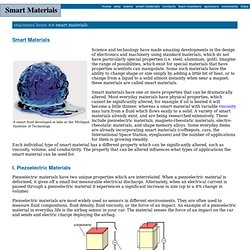
Science and technology have made amazing developments in the design of electronics and machinery using standard materials, which do not have particularly special properties (i.e. steel, aluminum, gold). http://webdocs.cs.ualberta.ca/~database/MEMS/sma_mems/smrt.html
Smart Materials

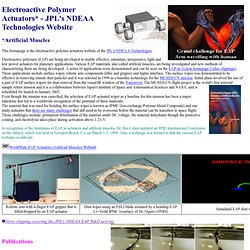
*Artificial Muscles This homepage is the electroactive polymer actuators website of the JPL's NDEAA Technologies . Electroactive polymers (EAP) are being developed to enable effective, miniature, inexpensive, light and low power actuators for planetary applications.

Artificial Muscles and Electroactive Polymers at JPL

http://ndeaa.jpl.nasa.gov/nasa-nde/lommas/aa-hp.htm
"Smart" materials respond to environmental stimuli with particular changes in some variables.

Design inSite

http://www.designinsite.dk/htmsider/md950.htm