
Art Spiegelman Retrospective at Jewish Museum. Reading Images: An Approach and a Demonstration. Approaching Images Students need to learn how to read images, including images linked with texts, for many of the same reasons they learn how to analyze and interpret purely verbal texts -- essays, memoirs, articles, and other forms of nonfiction; poems, stories, plays, and other genres of literature.
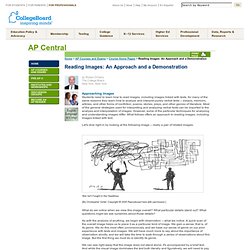
Most of the general strategies used for interpreting and analyzing verbal texts can be imported to the analysis and interpretation of images. However, some of the particular techniques for analyzing and understanding images differ. What follows offers an approach to reading images, including images linked with text. Let's dive right in by looking at the following image -- really a pair of related images. What do we notice when we view this image overall? As with the analysis of anything, we begin with observation -- what we notice. We can see right away that the image does not stand alone; it's accompanied by a brief text. Scott McCloud, author of "Understanding Comics" and "Zot!": Interview on The Sound of Young America. Scott McCloud.
Scott McCloud on comics. The Center for Cartoon Studies. Comics about Iraq, Chechnya, Abu Ghraib: Joe Sacco’s Journalism, reviewed. Journalism by Joe Sacco.
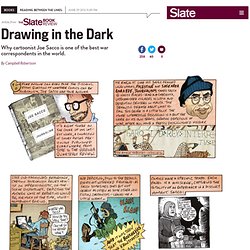
Metropolitan Books. Chris Hedges and Joe Sacco: drawing America's invisible poor - audio slideshow. Comic Books as Journalism: 10 Masterpieces of Graphic Nonfiction - Kirstin Butler. An unusual summer reading roundup of books that blend meaty subject matter with engaging visual storytelling Who doesn't love comic books?
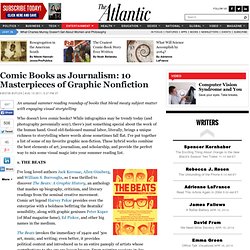
While infographics may be trendy today (and photography perennially sexy), there's just something special about the work of the human hand. Good old-fashioned manual labor, literally, brings a unique richness to storytelling where words alone sometimes fall flat. I've put together a list of some of my favorite graphic non-fiction. These hybrid works combine the best elements of art, journalism, and scholarship, and provide the perfect way to mix some visual magic into your summer reading list. I've long loved authors Jack Kerouac, Allen Ginsberg, and William S.
The Beats invokes the immediacy of 1940s and '50s art, music, and writing; even better, it provides political context and introduced us to an entire panoply of artists whose contributions to the era are lesser known. Maus Index. ComicBookLessonPlan. Elder-SIT-2009-guide. Responsibility in the holocaust ushmm. Representingtheholocaust - Course Schedule and Readings. Be A Nose! HD. The St. Louis Refugee Ship Blues (washingtonpost.com) Teaching Comics. Online Material for Comics Courses We're in the process of developing these pages to provide links and information on all comics related classes at UF.
Please email us if you teach comics classes at UF, elsewhere, or know of additional resources so we can add that information to these pages. For more information on teaching comics, see TeachingComics.org, which lists various teaching resources, syllabi, and more. Comic surrealism. Early in his career, René Magritte devised and published a rulebook for the rest of his life's work, "Les mots et les images" (La Révolution surréaliste, no. 12, 15 décembre 1929; in Magritte 1979: 60–63).
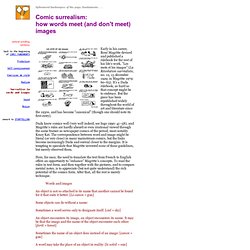
It's a Dada rulebook, as hard as that concept might be to embrace. But the piece has been republished widely throughout the world of art and literature since the 1930s, and has become "canonical" (though one should note its first entry). Dada knew comics well (very well indeed; see Inge 1990: 41–58), and Magritte's rules are hardly absurd or even irrational viewed through the same frames as newspaper comics of the period, most notably Krazy Kat. The correspondence between word and image might be literal (or very close) in many mainstream comics, but the links become increasingly Dada and surreal closer to the margins. Alan Moore: 'Why shouldn't you have a bit of fun while dealing with the deepest issues of the mind?'
There is a certain degree of swagger, a sudden interruption of panache, as Alan Moore enters the rather sterile Waterstones office where he has agreed to speak to me.
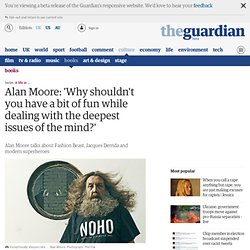
The jut of beard, the ringed fingers, the walking stick one feels he could use as a wand or a cudgel at any moment: he looks like Hagrid's wayward brother or Gandalf's louche cousin. He has a laugh that might topple buildings, though I doubt the man who reinvented the superhero comic would want such powers. Visual Literacy Using Digital Still Images. 1) learning the basics of how to use a digital still camera; 2) downloading your pictures to a computer; and 3) using ImageBlender software to create more advanced imaging techniques and integrate those images in the curriculum. As a teacher it doesn't matter if you are a beginner or a novice, your goal is to create of collect images that will optimize visual literacy with a community of learners. What is Visual Literacy? "Visual literacy is defined as the ability to interpret images as well as to generate images for communicating ideas and concepts". A visually literate person should be able to Interpret, understand and appreciate the meaning of visual messages;Communicate more effectively by applying the basic principles and concepts of visual design;Produce visual messages using computers and other technologies; andUse visual thinking to conceptualize solutions to problems Additonal Resources:
Looking & Telling: Take a good look! A format for looking at and talking about photographs. Overview. Digital Montage: Introduction. Describes subject matter that is presented in a brief, simplified, often distorted manner, with little or no attempt to represent images realistically.

In La ngresse blonde (The Blond Negress) Brancusi dramatically simplifies a woman's face, delineating only her hair and lips. Mondrian's New York City 2 reduces and abstracts the appearance and energy of the city to a series of lines. Advanced: Language Arts. Describes subject matter that is presented in a brief, simplified, often distorted manner, with little or no attempt to represent images realistically.

In La ngresse blonde (The Blond Negress) Brancusi dramatically simplifies a woman's face, delineating only her hair and lips. Mondrian's New York City 2 reduces and abstracts the appearance and energy of the city to a series of lines. Teaching Graphic Novels. But This Book Has Pictures! The Case for Graphic Novels in an AP Classroom. Make Complex Concepts Approachable Integrating graphic novels into my curriculum has been one of the best choices I have made as a teacher of both high- and lower-level students.

These novels can make a difficult subject interesting and relatable. I have seen many students with no previously expressed interest in language and literature excel in the analysis of a graphic novel. The graphic novel is also an excellent way to teach complex concepts to higher-level students and to introduce them to an important postmodern genre. Comics as Critique: Some Approaches to Graphic Teaching, part 1. Creating Effective Poster Prese. Three Bears Soviet Propaganda Parody. Comic Books for Grown-Ups: 10 Masterpieces of Graphic Nonfiction. By Kirstin Butler Seeing the world in six-panel strips, or what Allen Ginsberg has to do with the wonders of zygotes.
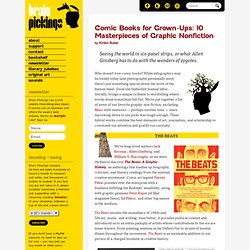
Who doesn’t love comic books? While infographics may be trendy today (and photography perennially sexy), there’s just something special about the work of the human hand. Good old-fashioned manual labor, literally, brings a unique richness to storytelling where words alone sometimes fall flat. 'The Graphic Canon': When Great Literature Collides With Cartoons. A Librarian Responds to a Book Challenge. 7 More Alan Moore Comics That Could Get Librarians Fired. A library employee in Kentucky was so offended by Alan Moore’s The League of Extraordinary Gentleman: The Black Dossier that she effectively took it out of circulation, and was recently fired for her efforts. But God knows what the amateur comics censor would have thought of the prolific Moore’s other titles, some of which make The Black Dossier look like Harold and the Purple Crayon.
Here are seven arguably more controversial works that might have burned bigger holes in her pious backpack. From Hell Most everyone knows the story: A deranged madman named Jack the Ripper terrorizes England, immediately rendering it less jolly. Alan Moore Culture Show pt1. Graphic novels. NOTE: This site is no longer active. Please visit Graphic Novels in the Classroom, my Scoop.it site where I'm now curating articles that focus on working with graphic novels in the the classroom. For a detailed list of my publications and presentations, please visit my Professional Profile. Picture books.
Graphic Novels. Comics. AAEC - Association of American Editorial Cartoonists. Congress clears way to sue Saudis Teachers: Download the lesson and print it out for use in your classroom. (PDF format) Common Core State Standard RL.CSS.2/4 Grades 6-12: Students determine the meaning of political cartoons through the analysis of their literal, symbolic and figurative meanings of the elements the artist used and their effect. Students are asked to describe the overall effect of the cartoon, and how the artist’s choices combine to create that effect. Finally, students determine the purpose of the cartoon and how it relates to current issues through discussion questions.
R. Sikoryak On Digital Tools For Comics. The New York Comics & Picture-Story Symposium is a weekly forum for discussing the tradition and future of text/image work. The Secret Language Of Comic Strips.