
Neoclassical growth model. The Solow–Swan model is an exogenous growth model, an economic model of long-run economic growth set within the framework of neoclassical economics.

It attempts to explain long-run economic growth by looking at capital accumulation, labor or population growth, and increases in productivity, commonly referred to as technological progress. At its core is a neoclassical aggregate production function, usually of a Cobb–Douglas type, which enables the model “to make contact with microeconomics”.[1]:26 The model was developed independently by Robert Solow and Trevor Swan in 1956,[2][3] and superseded the post-Keynesian Harrod–Domar model.
Due to its particularly attractive mathematical characteristics, Solow–Swan proved to be a convenient starting point for various extensions. For instance, in 1965, David Cass and Tjalling Koopmans integrated Frank Ramsey's analysis of consumer optimization, thereby endogenizing the savings rate—see the Ramsey–Cass–Koopmans model.
Background[edit] where , and . Ramsey–Cass–Koopmans model. Key equations of the Ramsey–Cass–Koopmans model[edit] Phase space graph (or phase diagram) of the Ramsey model.

Ramsey.pdf (application/pdf Object) Solow_1956.pdf (application/pdf Object) Labour-augmenting technical progress « mnmeconomics. The basic form of the Solow model gives us a bit of an unsatisfactory conclusion: 1.

The economy will grow in terms of output per worker until it reaches a steady state level of output per worker. At steady state level of output per worker, the economy still grows, but it only grows at the rate of labour force growth (which we model as equal to the rate of population growth). 2. Raising the saving rate means you can lift yourself out of steady state and continue to grow for a while until you reach a new steady state. So this basically says that all economies will reach a point where they can no longer increase their living standards because output per worker will become constant. If the Solow model is to really offer a good framework for thinking about growth, we need some way of explaining how countries can have continuously growing living standards. Solow Model « mnmeconomics. The basic form of the Solow model gives us a bit of an unsatisfactory conclusion: 1.

The economy will grow in terms of output per worker until it reaches a steady state level of output per worker. At steady state level of output per worker, the economy still grows, but it only grows at the rate of labour force growth (which we model as equal to the rate of population growth). 2. Raising the saving rate means you can lift yourself out of steady state and continue to grow for a while until you reach a new steady state.
So this basically says that all economies will reach a point where they can no longer increase their living standards because output per worker will become constant. If the Solow model is to really offer a good framework for thinking about growth, we need some way of explaining how countries can have continuously growing living standards. The algebra of the Solow model « mnmeconomics. When I looked at the Harrod-Domar model on this blog I basically presented two forms, a basic version: and a version in per capita terms:

Diminishing returns. The law of diminishing returns (also law of diminishing marginal returns or law of increasing relative cost) states that in all productive processes, adding more of one factor of production, while holding all others constant ("ceteris paribus"), will at some point yield lower per-unit returns.[1] The law of diminishing returns does not imply that adding more of a factor will decrease the total production, a condition known as negative returns, though in fact this is common.

For example, the use of fertilizer improves crop production on farms and in gardens; but at some point, adding more and more fertilizer improves the yield less per unit of fertilizer, and excessive quantities can even reduce the yield. A common sort of example is adding more workers to a job, such as assembling a car on a factory floor. At some point, adding more workers causes problems such as workers getting in each other's way or frequently finding themselves waiting for access to a part. History[edit] where. Stagnation Definition. Structural Unemployment Definition. Structural unemployment can often last for decades and may need radical change to redress the situation.

For example, hundreds of thousands of well-paying manufacturing jobs have been lost in the U.S. over the past three decades as production jobs have migrated to lower-cost jurisdictions in China and elsewhere. The 2007-09 global recession also aggravated structural unemployment in the U.S. As the jobless rate peaked at over 10% and the average unemployment period for millions of workers rose significantly compared with previous recoveries, their skills deteriorated during this period of prolonged unemployment. The depressed housing market also affected the job prospects of the unemployed, since relocating to a new job in another city would mean selling their homes at a substantial loss, which not many were willing to do. Marxian Economics Definition. Productivity paradox. The productivity paradox was analyzed and popularized in a widely cited article[1] by Erik Brynjolfsson, which noted the apparent contradiction between the remarkable advances in computer power and the relatively slow growth of productivity at the level of the whole economy, individual firms and many specific applications.

The concept is sometimes referred to as the Solow computer paradox in reference to Robert Solow's 1987 quip, "You can see the computer age everywhere but in the productivity statistics. "[2] The paradox has been defined as the “discrepancy between measures of investment in information technology and measures of output at the national level.”[3] It was widely believed that office automation was boosting labor productivity (or total factor productivity). Moore's law. Moore's law is the observation that, over the history of computing hardware, the number of transistors on integrated circuits doubles approximately every two years.
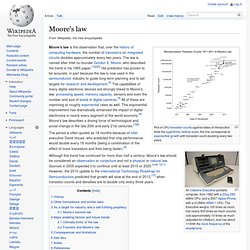
The law is named after Intel co-founder Gordon E. Moore, who described the trend in his 1965 paper.[1][2][3] His prediction has proven to be accurate, in part because the law is now used in the semiconductor industry to guide long-term planning and to set targets for research and development.[4] The capabilities of many digital electronic devices are strongly linked to Moore's law: processing speed, memory capacity, sensors and even the number and size of pixels in digital cameras.[5] All of these are improving at roughly exponential rates as well.
Economics of Information: Is Koomey's Law eclipsing Moore's law? Rock's law. Rock's law or Moore's second law, named for Arthur Rock, says that the cost of a semiconductor chip fabrication plant doubles every four years.[1] As of 2003, the price had already reached about 3 billion US dollars.

Rock's law can be seen as the economic flipside to Moore's law; the latter is a direct consequence of the ongoing growth of the capital-intensive semiconductor industry—innovative and popular products mean more profits, meaning more capital available to invest in ever higher levels of large-scale integration, which in turn leads to creation of even more innovative products. The semiconductor industry has always been extremely capital-intensive, with ever-dropping manufacturing unit costs.
Thus, the ultimate limits to growth of the industry will constrain the maximum amount of capital that can be invested in new products; at some point, Rock's Law will collide with Moore's Law.[2][3][4] See also[edit] Wirth's law. Wirth's law is a computing adage made popular by Niklaus Wirth in 1995.[1][2] It states that or, colloquially, "software gets slower faster than hardware gets faster". Computer hardware has become faster over time, and some of that development is quantified by Moore's law; Wirth's law points out that this does not imply that work is actually getting done faster.
Wirth attributed the saying to Martin Reiser, who, in the preface to his book on the Oberon System, wrote: "The hope is that the progress in hardware will cure all software ills. However, a critical observer may observe that software manages to outgrow hardware in size and sluggishness. The law was restated in 2009 and attributed to Larry Page, founder of Google. Gates' law[edit] Moore.pdf (application/pdf Object) Moore's Law to roll on for another decade. Moore's Law will continue for at least another 10 years, according to Intel cofounder Gordon Moore, but it's going to take a lot of work. "Another decade is probably straightforward," Moore said, speaking at the International Solid-States Circuits Conference.
"There is certainly no end to creativity. " The conference, a gathering of top semiconductor researchers organized by an IEEE group, takes place in San Francisco this week. Wheat and chessboard problem. Empty chessboard If a chessboard were to have wheat placed upon each square such that one grain were placed on the first square, two on the second, four on the third, and so on (doubling the number of grains on each subsequent square), how many grains of wheat would be on the chessboard at the finish?
The problem may be solved using simple addition. With 64 squares on a chessboard, if the number of grains doubles on successive squares, then the sum of grains on all 64 squares is: 1 + 2 + 4 + 8... and so forth for the 64 squares. The total number of grains equals 18,446,744,073,709,551,615, which is a much higher number than most people intuitively expect. The exercise of working through this problem may be used to explain and demonstrate exponents and the quick growth of exponential and geometric sequences. What we’re driving at. Larry and Sergey founded Google because they wanted to help solve really big problems using technology.
And one of the big problems we’re working on today is car safety and efficiency. Our goal is to help prevent traffic accidents, free up people’s time and reduce carbon emissions by fundamentally changing car use. So we have developed technology for cars that can drive themselves. Our automated cars, manned by trained operators, just drove from our Mountain View campus to our Santa Monica office and on to Hollywood Boulevard. They’ve driven down Lombard Street, crossed the Golden Gate bridge, navigated the Pacific Coast Highway, and even made it all the way around Lake Tahoe. Our automated cars use video cameras, radar sensors and a laser range finder to “see” other traffic, as well as detailed maps (which we collect using manually driven vehicles) to navigate the road ahead. Safety has been our first priority in this project. The Chess Master and the Computer by Garry Kasparov. Chess Metaphors: Artificial Intelligence and the Human Mind by Diego Rasskin-Gutman, translated from the Spanish by Deborah Klosky MIT Press, 205 pp., $24.95 In 1985, in Hamburg, I played against thirty-two different chess computers at the same time in what is known as a simultaneous exhibition.
I walked from one machine to the next, making my moves over a period of more than five hours. The National Safety Commission Alerts: Nevada Legislature Votes On Driverless Cars. Safety is No Accident. Visit the National Safety Commission - America's Safety Headquarters for driver safety information, auto recalls and teen safe driver tips. DARPA Grand Challenge. How Watson works: a conversation with Eric Brown, IBM Research Manager. Dr. Eric Brown, IBM Research Manager (Image: IBM) For nearly two years IBM scientists have been working on a highly advanced Question Answering (QA) system, codenamed “Watson.” The scientists believe that the computing system will be able to understand complex questions and answer with enough precision, confidence, and speed to compete in the first-ever man vs. machine Jeopardy! Competition, which will air on February 14, 15 and 16, 2011. We had some questions, so we spoke with Dr. IBM Paves The Way Towards Scalable Quantum Computing.
MIT's Scott Aaronson Explains Quantum Computing. IBM makes significant breakthrough towards scalable quantum computers. During the past months we’ve been reporting several breakthroughs in the field of quantum computing, and now IBM seems ready to truly pave the way for quantum computers. Researchers announced they are now able to develop a superconducting qubit made from microfabricated silicon that maintains coherence long enough for practical computation. Team designs world's smallest transistor › News in Science (ABC Science) South Africa's Recession Continues Even As The Rand Surges. By Edward Hugh: Barcelona. Advantages & Disadvantages of Automation. Shame on the Rich. The Real Future of the U.S. Economy: Peter Orszag. Can the Middle Class Be Saved? - Magazine. Educational planning: the international dimension - Jacques Hallak, International Bureau of Education, International Institute for Educational Planning.
Jean Claude Maswana.pdf (application/pdf Object) The Impact of the Global Recession on South Africa. Perspectives_3-09.pdf (application/pdf Object) QLFS-Q2-2009 Press Release.pdf (application/pdf Object) South Africa Economy Watch. P02111stQuarter2011.pdf (application/pdf Object) The Flow Approach to Labor Markets:New Data Sources and Micro–MacroLinks. Maslow's hierarchy of needs. The Demand for Workers and Hours and the Effects of Job Security Policies: Theory and Evidence. O-Ring theory of economic development.
Michael Kremer O-Ring Theory. Effeciency Wage Models(Library Login): The American Economic Review, Vol. 74, No. 2 (May, 1984), pp. 200-205. Parasite prevalence and the worldwide distribution of cognitive ability. Disease and intelligence: Mens sana in corpore sano. GlobalHealthRisks_report_full.pdf (application/pdf Object) SUSTAINED, HIGH JOBLESSNESSCAUSES LASTING DAMAGETO WAGES, BENEFITS, INCOME,AND WEALTH. Information Technology, Workplace Organization and the Demand for Skilled Labor: Firm-Level Evidence by Timothy Bresnahan, Erik Brynjolfsson, Lorin Hitt.
Foxconn to replace workers with 1 million robots in 3 years. Intangible Assets:Computers and Organizational Capital. Skills, Tasks and Technologies: Implications for Employment andEarnings. COMPUTING INEQUALITY: HAVE COMPUTERS CHANGEDTHE LABOR MARKET?* Marxist Manifesto. General Purpose Technologies "Engines of Growth?" by Timothy Bresnahan, Manuel Trajtenberg. Designing a Digital Future: Report to US Congress. Wanted: A First National Bank of Innovation. Computer-Generated Paper Accepted for Prestigious Technical Conference. The Lights In the Tunnel - Automation, Accelerating Technology and the Economy of the Future. Theory and Infomraion on General Purpose Technology. Your Life In 2020 - Forbes.com. Investing in the IT That Makes a Competitive Difference. A Broader Look at the U.S. Employment Situation and the Importance of a Good Education - Up Front Blog. It’s Man vs. Machine and Man Is Losing - Real Time Economics. Moravec's paradox.
Compensation/Productivity Gap expansion. Bureau of Labor Statistics Data. Stagnant_labor_market.pdf (application/pdf Object) 1973 job market signalling.pdf (application/pdf Object) The second economy - McKinsey Quarterly - Strategy - Growth. Why Unemployment Matters - Megan McArdle - Business. Rise of long term unemployment. Retail jobs are disappearing as shoppers adjust to self-service. Armies of Expensive Lawyers, Replaced by Cheaper Software. Satisfaction Dips to 20% in June. More Americans leaving the workforce. U.S. Bureau of Economic Analysis (BEA) Rule by Rentiers. Top Picks (Most Requested Statistics) : U.S. Bureau of Labor Statistics. Obama’s high-tech labor lies. Are We Ready For the Coming 'Age of Abundance?' - Dr. Michio Kaku (Full) Race Against the Machine.
The Future of Decision Making: Less Intuition, More Evidence - Andrew McAfee. The Real Story Behind Those "Record" Corporate Profits - Justin Fox. Real Private Nonresidential Investment: Equipment and Software (NRIPDCA. U.S. Corporate Profits Hit Record in Third Quarter. Evolution of the top incomes. Corporate Profits Not Actually At Record High. FigureA.png (PNG Image, 580 × 422 pixels) Goodbye Pareto Principle, Hello Long Tail: The Effect of Search Costs on the Concentration of Product Sales by Erik Brynjolfsson, Yu Jeffrey Hu, Duncan Simester. SyNAPSE: a cognitive computing project from IBM Research - United States. Khan Academy. The Big Idea: The Age of Hyperspecialization. Micromultinationals Will Run the World - By Hal Varian.
Master's Degree in Engineering and Management. Intro to AI - Introduction to Artificial Intelligence - Oct-Dec 2011.