
Kilobot. A Low Cost Scalable Robot System for Demonstrating Collective Behaviors Purchase some from K-Team: K-Team Corp is making Kilobots available for purchase, starting now!
See the K-Team Flier and K-Team homepage. K-team sells groups of robots, controllers, and charging stations - picture on the right is courtesy of Sabine Hauert, MIT. Several groups are starting to use kilobots, to test different distributed algorithms. Build some yourself: If you would like to build your own Kilobots, all the software and hardware details are available under a Creative Commons attribution-NonCommercial-ShareAlike 3.0 Unported (CC BY-NC-SA 3.0) license.
Programming Kilobots: Kilobots use a standard microcontroller (Atmel) and its programming environment, and the distribution above contains the bootloader program, libraries, and some sample programs. What can Kilobots do: Kilobot: A Low Cost Scalable Robot System for Collective Behaviors Michael Rubenstein, Christian Ahler, Radhika Nagpal IEEE Intl. Kilobot K-team. The Kilobot is designed to make tests of collective algorithms on hundreds or thousands of robots accessible to robotics researchers.
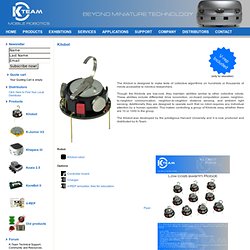
Though the Kilobots are low-cost, they maintain abilities similar to other collective robots. These abilities include differential drive locomotion, on-board computation power, neighbor-to-neighbor communication, neighbor-to-neighbor distance sensing, and ambient light sensing. Additionally they are designed to operate such that no robot requires any individual attention by a human operator. This makes controlling a group of Kilobots easy, whether there are 10 or 1000 in the group. The Kilobot was developed by the prestigious Harvard University and it is now produced and distributed by K-Team. Kilobots are leaving the nest. Kilobots gehen in die Serienfertigung - Golem. Der Name ist etwas irreführend: Kilobot heißt ein kleiner Roboter, den Wissenschaftler an der Harvard-Universität entwickelt haben.
Es braucht aber viele der dreibeinigen Schwarmroboter, um ein Kilogramm vollzubekommen. Ein Schweizer Unternehmen hat die Lizenz erhalten, die Roboter in Serie zu fertigen. Schwarm aus 1.000 Robotern Entwickelt wurden die Schwarmroboter von einem Forscherteam um Radhika Nagpal von der Self-Organizing Systems Research Group an der Harvard-Universität in Cambridge im US-Bundesstaat Massachusetts. Zweck des einfachen und günstig herzustellenden Roboters ist, Schwarmalgorithmen zu testen, die später in größere Roboter implementiert werden. Ein Kilobot hat einen Durchmesser von 33 Millimetern und ist mit seinen drei starren Füßen 34 Millimeter hoch. Kilobots - tiny, collaborative robots - are leaving the nest (w/ video) - StumbleUpon.
(PhysOrg.com) -- The Kilobots are coming.
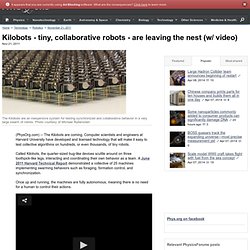
Computer scientists and engineers at Harvard University have developed and licensed technology that will make it easy to test collective algorithms on hundreds, or even thousands, of tiny robots. Called Kilobots, the quarter-sized bug-like devices scuttle around on three toothpick-like legs, interacting and coordinating their own behavior as a team. A June 2011 Harvard Technical Report demonstrated a collective of 25 machines implementing swarming behaviors such as foraging, formation control, and synchronization.
Once up and running, the machines are fully autonomous, meaning there is no need for a human to control their actions. The communicative critters were created by members of the Self-Organizing Systems Research Group led by Radhika Nagpal, the Thomas D. "Plus," he adds, "tiny robots are really cool! " So, what can you do with a thousand tiny little bots? Explore further: Can robots have social intelligence? Harvard's Kilobot project does swarm robots on the cheap (video) LEGO MINDSTORMS. Microsoft Robotics. These LEGO® MINDSTORMS NXT tutorials demonstrate how to control and interact with the LEGO® MINDSTORMS NXT from Microsoft Visual Programming Language (VPL).
If you have not previously set up your LEGO® NXT to communicate over Bluetooth then please read the topic Introduction. Flashlight Tutorial This walk-through will take you step-by-step through writing your first LEGO® NXT program using VPL. This simple program will demonstrate using the Touch Sensor to turn the Light Sensor on and off. You will learn how to configure your LEGO® NXT Brick and two sensors, and use a Touch Sensor notification to cause the Light Sensor spotlight to turn on and off. Ultrasonic Explorer This walk-through will take you step-by-step through writing your first driving program for the LEGO® MINDSTORMS NXT in a Tribot configuration using VPL. You will learn how to: Configure your NXT brick Receive UltraSonic sensor notifications Configure and drive the Tribot © 2012 Microsoft Corporation.
Bricx Command Center 3.3. NBC/NXC. NQC - Not Quite C. NXT Programs - Fun Projects for your LEGO Mindstorms NXT.