
From Capitalism To Democracy. Libertarian communism and capitalism - an introduction. Libcom.org's old basic introduction to our understanding of the world as it is, what we think can be done to make it better, and how a libertarian communist society could function.
We no longer think it is particularly good but reproduce it for reference. We have largely replaced it with our introductory guides. What is capitalism? We live in a truly beautiful world. There is easily enough of everything to go around for everyone to live comfortably. This is what capitalism is based on: we have to sell our ability to work - and hours of our life - for a wage. We think that the people doing the work - us - should get the lot! Capitalism produces things for profit rather than need. What do we want to replace it with? This all sounds very far fetched but actually it's more realistic then you think. All bosses and shareholders do is get in the way and take a huge chunk of the profit.
Just ask yourself: This week, how much time have I spent with the people I love? Anarcho-syndicalism - an introduction. A short explanation of anarcho-syndicalism and notes on its history.
Capitalism - an introduction. Libcom.org's brief introduction to capitalism and how it works.
This article in: Français At its root, capitalism is an economic system based on three things: wage labour (working for a wage), private ownership or control of the means of production (things like factories, machinery, farms, and offices), and production for exchange and profit. While some people own means of production, or capital, most of us don't and so to survive we need to sell our ability to work in return for a wage, or else scrape by on benefits. This first group of people is the capitalist class or "bourgeoisie" in Marxist jargon, and the second group is the working class or "proletariat".
See our introduction to class here for more information on class. Capitalism is based on a simple process – money is invested to generate more money. Those accumulating capital do so better when they can shift costs onto others. This difference between the wages we are paid and the value we create is called "surplus value". Laissez-faire capitalism is the political economic system based on individual rights. Reality is absolute; It is the standard of the true, the false, and the arbitary. Capitalism and communism - Gilles Dauvé. Excellent text from Gilles Dauvé outlining the development of capitalism, and communism as the real movement in everyday life which tends towards the abolition of wage labour.
Communism is not a programme one puts into practice or makes others put into practice, but a social movement. Those who develop and defend theoretical communism do not have any advantages over others except a clearer understanding and a more rigorous expression; like all others who are not especially concerned by theory, they feel the practical need for communism. They have no privilege whatsoever; they do not carry the knowledge that will set the revolution in motion; but, on the other hand, they have no fear of becoming "leaders" by explaining their positions.
The communist revolution, like every other revolution, is the product of real needs and living conditions. The problem is to shed light on an existing historical movement. The explanations in this text do not originate in a desire to explain. Capitalism. “Capitalism,” a term of disparagement coined by socialists in the mid-nineteenth century, is a misnomer for “economic individualism,” which Adam Smith earlier called “the obvious and simple system of natural liberty” (Wealth of Nations).
Economic individualism’s basic premise is that the pursuit of self-interest and the right to own private property are morally defensible and legally legitimate. Its major corollary is that the state exists to protect individual rights. Subject to certain restrictions, individuals (alone or with others) are free to decide where to invest, what to produce or sell, and what prices to charge. The Archdruid Report.
Anarchist communism - an introduction. A short introduction to anarchist-communism.
Anarchist communism is a form of anarchism that advocates the abolition of the State and capitalism in favour of a horizontal network of voluntary associations through which everyone will be free to satisfy his or her needs. Mikhail Bakunin. Peter Kropotkin. Prince Pyotr Alexeyevich Kropotkin (Russian: Пётр Алексе́евич Кропо́ткин; 9 December 1842 – 8 February 1921) was a Russian zoologist, evolutionary theorist, philosopher, scientist, revolutionary, philologist, economist, activist, geographer, writer, and prominent anarchist.
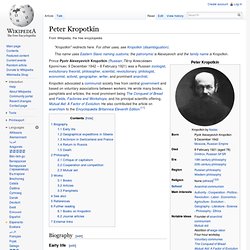
Kropotkin advocated a communist society free from central government and based on voluntary associations between workers. He wrote many books, pamphlets and articles, the most prominent being The Conquest of Bread and Fields, Factories and Workshops, and his principal scientific offering, Mutual Aid: A Factor of Evolution. He also contributed the article on anarchism to the Encyclopædia Britannica Eleventh Edition.[11] Biography[edit] Early life[edit] Kropotkin was born in Moscow, into the second-highest level of the Russian aristocracy. "[U]nder the influence of republican teachings," Kropotkin dropped his princely title at the age of twelve, and "even rebuked his friends, when they so referred to him Kropotkin in 1864.