
Registration Statement on Form S-1. Mark Zuckerberg's Letter To Facebook Investors. What a Facebook IPO means for Silicon Valley. Get ready for a blockbuster — and almost nuts — year of technology in 2012.
Why? Because Facebook is doing the mother of all initial public offerings. And much like Netscape and Google before it, the $5 billion offering is being viewed as the much-awaited catalyst for the technology industry and is expected to set off a flurry of activity. I have been here long enough to cover the IPOs of both Netscape and Google, and on both occasions, the tailgate effect was enough to pull even the clunkers (read: marginal startups) to the proverbial finish line. We are already seeing four recently public companies — Pandora, LinkedIn, Zynga and Groupon — ramping up their efforts to buy little startups.
I have been wondering whether we would see a slow exodus of Facebook employees, which in turn would force the social networking giant to go out and start acq-hiring people by buying a lot of tiny startups. I think Silverberg’s point is pretty spot-on. Facebook has more profit than... Une entrée en Bourse Record. Après la clôture de Wall Street mercredi soir, Facebook a lancé son très attendu processus d'entrée en Bourse, en déposant son dossier d'introduction.
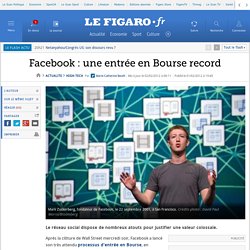
La firme américaine compte lever environ 5 milliards de dollars. Le réseau social serait valorisé entre 75 et 100 milliards de dollars. Avec de tels chiffres, Facebook serait la plus grosse introduction en Bourse d'un service Internet et une nouvelle occasion de réveiller le spectre de la bulle Internet. Car nombre d'observateurs se demandent encore si Facebook subira le même sort que MySpace. Comme s'il y avait une fatalité au déclin des réseaux sociaux. Le site réunit une audience unique au monde. 845 millions d'internautes sont actifs tous les mois sur Facebook, la moitié d'entre eux y viennent tous les jours. Facebook’s S-1 Reveals: 845 Million Users Every Month, More Than Half Daily, Half Mobile. As part of its initial filing to go public, Facebook has just revealed some new user numbers that illustrate just how big it is.
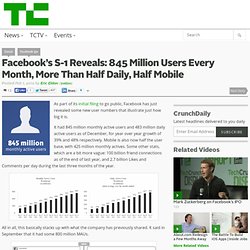
It had 845 million monthly active users and 483 million daily active users as of December, for year over year growth of 39% and 48% respectively. Mobile is also now half the user base, with 425 million monthly actives. Some other stats, which are a bit more vague: 100 billion friend connections as of the end of last year, and 2.7 billion Likes and Comments per day during the last three months of the year. All in all, this basically stacks up with what the company has previously shared. It said in September that it had some 800 million MAUs.
Net income and revenues: $1 billion on $3.71 billion in 2011. Facebook had $1 billion in net income on $3.71 billion in 2011, according to its filing to raise $5 billion in an initial public offering.
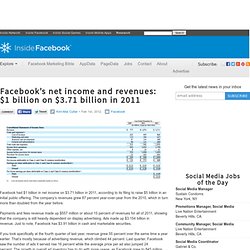
The company’s revenues grew 87 percent year-over-year from the 2010, which in turn more than doubled from the year before. Payments and fees revenue made up $557 million or about 15 percent of revenues for all of 2011, showing that the company is still heavily dependent on display advertising. Ads made up $3.154 billion in revenue. Just to note, Facebook has $3.91 billion in cash and marketable securities. If you look specifically at the fourth quarter of last year, revenue grew 55 percent over the same time a year earlier. The other key revenue stream to point out is fees or payments, which are mostly from social games that use the company’s virtual currency Credits. The question now is whether Facebook can duplicate its success in payments in verticals outside of gaming.
Mobile is another potential growth area. Zynga Accounts for 12 Percent of Facebook Revenue in 2011 - Tricia Duryee - Commerce. $68 million on acquisitions last year. The details: Facebook spent $68 million on acquisitions last year Facebook revealed that it spent $68 million in cash and stock on acquisitions last year, according to its filing for an initial public offering.
The company said all of the deals were not material. Facebook’s Amended S-1: 901 Million Users, 500M Mobile, Paid $300M Cash + 23M Shares For Instagram. Facebook has just filed a fourth amendment to its S-1 to IPO that notes that it now has 500 million mobile users, 901 million monthly active users, and that it paid 23 million shares at $30.89 a share plus $300 million cash for Instagram for a total of $1,010,470,000.
Facebook also made $1.058 billion in revenue in the first quarter of 2012, up 44.7% from Q1 2012 but down 6.5% from Q4 2011. So if Facebook maintains its current revenue rate, it would make between $4.69 and $4.81 on each of its 901 million users each year. Read on for more on Facebook’s business, user counts, photos, apps, employees, Instagram, and to see our embed of the full amended S-1.
Zynga Contributed 15% of Facebook’s Revenue In Q1, Down From 19% A Year Ago. Zynga and Facebook are ever gradually trying to separate from each other.
It’s working — sort of? Facebook said today that 15 percent of its revenue in the first quarter came from either advertising or payments tied to Zynga games.* That’s down from 19 percent during the same time a year earlier. Tracking Facebook's Valuation. Who Owns Facebook?
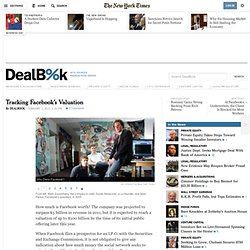
Facebook stake: 24 percentFacebook stake: 15 percentFacebook stake: 6 percentFacebook stake: 4 percentFacebook stake: 1 percentFacebook stake: less than 1 percent Jim Wilson/The New York Times From left, Mark Zuckerberg, the company's chief, Dustin Moskovitz, a co-founder, and Sean Parker, Facebook's president, in 2005. Why Facebook Clearly Belongs in the 10X Revenue Club. February 1, 2012: Attached are my thoughts on the Facebook S-1 along with some quick stabs at valuation.
Brief disclosure, Benchmark Capital has a minority position in Facebook as a result of the acquisition of FriendFeed, a company that was incubated in our offices. I thought it would be useful to look at Facebook using the scorecard from our May 24 blog post, “All Revenue is Not Created Equal, the Keys to the 10X Revenue Club.” For those that want to save time, the key point of this piece is that there is a broad disparity of Price/Revenue multiples for global Internet stocks, and that only a very small fraction of these companies achieve a multiple over 10X.
For Founders to Decorators, Facebook Riches. Who Owns What, Who Makes What. In what is probably the most anticipated document ever received by the U.S.
Securities and Exchange Commission, Facebook has filed to take its company public in a $5 billion initial public offering later this year. Having endured lots of speculation around who owns exactly how much, there are now some hard numbers from the S-1 filing that hit the SEC Web site today. Here are some details of the cap table, which is made up of both Class A and Class B shares, which carry different voting powers. Class B are the common shares. Not surprisingly, co-founder and CEO Mark Zuckerberg owns the most equity of any single person. The 27-year-old entrepreneur also holds 42.2 million Class A shares, which represents a 36.1 percent stake of that group. Facebook’s filing said he will sell some shares in the IPO, although it doesn’t specify how many. Goldman Sachs has a sizable 66-million share slice of Class A shares, or 56.3 percent.
In one crucial way, Facebook is still a private company. There has been a lot of attention — to say the least — paid to Facebook’s long-awaited public stock offering, which could put a valuation on the company as high as $100 billion. For the first time, average investors will get a chance to own a piece of the massive social network and its multibillion-dollar revenue stream. But in a very important way, Facebook still remains a private company. Why? Because it is controlled by CEO Mark Zuckerberg through a special class of stock that gives him super-voting rights, and he also controls the board. In other words, you may own stock in the company, but you have virtually no say in what happens to it.
Facebook's Biggest Risks Explained. Facebook is about to jump into unfriendly waters. If founder Mark Zuckerberg thought the company faced fierce competitors in Silicon Valley, he is about to find that the denizens of Wall Street are not nearly so forgiving. There are risks to going public. How does the world perceive your company? Can the platform grow and maintain its edge? The trick for Facebook will be to balance the concerns of its shareholders with the need to push the boundaries of innovation. Facebook, une réussite technologique. Hier soir, Facebook a enfin déposé son dossier d'introduction en Bourse auprès du gendarme américain de la Bourse, la SEC. Depuis, il est épluché par tous les experts de la place, qui cherchent à déterminer si une société qui fait 3,7 milliards de dollars de chiffre d'affaires peut réellement en valoir 100 milliards.
Mais ne regarder que la base d'utilisateurs (845 millions de membres actifs) et les recettes publicitaires revient à passer à côté d'un élément fondamental de la valeur de Facebook : son incroyable force technologique. C'est Patrice Lamothe, le fondateur de Pearltrees - et qui en tant que tel gère des interactions multiples d'une communauté d'internautes avec des objets Web - qui m'a expliqué le comment du pourquoi récemment. Why I'm thrilled Mark Zuckerberg is annoying the bankers. Pity the investment banker. He has gone through so much: There was the fall of Lehman Brothers and all those books and HBO movies that put his greed (isn't greed good?)
In not so favorable a light; his impetuous behavior has been blamed for the financial crisis; President Obama has said mean things about him, and, worst of all, he has been forced to listen to the drum circles of Occupy Wall Street. Now an arrogant young man comes pitching his company's initial public offering. Instead of paying homage to the rightly masters of the universe, he shows up in a hoodie, takes private meetings instead of pimping himself on a stage, and does little to conceal the notion that he'd rather be back in his Silicon Valley office working with engineers and doing the things that he's good at.
I say, good for Mark Zuckerberg.
Here's The Inside Story Of What Happened On The Facebook IPO. Facebook's IPO "Disaster" by MG Siegler. Facebook Shares Outstanding.