
Entreprises. Web Statistics. L'art des predictions. Hear, O Internet! Hear, O Internet.

It has been sixteen years since our previous communication. In that time the People of the Internet — you and me and all our friends of friends of friends, unto the last Kevin Bacon — have made the Internet an awesome place, filled with wonders and portents. From the serious to the lolworthy to the wtf, we have up-ended titans, created heroes, and changed the most basic assumptions about How Things Work and Who We Are. But now all the good work we've done together faces mortal dangers. When we first came before you, it was to warn of the threat posed by those who did not understand that they did not understand the Internet. These are The Fools, the businesses that have merely adopted the trappings of the Internet. Now two more hordes threaten all that we have built for one another. The Marauders understand the Internet all too well. But most dangerous of all is the third horde: Us.
A horde is an undifferentiated mass of people. We all like mass entertainment. Blogging's Massive Failure To Topple Mass Media. Posted by Tom Foremski - December 18, 2013 Om Malik, publisher of GigaOm, recently posted some thoughts about his 12 years of blogging and he came to the conclusion that blogs today are where he can aggregate all his fractured expressions across the web: Instagram photos, articles, comments, and whimsical musings.
But he writes, “The concept of blogging as we knew it has lost some of its meaning and even a bit of meaningfulness.” It certainly has and Om is being too gentle in his criticism because blogging has fallen very far from the promise it once had, and in attaining real meaningfulness. I started blogging in mid-2004 when I left my job as Technology Correspondent at the Financial Times to become a journalist-blogger. At the time I didn’t know I was the first newspaper journalist to leave his job journalist to become a professional “blogger.” I wasn’t sure what I was doing since I had never blogged before. Om and Dave were right about blogging, and its importance. My Homebrew Club… Exclusive: How Elizabeth Holmes’s House of Cards Came Tumbling Down. After he wrapped up, the leaders of Theranos stood before their employees and surveyed the room.
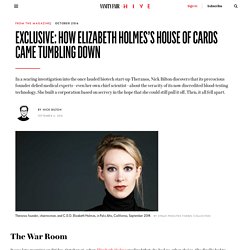
Then a chant erupted. “Fuck you . . .,” employees began yelling in unison, “Carreyrou.” It began to grow louder still. “Fuck you, Carreyrou!” Soon men and women in lab coats, and programmers in T-shirts and jeans, joined in. In Silicon Valley, every company has an origin story—a fable, often slightly embellished, that humanizes its mission for the purpose of winning over investors, the press, and, if it ever gets to that point, customers, too.
It generally works like this: the venture capitalists (who are mostly white men) don’t really know what they’re doing with any certainty—it’s impossible, after all, to truly predict the next big thing—so they bet a little bit on every company that they can with the hope that one of them hits it big. When Elizabeth Holmes emerged on the tech scene, around 2003, she had a preternaturally good story. Holmes had indeed mastered the Silicon Valley game.