
Fulltext.pdf (Objet application/pdf) Résultats Google Recherche d'images correspondant à. Fractal Architecture by Michael Ostwald for the Nexus Network Journal vol.3 no.1 Winter 2001. Michael J.

OstwaldDepartment of Architecture Faculty of Architecture, Building and Design, University of Newcastle University Drive, Callaghan, NSW 2308 AUSTRALIA INTRODUCTIONFor more than two decades an intricate and contradictory relationship has existed between architecture and the sciences of complexity. While the nature of this relationship has shifted and changed throughout that time a common point of connection has been fractal geometry. Both architects and mathematicians have each offered definitions of what might, or might not, constitute fractal architecture.
Curiously, there are few similarities between architects' and mathematicians' definitions of "fractal architecture". THE RISE OF FRACTAL ARCHITECTURE: 1978-1988In 1977 the scientist Benoit Mandelbrot's seminal work Fractals: Form, Chance, and Dimension, the first English language edition of his 1975 Les Objects Fractals: Forme, Hasard et Dimension, was published to much critical acclaim. But why appropriate scaling? Courbes et dimension fractale. Define Fractal at Dictionary. Fractal. Figure 1a.
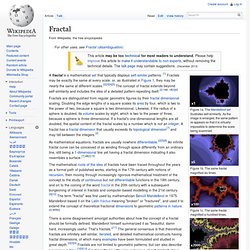
The Mandelbrot set illustrates self-similarity. As the image is enlarged, the same pattern re-appears so that it is virtually impossible to determine the scale being examined. Figure 1b. The same fractal magnified six times. Figure 1c. Figure 1d. Fractals are distinguished from regular geometric figures by their fractal dimensional scaling. As mathematical equations, fractals are usually nowhere differentiable.[2][5][8] An infinite fractal curve can be conceived of as winding through space differently from an ordinary line, still being a 1-dimensional line yet having a fractal dimension indicating it also resembles a surface.[7]:48[2]:15 There is some disagreement amongst authorities about how the concept of a fractal should be formally defined. Introduction[edit] The word "fractal" often has different connotations for laypeople than mathematicians, where the layperson is more likely to be familiar with fractal art than a mathematical conception.
History[edit] Fractale. Eis-hs.jpg (Image JPEG) Résultats Google Recherche d'images correspondant à. Jsalaworkshop.PDF (Objet application/pdf) Eisenman Architects - Exhibition. 02.23.07 - 04.22.07 | SCI-Arc Gallery Eisenman Architects: Grounded This installation considers Eisenman's "groundwork" from one of the earliest projects, the Cannaregio Town Square in Venice (1978), to the Wexner Center for the Arts in Columbus, Ohio (1989) and the City of Culture of Galicia, in Santiago de Compostela, Spain (currently under construction).
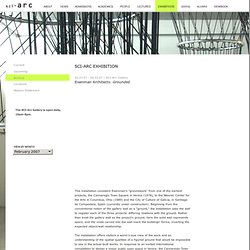
Beginning from the conventional notion of the gallery wall as a "ground," the installation uses the wall to register each of the three projects' differing relations with the ground. Rather than treat the gallery wall as the project's ground, here the solid wall represents space, and the voids carved into the wall mark the buildings' forms, inverting the expected object/wall relationship. The installation offers visitors a worm's-eye view of the work and an understanding of the spatial qualities of a figured ground that would be impossible to see in the actual built works.