
List of paradoxes. This is a list of paradoxes, grouped thematically.
The grouping is approximate, as paradoxes may fit into more than one category. Because of varying definitions of the term paradox, some of the following are not considered to be paradoxes by everyone. This list collects only scenarios that have been called a paradox by at least one source and have their own article. Although considered paradoxes, some of these are based on fallacious reasoning, or incomplete/faulty analysis. Informally, the term is often used to describe a counter-intuitive result. Logic[edit] Self-reference[edit] These paradoxes have in common a contradiction arising from self-reference. Barber paradox: A barber (who is a man) shaves all and only those men who do not shave themselves. Vagueness[edit] Ship of Theseus (a.k.a. Mathematics[edit] Omnipotence paradox. Zeno's paradoxes. Zeno's arguments are perhaps the first examples of a method of proof called reductio ad absurdum also known as proof by contradiction.
They are also credited as a source of the dialectic method used by Socrates.[3] Some mathematicians and historians, such as Carl Boyer, hold that Zeno's paradoxes are simply mathematical problems, for which modern calculus provides a mathematical solution.[4] Some philosophers, however, say that Zeno's paradoxes and their variations (see Thomson's lamp) remain relevant metaphysical problems.[5][6][7] The origins of the paradoxes are somewhat unclear.
Diogenes Laertius, a fourth source for information about Zeno and his teachings, citing Favorinus, says that Zeno's teacher Parmenides was the first to introduce the Achilles and the tortoise paradox. But in a later passage, Laertius attributes the origin of the paradox to Zeno, explaining that Favorinus disagrees.[8] Paradoxes of motion[edit] Achilles and the tortoise[edit] Pirate game. From Howard Pyle's Book of Pirates The pirate game is a simple mathematical game.
It illustrates how, if assumptions conforming to a homo economicus model of human behaviour hold, outcomes may be surprising. It is a multi-player version of the ultimatum game. The game[edit] There are 5 rational pirates, A, B, C, D and E. The pirates have a strict order of seniority: A is superior to B, who is superior to C, who is superior to D, who is superior to E. The pirate world's rules of distribution are thus: that the most senior pirate should propose a distribution of coins. Pirates base their decisions on three factors. The result[edit] The Hardest Logic Puzzle Ever. The Hardest Logic Puzzle Ever is a logic puzzle invented by American philosopher and logician George Boolos and published in The Harvard Review of Philosophy in 1996.
A translation in Italian was published earlier in the newspaper La Repubblica, under the title L'indovinello più difficile del mondo. The puzzle is inspired by Raymond Smullyan. The Paradox of Choice: Why More Is Less. Autonomy and Freedom of choice are critical to our well being, and choice is critical to freedom and autonomy.
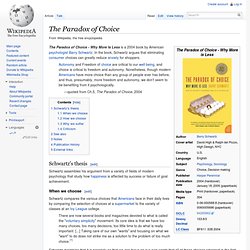
Nonetheless, though modern Americans have more choice than any group of people ever has before, and thus, presumably, more freedom and autonomy, we don't seem to be benefiting from it psychologically. —quoted from Ch.5, The Paradox of Choice, 2004. Irresistible force paradox. The irresistible force paradox, also called the unstoppable force paradox, is a classic paradox formulated as "What happens when an unstoppable force meets an immovable object?

" This paradox is a form of the omnipotence paradox, which is a simple demonstration that challenges omnipotence: ("Can God create a stone so heavy that not even God is strong enough to lift it? "). The immovable object and the irresistible force are both implicitly assumed to be indestructible, or else the question would have a trivial resolution ("it destroys it"). Furthermore, it is assumed that they are two separate entities, since an irresistible force is implicitly an immovable object, and vice versa. The paradox arises because it rests on two premises—that there exist such things as irresistible forces and immovable objects—which cannot both be true at once. Catch-22 (logic) A catch-22 is a paradoxical situation from which an individual cannot escape because of contradictory rules.[1][2] Catch-22s often result from rules, regulations, or procedures that an individual is subject to but has no control over.
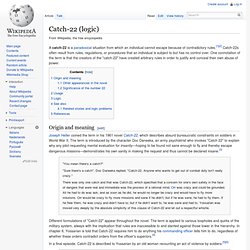
One connotation of the term is that the creators of the "catch-22" have created arbitrary rules in order to justify and conceal their own abuse of power. Joseph Heller coined the term in his 1961 novel Catch-22, which describes absurd bureaucratic constraints on soldiers in World War II. The term is introduced by the character Doc Daneeka, an army psychiatrist who invokes "Catch 22" to explain why any pilot requesting mental evaluation for insanity—hoping to be found not sane enough to fly and thereby escape dangerous missions—demonstrates his own sanity in making the request and thus cannot be declared insane.[3] Different formulations of "Catch-22" appear throughout the novel.