
1,000,000,000,000 Frames/Second Photography - Ramesh Raskar. Have scientists accidentally created a lightsaber? New form of matter discovered that has only ever been seen in science-fiction. Molecule behaves like lightsaber by moving photons around in a solid mass Discovery made after light particles were blasted through rubidium atomsThe finding could help drive the development of quantum computing May lead to creation of 3D structures, such as crystals, wholly out of light By Ellie Zolfagharifard Published: 13:47 GMT, 26 September 2013 | Updated: 15:11 GMT, 26 September 2013.

Why Physicists Are Saying Consciousness Is A State Of Matter, Like a Solid, A Liquid Or A Gas — The Physics arXiv Blog. There’s a quiet revolution underway in theoretical physics.
For as long as the discipline has existed, physicists have been reluctant to discuss consciousness, considering it a topic for quacks and charlatans. Ramesh Raskar: Imaging at a trillion frames per second. Light stopped completely for a minute inside a crystal: The basis of quantum memory. Scientists at the University of Darmstadt in Germany have stopped light for one minute.
For one whole minute, light, which is usually the fastest thing in the known universe and travels at 300 million meters per second, was stopped dead still inside a crystal. This effectively creates light memory, where the image being carried by the light is stored in crystals. Beyond being utterly cool, this breakthrough could lead to the creation of long-range quantum networks — and perhaps, tantalizingly, this research might also give us some clues on accelerating light beyond the universal speed limit.
Quand la lumière devient matière : l'incroyable expérience enfin réalisée ? PHYSIQUE.
Fabriquer de la matière à partir de la lumière - un phénomène quantique du monde subatomique - nul n'y était encore parvenu. Des chercheurs britanniques de l'Imperial College London ont annoncé avoir trouvé le moyen de parvenir à cette incroyable prouesse, dans un article paru dans la revue Nature ce dimanche ce 18 mai. Habituellement, dans les accélérateurs de particules, matière et antimatière s'annihilent spontanément en émettant des photons de haute énergie, mais une paire de photons peut-elle se transformer en matière ?
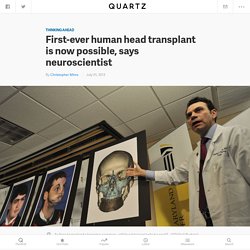
En théorie c'est possible, les physiciens Gregory Breit et John Wheeler l'avaient prédit en 1934 selon la célèbre équation d'Einstein E=mc² qui postule qu'énergie et matière sont deux entités équivalentes, m étant la masse et c étant la vitesse de la lumière. Quantum Levitation. One weird theory could make anti-gravity and faster-than-light travel possible. First-ever human head transplant is now possible, says neuroscientist. Promotional posters for the new Everest movie recently appeared in New York City subway stations, and these days I travel to and from work with a strange lump in my throat.
Everest, which opens in wide release in the US today (Sept. 25), is based on the true story of how eight people died in a storm on the world’s tallest mountain in 1996. It’s the same story that Jon Krakauer told in his bestselling book Into Thin Air. It was, until last year, the most deadly accident in Mount Everest’s history. Then on April 18, 2014, an ice release killed 16 climbers on the mountain.
And barely a year later, April 25, 2015 became the new deadliest day in Everest history, when a magnitude 7.8 earthquake killed nearly 9,000 people in Nepal, 21 of them in an avalanche at Everest Base Camp. 7 Totally Unexpected Outcomes That Could Follow the Singularity. Faster than light particles found, claim scientists. It is a concept that forms a cornerstone of our understanding of the universe and the concept of time – nothing can travel faster than the speed of light.
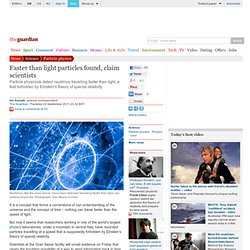
But now it seems that researchers working in one of the world's largest physics laboratories, under a mountain in central Italy, have recorded particles travelling at a speed that is supposedly forbidden by Einstein's theory of special relativity. Scientists at the Gran Sasso facility will unveil evidence on Friday that raises the troubling possibility of a way to send information back in time, blurring the line between past and present and wreaking havoc with the fundamental principle of cause and effect. They will announce the result at a special seminar at Cern – the European particle physics laboratory – timed to coincide with the publication of a research paper (pdf) describing the experiment.
The measurement amounts to the neutrinos travelling faster than the speed of light by a fraction of 20 parts per million. Reconstructing visual experiences from brain activity evoked by natural movies. - GallantLabUCB. Scientists Reconstruct Brains' Visions Into Digital Video In Historic Experiment. Dynamic Jupiter. If Jupiter’s magnetosphere were in glow mode, it would be the largest structure visible in the night sky.
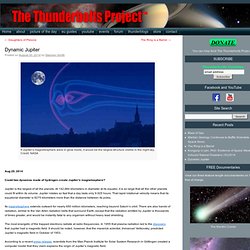
Credit: NASA. The Holographic Universe. Are We Living in a Holographic Universe? This May Be the Greatest Revolution of the 21st Century. The Universe as a Hologram. The Holographic Universe. The Holographic Universe: 12 Keys for Higher Awareness. Japanese Scientists Create Touchable Holograms. To Our Faithful Current.com Users:

Ode Magazine : The amazing promises of the Zero Point Field. ICAACT. Robert Lanza » The Biocentric Universe Theory: Life Creates Time, Space, and the Cosmos Itself. Stem-cell guru Robert Lanza presents a radical new view of the universe and everything in it.

NASA/ESA/A. Schaller (for STScI) The farther we peer into space, the more we realize that the nature of the universe cannot be understood fully by inspecting spiral galaxies or watching distant supernovas. BioprintingInfographic.jpg. L’etude de l’antimatiere peut-elle prouver le mythe des univers parallèles? - Introduction. Cern scientists suspect glimpse of Higgs boson. Scientists may have caught their first glimpse of the elusive Higgs boson, which is thought to give mass to the basic building blocks of nature.
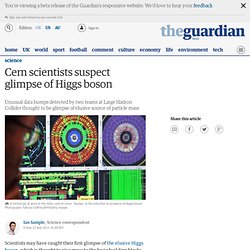
Researchers at the Large Hadron Collider at Cern, the European particle physics lab near Geneva, announced the findings at a conference on Friday. How NASA might build its very first warp drive. I want to see this work as much as anyone else on io9, but every time I read an article on warp drive, I expend so much mental energy trying to wrap my head around the concept that my entire left hand side goes numb. Somewhere along the line my understanding of concepts such as the nature of Spacetime is deficient.
NASA Warp Drive Project - "Speeds" that Could Take a Spacecraft to Alpha Centauri in Two Weeks. Parallel worlds exist: scientific evidence. Dark Plasma Theory. Clarke's three laws. Clarke's Three Laws are three "laws" of prediction formulated by the British science fiction writer Arthur C. Clarke. Fiction-to-reality-timeline-infographic.jpg (Image JPEG, 1400x873 pixels) - Redimensionnée (91%)
Isaac Asimov’s 1964 Predictions About 2014 Are Frighteningly Accurate. In 1964, famed science fiction writer Isaac Asimov ventured a guess at what you might find if you set foot inside the 2014 World’s Fair. Using his gift for envisioning future technology, Asimov’s predictions from 50 years out are both stunningly accurate and perhaps a little bit depressing. Here’s a look at what he got right. “One thought that occurs to me is that men will continue to withdraw from nature in order to create an environment that will suit them better.” “Kitchen units will be devised that will prepare “automeals,” heating water and converting it to coffee” “Complete lunches and dinners, with the food semiprepared, will be stored in the freezer until ready for processing.”
“The appliances of 2014 will have no electric cords, of course” "Any sufficiently advanced technology is indistinguishable from magic" The Coming of The Nåno Åge... Nanotubes help cells pass messages. Blackest is the new black: Scientists develop a material so dark that you can't see it... - Science - News. The Measurement That Would Reveal The Universe As A Computer Simulation.
One of modern physics’ most cherished ideas is quantum chromodynamics, the theory that describes the strong nuclear force, how it binds quarks and gluons into protons and neutrons, how these form nuclei that themselves interact. Finally! A Low Cost Solar Panel that Can See in the Dark. The Most Futuristic Predictions That Came True in 2012. Inventions and Ideas from Science Fiction Books and Movies at Technovelgy.com.
Do Sci Fi attitudes reflect our times? Congress now speaks a full grade level lower than it did in 2005. Falling from grade 11.5 to 10.6. Ecstasy Kills Cancer. It may sound like a hoax, but it’s true: Recent studies show that a modified form of ecstasy kills 100% of blood cancer cells. Harvard Scientists Create Cyborg Tissue That Merges The Biologic And Electronic. Scientist Prove DNA Can Be Reprogrammed by Words and Frequencies. By Grazyna Fosar and Franz Bludorf. A chimp-pig hybrid origin for humans? Scientist Proves DNA Can Be Reprogrammed by Words and Frequencies.