
Murray Bookchin (fr) Un article de Wikipédia, l'encyclopédie libre.
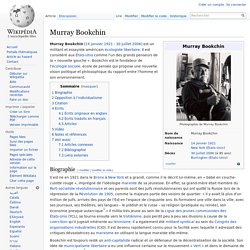
Murray Bookchin Photographie de Murray Bookchin Murray Bookchin (14 janvier 1921 - 30 juillet 2006) est un militant et essayiste américain écologiste libertaire. Il est considéré aux États-Unis comme l'un des grands penseurs de la « nouvelle gauche ». Bookchin est le fondateur de l'écologie sociale, école de pensée qui propose une nouvelle vision politique et philosophique du rapport entre l'homme et son environnement. Biographie[modifier | modifier le code] Bookchin est toujours resté un anti-capitaliste radical et un défenseur de la décentralisation de la société. Opposition à l'individualisme[modifier | modifier le code] Dans Social Anarchism or Lifestyle Anarchism, Murray Bookchin analyse l’anarchisme individualiste dans son incarnation la plus moderne, le « lifestyle anarchism » (« anarchisme comme mode de vie »), apparu au cours des années 1980 et 1990, période de reflux des mouvements révolutionnaires, aux États-Unis comme ailleurs.
Écologie sociale. Un article de Wikipédia, l'encyclopédie libre.
L’écologie sociale est une théorie philosophique, sociale et politique sur l'écologie mise sur pied par l’américain Murray Bookchin (1921-2006) dans les années soixante. Elle montre les problèmes écologiques comme découlant principalement de problèmes sociaux, notamment des différentes formes de hiérarchies et de dominations, et cherche à les régler à travers le modèle d’une société adaptée au développement humain et à la biosphère. C’est une théorie d’écologie politique radicale basée sur le communalisme qui s’oppose au système capitaliste actuel de production et de consommation. Elle vise la mise en place d’une société morale, décentralisée, solidaire, guidée par la raison.
Principes fondamentaux[modifier | modifier le code] Ecologie Sociale.ch. Johns Hopkins - Health and Education South Africa. This week we have lost the inspirational Professor Lynn Dalrymple, a pioneer in the field of theatre and AIDS communication, who made a significant contribution to HIV and AIDS education in South Africa.
She died on Saturday 14 April, after a long battle with kidney failure. Dalrymple was born and schooled in Durban, and started her career as a teacher of English and Drama in the late 1960s in Empangeni. She was later appointed as a lecturer in the Department of English at the University of Zululand (UNIZUL). During this period, she challenged the accepted practice of using only Western texts and teaching methods at the University, and fought for contextual and cultural relevance; a central theme throughout her later work.
Dalrymple had a great love and passion for theatre, and went on to establish the Department of Drama at UNIZUL, where she was Professor and Head between 1988 and 1996. Dalrymple chaired the HIV and AIDS Committee of Council and Senate for the University of Zululand. "Social ecology" Murray Bookchin (en) Bookchin was an anti-capitalist and vocal advocate of the decentralisation of society along ecological and democratic lines.
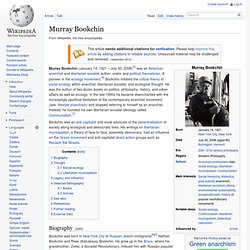
His writings on libertarian municipalism, a theory of face-to-face, assembly democracy, had an influence on the Green movement and anti-capitalist direct action groups such as Reclaim the Streets. Biography[edit] From 1947 he collaborated with a fellow lapsed Trotskyist, the German expatriate Josef Weber, in New York in the Movement for a Democracy of Content, a group of 20 or so post-Trotskyists who collectively edited the periodical Contemporary Issues – A Magazine for a Democracy of Content.
Contemporary Issues embraced utopianism. The periodical provided a forum for the belief that previous attempts to create utopia had foundered on the necessity of toil and drudgery; but now modern technology had obviated the need for human toil, a liberatory development. He continued to teach at the ISE until 2004. Thought[edit] Bookchin's Collected Works. Murray bookchin - De désillusion en désillusion - une vidéo Actu et Politique.
Entretien avec Murray Bookchin par Janet Biehl. Burlington, Vermont, le 12 novembre 1996.
Q. Murray, un de vos critiques anarchistes a pris votre mot d'ordre «démocratiser la république et radicaliser la démocratie» et, en un certain sens, il l'a scindé en deux. Il vous accuse de vouloir seulement démocratiser la république, omettant de dire que vous voulez aussi radicaliser la démocratie. Pouvez-vous expliquer le sens de ce mot d'ordre? R. 1. The Institute for Social Ecology. Social ecology. Social ecology is a critical social theory founded by Green author and activist Murray Bookchin.
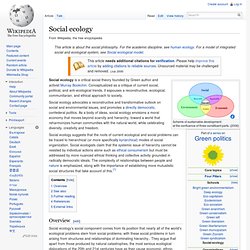
Conceptualized as a critique of current social, political, and anti-ecological trends, it espouses a reconstructive, ecological, communitarian, and ethical approach to society. Social ecology advocates a reconstructive and transformative outlook on social and environmental issues, and promotes a directly democratic, confederal politics. As a body of ideas, social ecology envisions a moral economy that moves beyond scarcity and hierarchy, toward a world that reharmonizes human communities with the natural world, while celebrating diversity, creativity and freedom.
Social ecology suggests that the roots of current ecological and social problems can be traced to hierarchical (or more specifically kyriarchical) modes of social organization. Overview[edit] Social ecology locates the roots of the ecological crisis firmly in relations of hierarchy and domination between people. See also[edit]