Astronomy
Get flash to fully experience Pearltrees
Cosmology
psychology & neuroscience
Father and Son Film Outer Space, Do-It-Yourself Style (Video)
Other People's Space Perals
Galaxy : Built with Processing
Recommended Version 7 Update 17 Select the file according to your operating system from the list below to get the latest Java for your computer. By downloading Java you acknowledge that you have read and accepted the terms of the end user license agreement <p><span class="termhighlight">In order to optimize your experience and provide you with accurate messages, please enable javascript in your browser for the duration of your Java installation.Physical Review D - First observational tests of eternal inflation: Analysis methods and WMAP 7-year results
'Multiverse' theory suggested by microwave background
Discover the cosmos! Each day a different image or photograph of our fascinating universe is featured, along with a brief explanation written by a professional astronomer. 2011 March 25 Explanation: Intense auroral activity flooded the night with shimmering colors on February 24, captured here from a lodge near the city of Yellowknife in northern Canada. The stunning sequence (left to right) of three all-sky exposures, taken at 30 second intervals, shows rapid changes in dancing curtains of northern lights against a starry background. What makes the northern lights dance?
2011 March 25 - Auroral Substorm over Yellowknife
Seriously jaw-dropping picture of the Sun
Introduction to Cosmology
Forget about inclined planes and pulleys. In this series from the PBS program NOVA, physics is presented as an exotic, mind-bending realm. The Fabric of the Cosmos , first broadcast in November, follows up on the 2003 Peabody Award-winning The Elegant Universe . Both series are adapted from the best-selling books of host Brian Greene , a mathematician and physicist at Columbia University. Like the earlier series, which was centered around String Theory, The Fabric of the Cosmos deals with ideas that are on the cutting edge of scientific theory.
The Fabric of the Cosmos with Brian Greene: Watch the Complete NOVA Series Online
The Origin, History, Evolution & Future of the Universe
Dark Matter & Dark Energy
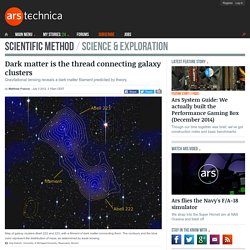
Dark matter is the thread connecting galaxy clusters
Aug 21, 2008 Holes in Space In the gravitational model of the universe, "dark matter" attraction pulls galaxies into filaments. Birkeland currents could be a better explanation. A recent announcement in the astronomical journals and popular press identifies an area of space as a " huge hole " completely empty of matter and energy. "Not only has no one ever found a void this big, but we never even expected to find one this size," said researcher Lawrence Rudnick of the University of Minnesota.
Holes in Space
Does the Universe Exist if We're Not Looking? | Cosmology
John Archibald Wheeler, high priest of quantum mysteries, suspects thatreality exists not because of physical particles but rather because of the actof observing the universe. "Information may not be just what we learn about the world," he says. "It may be what makes the world." The world seems to be putting itself together piece by piece on thisdamp gray morning along the coast of Maine.May 27th, 2011: the last spacewalk for NASA’s Endeavour astronauts. Here, a fish-eye lens attached to an electronic still camera was used to capture this image of NASA astronaut Michael Fincke (top center) during the mission’s fourth session of extravehicular activity (EVA) as construction and maintenance continued on the International Space Station. Photo #1 by NASA A bright sun, a portion of the International Space Station and Earth’s horizon are featured in this image photographed by a spacewalker during the STS-134 mission. Photo #2 by NASA
46 Fabulous Photos of Endeavour’s Last Ever Spacewalk
Atmospheres can refract light, as light changes angle depending on the medium it passes through. Gravity actually bends light, as the space the light travels through is warped, in exactly the same way it bends matter. To be specific, it doesn't bend the light itself, but the space if moves through. So if the space around an object is curved toward it, that object would cause the paths of comets, atoms, particles, and photons to bend slightly toward it too.


Team Astronomy ,help me get into actual space via Axe Apollo Space Academy.JUST COPY & VOTE : https://www2.axeapollo.com/en_PH/18025/dennis-del-rosario?image=0 by dennismirandadelrosario Jan 31