
Mushroom - Powerful Immune Secret to Prevent Cold and Flu. Medicinal mushrooms. Lepista nuda Medicinal mushrooms are mushrooms used in medicine or medical research.
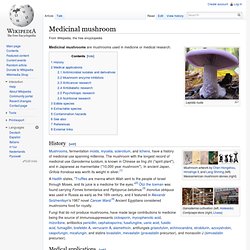
Lingzhi mushroom. Taxonomy and naming[edit] Names for the lingzhi fungus have a two thousand year history.
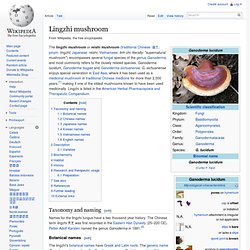
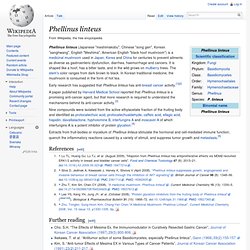
The Chinese term lingzhi 灵芝 was first recorded in the Eastern Han Dynasty (25–220 CE). Petter Adolf Karsten named the genus Ganoderma in 1881.[2] Botanical names[edit] There are multiple species of Lingzhi, scientifically known to be within the Ganoderma lucidum species complex and mycologists are still researching the differences among species within this complex.[4] Phellinus linteus. Early research has suggested that Phellinus linteus has anti-breast cancer activity.[1][2] A paper published by Harvard Medical School reported that Phellinus linteus is a promising anti-cancer agent, but that more research is required to understand the mechanisms behind its anti-cancer activity.[3] Nine compounds were isolated from the active ethylacetate fraction of the fruiting body and identified as protocatechuic acid, protocatechualdehyde, caffeic acid, ellagic acid, hispidin, davallialactone, hypholomine B, interfungins A and inoscavin A of which interfungins A is a potent inhibitor of protein glycation.[4] Extracts from fruit-bodies or mycelium of Phellinus linteus stimulate the hormonal and cell-mediated immune function; quench the inflammatory reactions caused by a variety of stimuli, and suppress tumor growth and metastasis.[5]
Shiitake. The Shiitake (Lentinula edodes) is an edible mushroom native to East Asia, which is cultivated and consumed in many Asian countries.
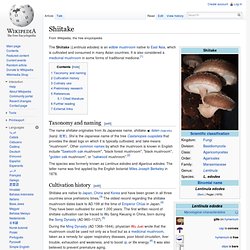
It is also considered a medicinal mushroom in some forms of traditional medicine.[1] Taxonomy and naming[edit] The name shiitake originates from its Japanese name, shiitake. listen (kanji: 椎茸). Shii is the Japanese name of the tree Castanopsis cuspidata that provides the dead logs on which it is typically cultivated, and take means "mushroom". The species was formerly known as Lentinus edodes and Agaricus edodes. Agaricus subrufescens. Ophiocordyceps sinensis. Ophiocordyceps sinensis is a fungus that parasitizes larvae of ghost moths and produces a fruiting body valued as an herbal remedy.
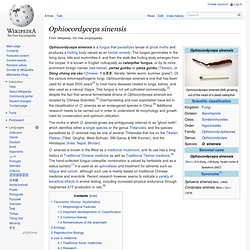
The fungus germinates in the living larva, kills and mummifies it, and then the stalk-like fruiting body emerges from the corpse. It is known in English colloquially as caterpillar fungus, or by its more prominent foreign names (see below): yartsa gunbu or yatsa gunbu (Tibetan), or Dōng chóng xià cǎo (Chinese: 冬虫夏草; literally "winter worm, summer grass"). Of the various entomopathogenic fungi, Ophiocordyceps sinensis is one that has been used for at least 2000 years[2] to treat many diseases related to lungs, kidney, and also used as a natural Viagra. Taxonomic History/ Systematics[edit] Caterpillars with emerging Ophiocordyceps sinensis. Hericium erinaceus. Hericium erinaceus (also called Lion's Mane Mushroom, Bearded Tooth Mushroom, Hedgehog Mushroom, Satyr's Beard, Bearded Hedgehog Mushroom, pom pom mushroom, or Bearded Tooth Fungus) is an edible mushroom and medicinal mushroom in the tooth fungus group.
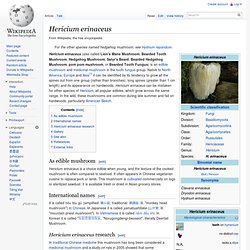
Native to North America, Europe and Asia[1] it can be identified by its tendency to grow all the spines out from one group (rather than branches), long spines (greater than 1 cm length) and its appearance on hardwoods. Hericium erinaceus can be mistaken for other species of Hericium, all popular edibles, which grow across the same range. In the wild, these mushrooms are common during late summer and fall on hardwoods, particularly American Beech.
Pleurotus. Pleurotus means "side ear", from Greek πλευρή (pleurē), "side"[4] + ὠτός (ōtos), genitive of οὖς (ous), "ear".[5] Description[edit] The caps may be laterally attached (with no stem).
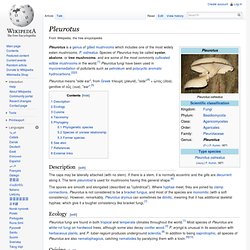
If there is a stem, it is normally eccentric and the gills are decurrent along it. The term pleurotoid is used for mushrooms having this general shape.[6] The spores are smooth and elongated (described as "cylindrical"). Laricifomes officinalis. Laricifomes officinalis is a wood-decay fungus in the order Polyporales.
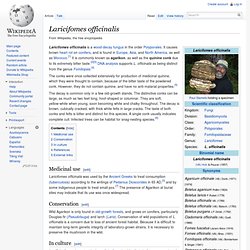
It causes brown heart rot on conifers, and is found in Europe, Asia, and North America, as well as Morocco.[1] It is commonly known as agarikon, as well as the quinine conk due to its extremely bitter taste.[2][3] DNA analysis supports L. officinalis as being distinct from the genus Fomitopsis.[4] The conks were once collected extensively for production of medicinal quinine, which they were thought to contain, because of the bitter taste of the powdered conk. Chaga mushroom. The chaga mushroom is considered a medicinal mushroom in Russian and Eastern European folk medicine and research on its medicinal potential is ongoing.
However there is currently no evidence for its effectiveness or safety for medicinal use. Name[edit] The name chaga (pronounced "tsjaa-ga") comes from the Russian word of the mushroom (anglicized from czaga), which in turn is purportedly derived from the word for the fungus in Komi-Permyak, the language of the indigenous peoples in the Kama River Basin, west of the Ural Mountains. Grifola frondosa. Trametes versicolor. Trametes versicolor – also known as Coriolus versicolor and Polyporus versicolor – is a common polypore mushroom found throughout the world.
Meaning 'of several colours', versicolor reliably describes this mushroom found in different colors. By example, due to its resembling multiple colors in the tail of wild turkey, T. versicolor is commonly called turkey tail. Description and ecology[edit] The top surface of the cap shows typical concentric zones of different colours. Flesh 1–3 mm thick, leathery texture. May be eaten by caterpillars of the fungus moth Nemaxera betulinella and by maggots of the Platypezid fly Polyporivora picta.[1] Research and traditional medicine[edit] According to the American Cancer Society: "Available scientific evidence does not support claims that the raw mushroom itself is an effective anti-cancer agent in humans.