
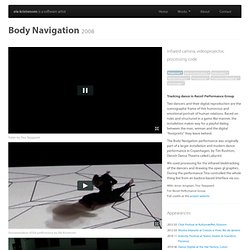
Processing.org. Learn to code. Body Navigation « ole kristensen. Infrared camera, videoprojector, processing code Featured Infrared Tracking Interactive Modern Dance Processing Projection Mapping Set Design.
Profile on TED.com. Managing and improvising: lessons from jazz. Synesthesia. How someone with synesthesia might perceive (not "see") certain letters and numbers.
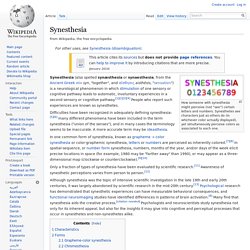
Synesthetes see characters just as others do (in whichever color actually displayed), yet simultaneously perceive colors as associated to each one. Synesthesia (also spelled synæsthesia or synaesthesia; from the Ancient Greek σύν syn, "together", and αἴσθησις aisthēsis, "sensation") is a neurological phenomenon in which stimulation of one sensory or cognitive pathway leads to automatic, involuntary experiences in a second sensory or cognitive pathway.[1][2][3][4] People who report such experiences are known as synesthetes.
Difficulties have been recognized in adequately defining synesthesia:[5][6] many different phenomena have been included in the term synesthesia ("union of the senses"), and in many cases the terminology seems to be inaccurate. A more accurate term may be ideasthesia. Characteristics[edit] Alex Grey. VS Ramachandran on your mind. Alan Watts quotes. Douglas Adams Quotes. Full List of Stuff White People Like. The World As I See It - StumbleUpon. "How strange is the lot of us mortals!

Each of us is here for a brief sojourn; for what purpose he knows not, though he sometimes thinks he senses it. But without deeper reflection one knows from daily life that one exists for other people -- first of all for those upon whose smiles and well-being our own happiness is wholly dependent, and then for the many, unknown to us, to whose destinies we are bound by the ties of sympathy.
The World As I See It - StumbleUpon. EEG headset with flying harness lets users 'fly' by controlling their thoughts. A team of Rensselaer Polytechnic Institute students has created a system that pairs an EEG headset with a 3-D theatrical flying harness, allowing users to "fly" by controlling their thoughts.

The "Infinity Simulator" will make its debut with an art installation in which participants rise into the air -- and trigger light, sound, and video effects -- by calming their thoughts. Creative director and Rensselaer MFA candidate Yehuda Duenyas describes the "Infinity Simulator" as a platform similar to a gaming console -- like the Wii or the Kinect -- writ large. Single dose of 'magic mushrooms' hallucinogen may create lasting personality change, study suggests.
A single high dose of the hallucinogen psilocybin, the active ingredient in so-called "magic mushrooms," was enough to bring about a measurable personality change lasting at least a year in nearly 60 percent of the 51 participants in a new study, according to the Johns Hopkins researchers who conducted it.

Lasting change was found in the part of the personality known as openness, which includes traits related to imagination, aesthetics, feelings, abstract ideas and general broad-mindedness. John Bohannon: Dance vs. powerpoint, a modest proposal. Neural Substrates of Spontaneous Musical Performance: An fMRI Study of Jazz Improvisation. To investigate the neural substrates that underlie spontaneous musical performance, we examined improvisation in professional jazz pianists using functional MRI.

By employing two paradigms that differed widely in musical complexity, we found that improvisation (compared to production of over-learned musical sequences) was consistently characterized by a dissociated pattern of activity in the prefrontal cortex: extensive deactivation of dorsolateral prefrontal and lateral orbital regions with focal activation of the medial prefrontal (frontal polar) cortex. Such a pattern may reflect a combination of psychological processes required for spontaneous improvisation, in which internally motivated, stimulus-independent behaviors unfold in the absence of central processes that typically mediate self-monitoring and conscious volitional control of ongoing performance.
Figures Academic Editor: Ernest Greene, University of Southern California, United States of America Introduction Figure 1. Results. Art and the Limits of Neuroscience. The Stone is a forum for contemporary philosophers and other thinkers on issues both timely and timeless.

What is art? What does art reveal about human nature? The trend these days is to approach such questions in the key of neuroscience. Finley. Critical Studies in Improvisation / Études critiques en improvisation. Barbara Browning At its core, improvisation demands an ongoing interaction with shifting tight places, whether created by power relations, social norms, aesthetic traditions, or physical technique.

Improvised dance literally involves giving shape to oneself and deciding how to move in relation to an unsteady landscape. (Danielle Goldman, I Want to Be Ready: Improvised Dance as a Practice of Freedom, 146) De fato, tanto no jazz quanto no samba, atua de modo especial a síncopa, incitando o ouvinte a preencher o tempo vazio com a marcação corporal – palmas, meneios, balanços, dança. The Applied Improvisation Network - Spreading the Transforming Power of Improvisation. Scientists measure dream content for the first time: Dreams activate the brain in a similar way to real actions.
The ability to dream is a fascinating aspect of the human mind.

However, how the images and emotions that we experience so intensively when we dream form in our heads remains a mystery. Up to now it has not been possible to measure dream content. Putting the body back into the mind of schizophrenia. A study using a procedure called the rubber hand illusion has found striking new evidence that people experiencing schizophrenia have a weakened sense of body ownership and has produced the first case of a spontaneous, out-of-body experience in the laboratory.

These findings suggest that movement therapy, which trains people to be focused and centered on their own bodies, including some forms of yoga and dance, could be helpful for many of the2.2 million people in the United States who suffer from this mental disorder. The study, which appears in the Oct. 31 issue of the scientific journal Public Library of Science One, measured the strength of body ownership of 24 schizophrenia patients and 21 matched control subjects by testing their susceptibility to the "rubber hand illusion" or RHI. ADTA - Home. Exercise & Muscle Directory.
How we create false memories: Assessing memory performance in older adults. A new study in Psychological Science, a journal of the Association for Psychological Science, published online October 26 addresses the influence of age-related stereotypes on memory performance and memory errors in older adults. Ayanna Thomas, assistant professor of psychology and director of the Cognitive Aging and Memory Lab at Tufts University, and co-author Stacey J. Understanding emotions without language. Does understanding emotions depend on the language we speak, or is our perception the same regardless of language and culture? According to a new study by researchers from the MPI for Psycholinguistics and the MPI for Evolutionary Anthropology, you don't need to have words for emotions to understand them. The results of the study were published online on October 17 in Emotion, a journal of the American Psychological Association. The study provides new evidence that the perception of emotional signals is not driven by language, supporting the view that emotions constitute a set of biologically evolved mechanisms.