
Evgeny Morozov. Evgeny Morozov (2010) Evgeny Morozov (Russian: Евгений Морозов) is a writer and researcher of Belarusian origin who studies political and social implications of technology.
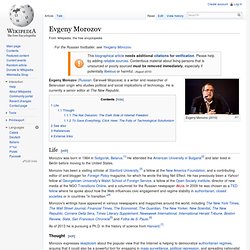
He is currently a senior editor at The New Republic. Life[edit] Morozov was born in 1984 in Soligorsk, Belarus.[1] He attended the American University in Bulgaria[2] and later lived in Berlin before moving to the United States. Evgeny Morozov (evgenymorozov) Evgeny Morozov: How democracy slipped through the net. On 15 June 2009, while thousands of Iranians were streaming on to the streets of Tehran to protest against the disputed results of the presidential election, Jared Cohen, an official in the US state department, quietly sent an email to Twitter.
Evgeny Morozov: How the Net aids dictatorships. The Net Delusion. Evgeny Morozov: 'Google and Facebook get away with things other companies wouldn't' - video. RSA Animate - The Internet in Society: Empowering or Censoring Citizens? Evgeny Morozov and the Rhetoric of Contempt. Evgeny Morozov is perhaps the most skilled contemporary practitioner of the rhetoric of contempt.
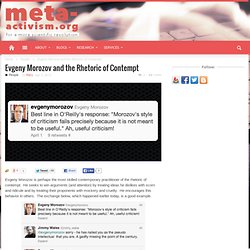
He seeks to win arguments (and attention) by treating ideas he dislikes with scorn and ridicule and by treating their proponents with mockery and cruelty. He encourages this behavior in others. The exchange below, which happened earlier today, is a good example. When I first met Evgeny in 2008 he was a journalist, working for The Economist. He was smart and entertaining. So he has turned his gaze to Silicon Valley and has started attacking Tim O’Reilly and Jimmy Wales instead of the State Department. I have not asked Evgeny about his rhetorical strategy, but I would bet that it is strategic. So, this post is not a plea to Evgeny to stop using the rhetoric of contempt. The Myth of the Techno-Utopia. Was What Happened in Tunisia a Twitter Revolution?: Tech News and Analysis « The Meme Hustler. Tim O’Reilly’s crazy talk Evgeny Morozov [from The Baffler No. 22, 2013] While the brightest minds of Silicon Valley are “disrupting” whatever industry is too crippled to fend off their advances, something odd is happening to our language.

Old, trusted words no longer mean what they used to mean; often, they don’t mean anything at all. Our language, much like everything these days, has been hacked. This is not to deny that many of our latest gadgets and apps are fantastic. Fortunately, Silicon Valley, that never-drying well of shoddy concepts and dubious paradigms—from wiki-everything to i-something, from e-nothing to open-anything—is ready to help. Silicon Valley has always had a thing for priests; Steve Jobs was the cranky pope it deserved. The enduring emptiness of our technology debates has one main cause, and his name is Tim O’Reilly. Alas, O’Reilly and the dead Germans parted ways long ago.
Evgeny Morozov: How much for your data? Evgeny Morozov on Why Our Privacy Problem is a Democracy Problem in Disguise. In 1967, The Public Interest, then a leading venue for highbrow policy debate, published a provocative essay by Paul Baran, one of the fathers of the data transmission method known as packet switching.
Titled “The Future Computer Utility,” the essay speculated that someday a few big, centralized computers would provide “information processing … the same way one now buys electricity.” Our home computer console will be used to send and receive messages—like telegrams. We could check to see whether the local department store has the advertised sports shirt in stock in the desired color and size. We could ask when delivery would be guaranteed, if we ordered. L'État-Nation peut-il survivre à la Société de l'Information ?
Clay Shirky's Internet Writings. À quoi ça sert de s'activer sur Internet ? Doctorow répond à Morozov. Cory Doctorow est souvent traduit sur ce blog car c’est l’une des rares personnalités qui pense l’Internet et agit en conséquence pour qu’il conserve ses promesses initiales d’ouverture et de partage.
Il a rédigé un long mais passionnant article dans The Guardian qui prend appui sur un lecture (très) critique du récent mais déjà fort commenté livre The Net Delusion: The Dark Side of Internet Freedom de Evgeny Morozov. Chercheur biélorusse à l’université de Georgetown et chroniqueur dans plusieurs journaux, Morozov remet radicalement en question, dans son ouvrage, le pouvoir libérateur d’Internet. On peut le voir exposer son point de vue dans cette courte conférence au format TED : Comment Internet aide les dictatures, qui constitue un excellent préambule à ce qui va suivre. On comprendra dès lors aisément que le « net-activiste » Cory Doctorow ait pris sa plume pour répondre dans le détail à l’argumentaire de Morozov. Internet n’est certainement pas synonyme de libération. Google as God? Posted by gregfisher on Apr 4th, 2013 in Blog, Social | 1 comment Opportunities and Risks of the Information Age by Dirk Helbing (ETH Zurich) “You’re already a walking sensor platform… You are aware of the fact that somebody can know where you are at all times because you carry a mobile device, even if that mobile device is turned off.
You know this, I hope? Clay Shirky on institutions vs. collaboration. Clay Shirky: How social media can make history. Clay Shirky - Speaker. Here Comes Everybody. This article is about the book.
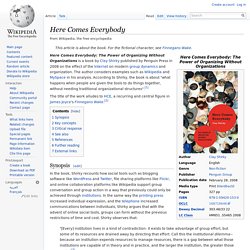
For the fictional character, see Finnegans Wake. Here Comes Everybody: The Power of Organizing Without Organizations is a book by Clay Shirky published by Penguin Press in 2008 on the effect of the Internet on modern group dynamics and organization. The author considers examples such as Wikipedia and MySpace in his analysis. According to Shirky, the book is about "what happens when people are given the tools to do things together, without needing traditional organizational structures".[1] Clay Shirky. Clay Shirky. Clay Shirky (born 1964[2]) is an American writer, consultant and teacher on the social and economic effects of Internet technologies.
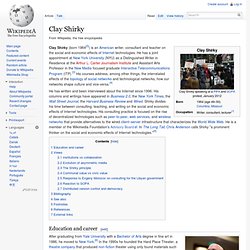
He has a joint appointment at New York University (NYU) as a Distinguished Writer in Residence at the Arthur L. Carter Journalism Institute and Assistant Arts Professor in the New Media focused graduate Interactive Telecommunications Program (ITP).[3] His courses address, among other things, the interrelated effects of the topology of social networks and technological networks, how our networks shape culture and vice-versa.[4] Education and career[edit] Cognitive Surplus. Cognitive Surplus: Creativity and Generosity in a Connected Age is a 2010 non-fiction book by Clay Shirky.
The book is an indirect sequel to Shirky's Here Comes Everybody, which covered the impact of social media. Summary[edit] Clay Shirky: How cognitive surplus will change the world. Clay Shirky: Let a thousand flowers bloom to replace newspapers; don’t build a paywall around a public good. Cognitive Surplus - Books by Clay Shirky. Clay Shirky on the Demise of the Newspaper. Clay Shirky (cshirky) Clay Shirky: Why SOPA is a bad idea. Clay Shirky: Unlocking Mankind’s Untapped Potential.
Le peuple des connecteurs. Connected Citizens: The Power, Potential and Peril of Networks. Ten years ago, a tiny web site asked people to volunteer to write their own encyclopedia. Today, Wikipedia is the most widely used reference work in the world. Rapid advances in digital media and technology are changing how we connect to information and each other. The way we engage in public dialogue, coordinate, solve problems—all of it is shifting. New networks are emerging everywhere. It’s exciting—and frightening. These questions matter to us because our work at Knight Foundation hopes to create informed, engaged communities. We asked our partner, Monitor Institute, to take a critical look at the role of networks in community life. We have derived much value from this work and hope that it also has meaning for you. Clay Shirky: How the Internet will (one day) transform government.
The Real Revolution Is Openness, Clay Shirky Tells Tech Leaders - Wired Campus. Denver — Clay Shirky is one of the country’s most prominent Internet thinkers—“a spiritual guide to the wired set,” as The Chronicle Review put it in a 2010 profile of him. In his latest book, Cognitive Surplus, the New York University professor argues that a flowering of creative production will arise as the Internet turns people “from consumers to collaborators.” On Wednesday, Mr. Shirky took that message to a group of higher-education-technology leaders who have been buffeted by a rapidly evolving ed-tech landscape.
Mr. Shirky, in a keynote speech kicking off this year’s Educause conference, explored how technology was changing everything, from research to publishing to studying. The future of the internet: A virtual counter-revolution. - How We Will Read: Clay Shirky. This post is part of “How We Will Read,” an interview series exploring the future of books from the perspectives of publishers, writers, and intellectuals. Read our kickoff post with Steven Johnson here. And check out our new homepage, a captivating new way to explore Findings. This week, we were extremely honored to speak to Internet intellectual Clay Shirky, writer, teacher, and consultant on the social and economic effects of Internet technologies.
Clay Shirky. The disruptive power of collaboration: An interview with Clay Shirky. From the invention of the printing press to the telephone, the radio, and the Internet, the ways people collaborate change frequently, and the effects of those changes often reverberate through generations. In this video interview, Clay Shirky, author, New York University professor, and leading thinker on the impact of social media, explains the disruptive impact of technology on how people live and work—and on the economics of what we make and consume. This interview was conducted by McKinsey Global Institute partner Michael Chui, and an edited transcript of Shirky’s remarks follows. Interview transcript Sharing changes everything. NYU Interactive Telecommunications Professor. Mon article sur le livre de Clay Shirky, "Here comes everybody" - Ceci n'est pas un blog.
Shirky: The Shock of Inclusion and New Roles for News in the Fabric of Society. De La Transparence, De L'Internet Et Du Totalitarisme.
Two decades of the web: a utopia no longer. 'Who Owns The Future?' Jaron Lanier thinks Google and the government should pay for your data. 41inShare Jump To Close. Political Repression 2.0. Through a Web Darkly: Does the Internet Spread Democracy or Ignorance? With Twitter lauded for bringing down tyrannies and Facebook valued at more than $50 billion, we seem to be entering a new phase of digital utopianism.
Events. When: 27th May 2011, 03:00PM. Eric Schmidt and Jared Cohen: The Dark Side of the Digital Revolution. Jaron Lanier: the digital pioneer who became a web rebel –interview. How to Not Create a New Cyber Plutocracy. FOREIGN POLICY. Mind Control & the Internet by Sue Halpern. CIA Presentation On Big Data.