
Portal:History. Category:Theories of history. From Wikipedia, the free encyclopedia This is for works that don't just document history, but provide theories for why things happened the way they did (and possibly what that means for the future).
Théorie du déversement. Un article de Wikipédia, l'encyclopédie libre.
Loi des trois états. Un article de Wikipédia, l'encyclopédie libre.
La loi des trois états est un concept énoncé par Auguste Comte, fondateur du positivisme, selon lequel l'esprit humain, ainsi que l'espèce humaine entière, passe par trois états théoriques successifs : théologique, métaphysique et positif. La philosophie positiviste considère que la métaphysique est une manifestation de l'esprit qui est rendue caduque par l'avènement des sciences. Category:History. Category:Historiography. Historiography is the study of historians and their work.

Les Grands Sites Archéologiques. Mapped historical photos, film, and audio. Retronaut. Historical Figures With Image Map - ClipTank.com. Visual graphics and visual histories.
Histomap of Evolution.jpg (Image JPEG, 3212x8748 pixels)
The Ancient Indus Valley and the British Raj in India and Pakistan. What happened in my birth year? Digital History. Best of History Web Sites. EyeWitness to History - history through the eyes of those who lived it. Histomapwider.jpg (Image JPEG, 2097x9554 pixels) TOP 100 HISTORY SITES SORTED BY POPULARITY.
World History. Ancient Civilizations. Gangrule - The History of the Mafia - StumbleUpon. Television News Archive. Holocaust Resources for Teachers. Welcome to IISH. Newspaper Archive - View old newspapers online. Explore Historical Newspaper Archives Online.
The Labyrinth. Booksellers of Used, Out of Print, Antiquarian Books and Prints on the Archeology of Ancient Egypt, the Near East, Greece and Rome, and the Americas. Ancient Digger Archaeology. Archaeologists and technologists develop supercomputer-powered solutions to protect and preserve ancient sites and artifacts. EyeWitness To The Middle Ages and Renaissance. Life in a Christian Monastery, ca. 585"When he was dead his body was not placed with the bodies of the brethren, but a grave was dug in the dung pit, and his body was flung down into it. . .

" Crime and punishment in a medieval monastery: the monastery's Abbott provides insight into the monastic life. The Vikings Discover America, ca. 1000"There was no want of salmon either in the river or in the lake. " Five hundred years before Columbus, the Vikings discover a New World. Historypin. History and Geography of Europe. Lists. 6 Ingenious Acts of Battlefield Deception From a famous War of 1812 charade to Alexander the Great’s masterful ambush at the Battle of the Hydaspes, take a look back at six occasions when military commanders used unconventional methods to outfox their opponents. 7 Lost Burial Sites From Genghis Khan to Alexander the Great, get the facts on seven historical titans whose final resting places are unaccounted for. 10 19th-Century Celebrities You Should Know In the 1800s Industrial Revolution advances in transportation and communication laid the groundwork for the modern culture of fame.

Archaeology, Archaeologists, Important archaeological discoveries, excavations, news, ancient archaeology, museums, monuments, archaeological organizations, epic movies.
List of cryptids. The following is a list of cryptids, animals and plants studied under the field of cryptozoology.
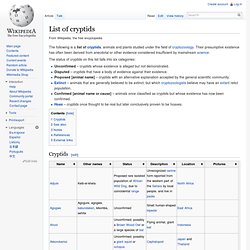
Their presumptive existence has often been derived from anecdotal or other evidence considered insufficient by mainstream science. The status of cryptids on this list falls into six categories: Unconfirmed – cryptids whose existence is alleged but not demonstrated.Disputed – cryptids that have a body of evidence against their existence.Proposed [animal name] – cryptids with an alternative explanation accepted by the general scientific community.Extinct – animals that are generally believed to be extinct, but which cryptozoologists believe may have an extant relict population.Confirmed [animal name or cause] – animals once classified as cryptids but whose existence has now been confirmed.Hoax – cryptids once thought to be real but later conclusively proven to be hoaxes.
Archaeology: The milk revolution. In the 1970s, archaeologist Peter Bogucki was excavating a Stone Age site in the fertile plains of central Poland when he came across an assortment of odd artefacts.
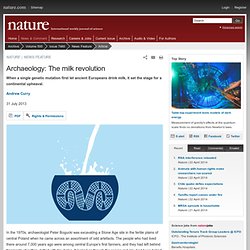
The people who had lived there around 7,000 years ago were among central Europe's first farmers, and they had left behind fragments of pottery dotted with tiny holes. It looked as though the coarse red clay had been baked while pierced with pieces of straw. Looking back through the archaeological literature, Bogucki found other examples of ancient perforated pottery. “They were so unusual — people would almost always include them in publications,” says Bogucki, now at Princeton University in New Jersey. He had seen something similar at a friend's house that was used for straining cheese, so he speculated that the pottery might be connected with cheese-making.
Free podcast Mark Thomas talks about human evolution and the rise of dairying. Writing_French_caves.jpg (Image JPEG, 1584x1056 pixels) - Redimensionnée (77%) Terence McKenna’s ‘Stoned Ape Theory’ animated. History Commons. Projet Beauceant, Premiere encyclopedie interactive sur les Templiers et l'Ordre du Temple. A Zoomable Graph of the History of Philosophy. Le dix-neuvième siècle. Les Saucissons chauds.
Francophone Slavery.
Smarthistory: a multimedia web-book about art and art history. How Homo became Sapiens – on the Evolution of Thinking. Théorie des vagues de développement. Un article de Wikipédia, l'encyclopédie libre.
Dans une série d’ouvrages publiés entre 1971 et 1994, dont les plus marquants sont Le Choc du futur, La Troisième vague et Les Nouveaux Pouvoirs, Alvin Toffler et son épouse Heidi ont développé une idée fondée sur l’observation et la mise en perspective de l’évolution sociale et politique de l’humanité depuis environ 10 000 ans. Elle met en évidence trois vagues de développement qui se succèdent et se superposent à la fois. Cet article part de la découverte d’une histoire synthétique de l’humanité, portée par ses trois vagues de développement puis se penche plus précisément sur l’application de cette vision au domaine particulier de la guerre. Une vision structurante de l’évolution de l’humanité[modifier | modifier le code] The Earth is Expanding. THE PANGEA THEORY is wrong . Yet it’s still the generally accepted one; still taught in our schools. Meteorite Dust and the Age of the Earth. Introduction otivated by watching while the same old arguments are repeated ad nauseum on talk.origins, I decided to acquaint myself, as best I could, with the current state of understanding as to extraterrestrial dust infall to the Earth.